Locations
Author: James Brindley
Ownership in action: local leaders, local solutions
January 18, 2026

Photo: UNDP Uzbekistan
“We are encouraging a culture of care and collective ownership,” said Guliniso Izomova, chairperson of the Kunji-qal’a mahalla (neighbourhood) of the Bukhara region. “My aim is to transform our mahalla into a place which is not only well-developed and modern, but also home to happy, united people with abundant opportunities.”
While Uzbekistan’s quality of life has steadily improved over ten years of reform, there remains a challenge of how to address infrastructural gaps in rural areas. People in rural mahallas still have poor quality schools, hospitals and other public buildings, and outdated water and power grids – shortcomings often worsened by the negative impacts of climate change and the Aral Sea’s disappearance.
The ‘Sustainable Rural Development’ (SRD) project implemented by UNDP and the Ministry of Economy and Finance, with funding from IsDB and the OPEC Fund for International Development, has worked to address these concerns in 170 targeted communities of the Karakalpakstan, Bukhara, Navoi, and Khorezm regions.
The project’s secret to success has been to encourage each community’s direct ownership and resolution of problems, through the use of Community Development Plans (CDPs) created by local Initiative Groups. It has relied on the insights of local leaders like Guliniso to identify the prominent issues their neighbours face and to create solutions.

Photo: UNDP Uzbekistan
Community-led planning for lasting impact
Fundamental to the success of the SRD project’s first phase (with its second phase launched in 2024, covering the Samarkand, Surkhandarya, and Kashkadarya regions) has been work done to support the development and application of CPDs. Our blog ‘Harnessing community empowerment to create sustained change’ expands further on what this process has involved. In brief, these CPDs were developed by local leaders to fix problems they identified within their communities, using funding and advice offered by UNDP and our partners.
Key to this approach is the understanding that communities themselves always have the best grasp of the multidimensional challenges they face, and so are inherently the most qualified and best equipped to tackle these head-on. The SRD project’s funding and support makes sure that locally-developed plans are implemented in the most effective way possible.
In each targeted community the SRD project has established community Initiative Groups. These groups have 1,383 members nationwide (411 women), including people representing the interests of women and girls, people who are underemployed or looking for work, people with disabilities, and other key groups. This arrangement helps ensure the needs of all community members are addressed through the CPDs, creating better living standards for all.
To complement the existing knowledge of Initiative Groups, the SRD project held trainings covering project implementation, monitoring and management, attended by over 3,300 local residents (1,219 women). Along with encouraging unique thinking about challenges communities face, these trainings have also inspired participants to pursue extra sources of funding through the ‘Open Budget’ platform – the results of which we present further below.

Photo: UNDP Uzbekistan
Local-led progress on the ground
The scale of the SRD project’s community development results has been remarkable. Across the 170 engaged communities, it is estimated that the infrastructure development work which has been implemented (or is now being carried out) will benefit over 700 000 citizens.
While there isn’t space here to present the experiences of all communities in the four targeted regions, we’ve brought together snapshots of considerable progress the SRD project has achieved by leveraging community Initiative Groups.
In the Yangi Makon mahalla of Karakalpakstan’s Takhiatash district, which has been deeply impacted by the Aral Sea’s disappearance, the focus is on making infrastructure improvements needed to give local citizens a better standard of life. Alongside establishing new local facilities, including a sports ground and library, the mahalla is also installing new water pipelines for delivering potable water to individual homes.
As the community Initiative Group leader Khaitboy Khalillayev shared, the work has only been successful due to sustained communication with fellow residents. He remarked, “I believe that trust within the mahalla is only built through transparency. In my view, if every resident receives clear and accurate information, this leads to good communication.”
Another compelling example of a community leveraging the SRD project’s assistance is the Varq mahalla, in the Navoi region’s Karmana district. “I have been actively working together with our community council to address our residents’ long-standing problems, needs and suggestions,” said mahalla chairperson Nurali Holiqov. “Together, we strive toward a common goal of ensuring a better and more prosperous life for our community.”
As with every development plan created in the four pilot regions, goals for the Varq mahalla combined insights from local business and community leaders. The community has been reconstructing a local gas network supplying 256 homes, digging a new well, and building an exercise playground and kindergarten. It has also replaced 95 old streetlights, installed new security cameras and traffic lights, paved pedestrian sidewalks, improved public transport, and set up new social infrastructures.
These significant improvements have been mirrored by work done in the Kunji-qal’a mahalla of the Bukhara region, led by mahalla chairperson Guliniso Izomova, and by dozens of other communities in the target districts. General livelihoods have improved, while standard of living gaps have been closed.
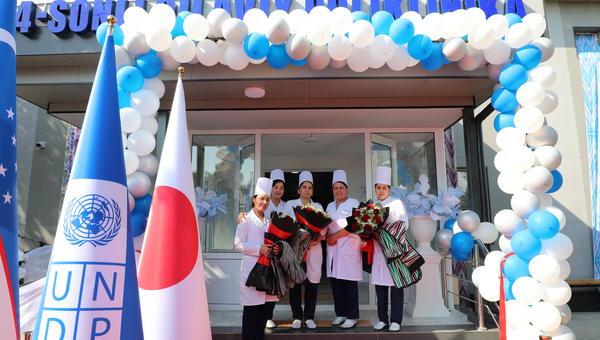
In total the 170 target communities have repaired 168 roads, while 147 have enhanced their electricity grids. Additionally,128 public schools and 89 preschools have been renovated or newly constructed. Other outcomes have included new irrigation systems, pedestrian pavements, street and bridge lighting, and investments in green job creation. 895 sub-projects are being implemented, supporting infrastructure development and making better living conditions in rural areas.
In parallel, communities in the Karakalpakstan and Bukhara regions have made improvements using independently attracted funds. With monies secured through the aforementioned Uzbekistan’s ‘Open Budget’ platform, many communities have improved their public infrastructure. In Karakalpakstan 10.5km of roads were paved with gravel-sand mixture and 2.5km were asphalted, while a transformer was installed to improve electricity supply. Likewise, in the Bukhara region, 13.1km of roads in three mahallas were asphalted using this funding.
These self-reliant achievements show how empowering community members, and creating access to independent financing, lets them address their most pressing challenges effectively and independently – now and into the future.


Applying experience to new regions
As the active part of the project’s first phase concludes, its second ‘Integrated Rural Development’ phase has begun in the Samarkand, Surkhandarya, and Kashkadarya regions. Results of the first phase indicate that effective engagement of not only community residents, but also local business and decision-making individuals in local government, is a bedrock for lasting change.
Alongside improving water, education, and healthcare infrastructure, purpose-built to be future-proof and sustainable, the installation of new digital infrastructure including accessible, high-speed internet has been another important outcome. The most thriving communities have maintained open channels through which citizens can make comments or share feedback – essential for building community ownership of work done, so everyone benefits equally.
“We are proud to recognise that the SRD project’s first phase has achieved its purpose, being to help rural communities catch up with urban areas in terms of their quality of life, and also address remaining inequalities within those communities,” project manager Bakhtiyor Sayfitdinov shared. “We look forward to seeing similar results in our project’s second phase.”
***
These initiatives were realized by the ‘Sustainable Rural Development’ joint project of the Ministry of Economy and Finance of the Republic of Uzbekistan and UNDP, funded by the Islamic Development Bank and the OPEC Fund for International Development.
Find more information about the project at https://go.undp.org/srdpen.