Locations
Author: Nozimakhon Ozmen
Leadership and impact of international cooperation in mahalla development
October 14, 2025

Photo: UNDP Uzbekistan
For many years, residents of the Kunji-qal’a mahalla in the Bukhara region faced the same persistent challenge: the technical condition of the local school was steadily deteriorating, the water supply networks had become outdated, and the roads had fallen into disrepair. These issues had a particularly strong impact on the lives of children and families. Every day, students had to walk along dusty streets to reach school, while the learning environment was becoming increasingly unsafe.
It was this situation that prompted Guliniso Izomova, an active resident of Yuqori Novmetan, to take action. She decided not merely to live in her mahalla, but to transform it for the better. Today, the community’s appearance has changed significantly.
Guliniso holds a higher education degree in Economics and began her work within the mahalla system. In 2021, she started her activities as a women’s rights activist, with the primary goal of increasing women’s employment and strengthening their participation in social life. She facilitated the employment of several unemployed women and young girls, actively supported the reintegration of women who faced challenges during migration, and made a significant contribution by providing them with psychological counseling and essential knowledge.
Guliniso actively participated in a number of training programs organized by UNDP. In particular, she completed project design training, where she gained practical knowledge in problem analysis, prioritization, and the development of sustainable development plans.


In addition, she attended monitoring and evaluation trainings, where she learned how to assess project effectiveness. During a study visit to the Republic of Karakalpakstan, she observed successful initiatives from other regions and was inspired to apply these lessons in her own mahalla.
Reflecting on the significance of the training programs, Guliniso Izomova says: "The trainings and seminars not only equipped me with valuable knowledge but also taught me to view the challenges in our mahalla from a new perspective. I am now committed to applying this experience in practice and contributing to the continued development of our community."
Building on the knowledge and experience gained through UNDP training programs, Guliniso earned the trust of her community and, in 2024, was elected Chairperson of the Mahalla Citizens’ Assembly of Kunji-qal’a in the Bukhara district. One of her first challenges as mahalla chairperson was to improve the unsatisfactory technical condition of School No. 33. She initiated the construction of an additional building with 120 seats and a sports hall, successfully securing consideration of the proposal by the relevant authorities. At the same time, she contributed to addressing the issue of unstable electricity supply in the community.
Looking ahead, she plans to establish pedestrian pathways along the main streets to ensure the safe movement of students and residents within the mahalla.

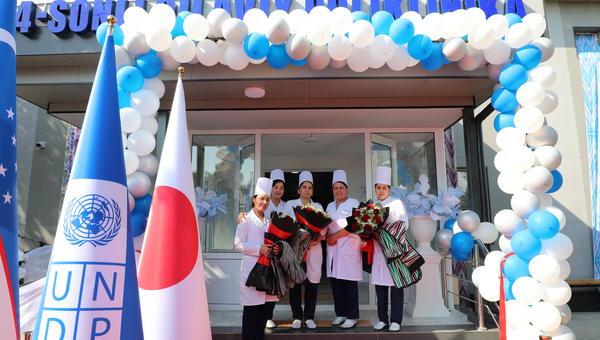
Monitoring process at the newly constructed kindergarten in Novmetan Makhalla (adjacent to Kunji-qal’a Makhalla)
Today, the changes taking place in the Kunji-qal’a mahalla and the dedicated work for the benefit of its residents are the result of the effective leadership of women like Guliniso Izomova, as well as the educational support provided by UNDP.
The transformation led by Guliniso is part of a larger nationwide movement. In 170 pilot mahallas across 4 regions of the country, we have established initiative groups composed of active representatives from various segments of the population.


These groups are composed of active citizens selected from the local community. Their primary goal is to develop mahalla development plans and implement them in practice.
Currently, initiative groups, in collaboration with the project team, actively participate in implementing and overseeing selected initiatives in the mahallas. In particular, a 540-seat school and a kindergarten are being renovated, additional buildings are being constructed, more than 16 kilometers of old water pipes are being replaced, streets are being paved, and pedestrian walkways are being established. These improvements provide the community with modern facilities and enhanced living conditions.
As part of this initiative, we organized training sessions for members of the initiative groups on effective development of agriculture and rural economy, cyber hygiene, and enhancing the engagement of the mahalla and the community. During these sessions, participants gained practical knowledge and skills in community mobilization, monitoring and evaluation, as well as effective leadership and communication.
Most importantly, this knowledge was immediately applied in practice, ensuring that the selected projects met the real needs of the population and were sustainable. In this way, UNDP’s initiatives not only provided theoretical knowledge but also laid the foundation for rapid and effective changes in the mahallas.


It is precisely such active women and initiative groups, bringing communities together, that have been established across different regions of our country and are currently operating successfully in 170 targeted mahallas. Specifically:
46 groups in the Republic of Karakalpakstan
49 groups in Khorezm region
34 groups in Navoiy region
41 groups in Bukhara region
In total, our initiative groups include 1,415 members: 258 in the Republic of Karakalpakstan, 474 in Khorezm, 297 in Navoiy, and 386 in Bukhara.
In these initiatives, women and men work side by side: 388 women and 1,027 men contribute to positive changes in their mahalla. Since these initiatives have proven successful, we plan to expand them to other regions of the country in the future.
This initiative is being implemented as part of our project “Sustainable Rural Development,” carried out in collaboration with the Ministry of Economy and Finance of the Republic of Uzbekistan, with financial support from the Islamic Development Bank and the OPEC Fund for International Development.