Locations
Author: James Brindley
Harvests from sand – How sustainable rural development transforms agriculture
March 3, 2026

Photo: UNDP Uzbekistan
Oychekhra Tokhirova is the innovative director of the ‘Shovot-Kumtepa’ farming enterprise, in the Shovot district of the Khorezm region. As a cornerstone of her community, Oychekhra is proud to sell organic, high-quality fruit and vegetables at the local bazaar, while also employing several workers.
‘Shovot-Kumtepa’ was independently launched in 2017, using Oychekhra’s own personal funds, on the sandy soil of the Khorezm desert. She started by growing millet, sesame, and sunflowers, and then from 2022 tried planting different vegetables and watermelons, but only with mixed success. Farming communities in her district all tackle the problem of desertification, which threatens the yield and quality of fruit and vegetables grown on the land.
To help address long-term challenges faced in communities like Oychekhra’s, the ‘Sustainable Rural Development’ (SRD) project implemented by UNDP and the Ministry of Economy and Finance, and funded by IsDB and the OPEC Fund for International Development, directly empowers communities to improve their situation. Our blog on the Community Development Plan approach , initially applied in the pilot Karakalpakstan, Bukhara, Navoi, and Khorezm regions, explains the project’s method in more detail.
A key part of this work has been advising local farmers on best ways to overcome long-term problems on their land, such as low soil quality and insufficient water, to directly improve food security in their communities.


Same land, better produce
In 2023 the elected Initiative Group of Oychekhra’s mahalla identified several challenges they wished to resolve with funding and guidance provided through the SRD project. One of these was the concern posed by all local farmers: what are the best crops to grow, and how should they use limited water resources to get the best results?
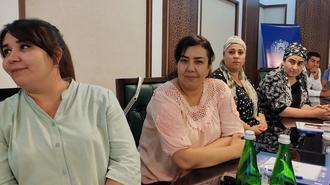
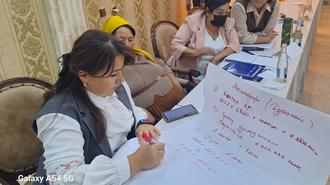
These questions were answered through a series of training seminars requested by her community’s Initiative Group. In total, 219 district farmers attended the seminars which presented practical information on sustainable planting and irrigation methods, means of combating and countering desertification, and best crops to grow in the Shovot District.
Based on the guidance she received, Oychekhra chose to plant capers (Capparis spinosa), which can be successfully cultivated in sandy soils and have both culinary and medicinal uses. She was also advised on which tomato varieties to grow. A lack of calcium in the soil often resulted in common tomato crops wilting on the vine and producing very little output, but instead she was recommended a variety that is hardier and can grow in harsher climates.
After the workshops had concluded, the trainer left their contact details with participating farmers like Oychekhra, meaning they could submit follow-up questions to clarify essential points covered in the training and ensure new recommended practices could be sustained and duplicated throughout their community.
Thanks to the assistance provided through the SRD project, the ‘Shovot-Kumtepa’ farming enterprise completely reinvented itself. They now grow crops better suited to their land, using advanced drip irrigation and other green agricultural practices, to produce multiple bountiful harvests every year.

Photo: UNDP Uzbekistan
National expertise applied to local challenges
Since 2023, the RSD project has trained 655 private and public sector experts of the four target regions (including 143 women) not only in better agricultural practices, but also in energy-efficient construction, Building Information Modelling, and the best application of ICT in rural communities.
In 2025 the project delivered additional practical trainings which included a masterclass on regional master planning, workshops on cyber hygiene and e-governance services, and guidance on creating the Community Development Plans central to this RSD project. One of the most in-demand trainings was the ‘Effective Agriculture and Rural Economy’ programme attended by 835 participants, which introduced a scientific, evidence-based approach to farming in adverse conditions.
Through this programme, farmers learned how to factor in climate data, soil characteristics, agrometeorological information, and the principles of crop rotation, when deciding what to plant and when. It strengthened their ability to choose suitable crop varieties, manage irrigation efficiently, and apply modern technologies that improve productivity and resilience.
UNDP also helped communities implement their own public education initiatives. For example, over 3,500 students have been trained to use new ICT equipment at schools in the four pilot regions, while 315 residents can now access e-government services. Technology is being leveraged to better address well-being disparities within communities.
As with all other aspects of the SRD project, the training sessions conducted in mahallas were specialized for each community, addressing specific local concerns. By training trusted local experts like Oychekhra to pass their knowledge on to others, the project has helped ensure that better practices are sustained over longer periods, continuing to benefit local people.




Growing to new levels of success
Oychekhra’s farming enterprise has benefited from the SRD project in many ways. The capers her team planted in 2025 have already sprouted, and in 2026 they’ll be grown over 20 hectares. Meanwhile in September and October of 2025 the newly planted tomato variety has continued to bloom and yield harvests. She’s now selling dried tomatoes to kindergartens, schools, sanatoriums, and local markets.
Other people in the community are coming to learn her secrets to success, particularly about how she’s made the most use of her land. To date, Oychekhra has trained 12 women from low-income families in applying drip irrigation on their household plots, and also on how to successfully grow tomatoes in sandy soils.
Her success has even helped farmers as far away as the People’s Republic of China. When the Prime Minister of Uzbekistan visited the nation and shared best practices in growing capers in difficult soils, Oychekhra’s farming enterprise was used as a prime example of success.
With the SRD project’s assistance, the ‘Shovot-Kumtepa’ farming enterprise in the Khorezm region has become proof of the saying that “from little things, big things grow.”
***
These initiatives were realized by the ‘Sustainable Rural Development’ joint project of the Ministry of Economy and Finance of the Republic of Uzbekistan and UNDP, funded by the Islamic Development Bank and the OPEC Fund for International Development.
Find more information about the project at https://go.undp.org/srdpen