Locations
Author: Gulnur Kaypnazarova
After Seven Years of Waiting — Doors Unlock Healthcare Access in Aral Sea Communities
February 10, 2026

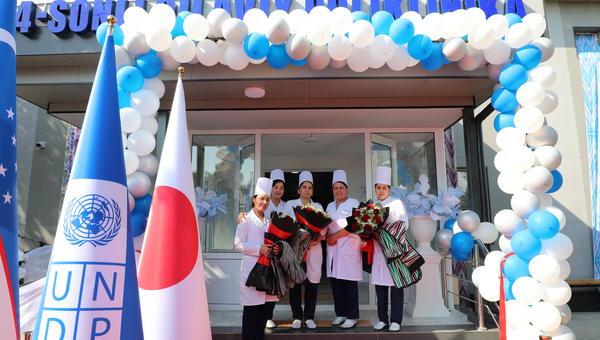
After seven years of waiting, residents of Kulab, Kumbyz, and Saryshungul communities in the Khojeli district can once again access healthcare close to home — at the Taza Baz family health post.
Photo: UNDP Uzbekistan / Gulnur Kaypnazarova
When Kutligul Esemuratova first arrived at the Taza Baz family health post in Kulab community, Khojeyli district, she couldn't believe her eyes. The young pediatrician had just graduated from Karakalpak Medical Institute, eager to begin her career. But the building before her looked nothing like she had imagined.
"I stood in front of the clinic thinking: how am I going to see patients here?" Kutligul recalls. "The building was freezing, with just two beds in the day ward and constant power outages. I wanted to turn around and leave."
But then she remembered why she had chosen medicine. As a child, Kutligul had suffered from severe anemia, landing in the hospital four to five times a year. The doctor who treated her gave her hope for recovery and inspired her by example. That's when Kutligul decided to become a physician.

Kutligul Esemuratova, senior physician at the Taza Baz family health post in Khojeli district.
Photo: UNDP Uzbekistan
The Taza Baz family health clinic, built in 1995, once served three neighboring communities—Kulab, Kumbyz, and Saryshungul. But by 2017, the building had deteriorated so badly it was forced to close. More than 6,000 residents lost access to primary healthcare.
For seven years, residents traveled to the district polyclinic or neighboring towns. For young mothers with infants, elderly people with chronic conditions, and those needing urgent care, every doctor's visit became an ordeal.
Those seven years revealed the consequences of losing access to primary healthcare. Karakalpakstan sits at the epicenter of the Aral Sea disaster—one of the largest environmental tragedies of the 20th century. The drying of the Aral Sea has had a critical impact on the health of the region's population. Each year, up to 100 million tons of toxic dust rise from the dried seabed, creating severe problems for local communities. Karakalpakstan's residents suffer from respiratory diseases, anemia, cancer, and digestive problems. Tuberculosis rates in the region stand at 147 cases per 100,000 people—significantly higher than the national average. In these conditions, access to basic healthcare becomes not just a right, but a matter of survival.
Khojamurat Davletmuratov, a second-degree disability holder following lung surgery, was forced to travel first to the neighboring Myasokombinat settlement, then to Nukus for regular treatment. "The journey took so much time, plus transport costs. And I can barely walk," says the 50-year-old man.




Obstetrician-gynecologist Gulchekhra Zarimbetova monitors 1,567 women of reproductive age across three mahallas. Over the years, she has witnessed the consequences of missed regular checkups.
"Six months ago, we lost a patient. She was 40 years old, breast cancer. By the time she sought help, it was too late—three rounds of chemotherapy didn't help," says Gulchekhra. "Regular screenings would have caught the problem early. But without a nearby clinic, women postponed their visits."
Another patient with cervical cancer is now undergoing her twelfth round of chemotherapy. "Every day I see eight to nine women. I have 54 pregnant women under my care. When services are far away, people only come when things get really bad. And then treatment is much harder."
In early 2025, the chief physician of the district health service applied for a grant from UNDP under the "Project to Support Self-Reliance through Climate-Resilient Agriculture in the Aral Sea Region," with financial support from the Government of Japan. The Taza Baz family health clinic became one of the region's medical facilities to receive support under the basic infrastructure restoration program.

Photo: UNDP Uzbekistan.
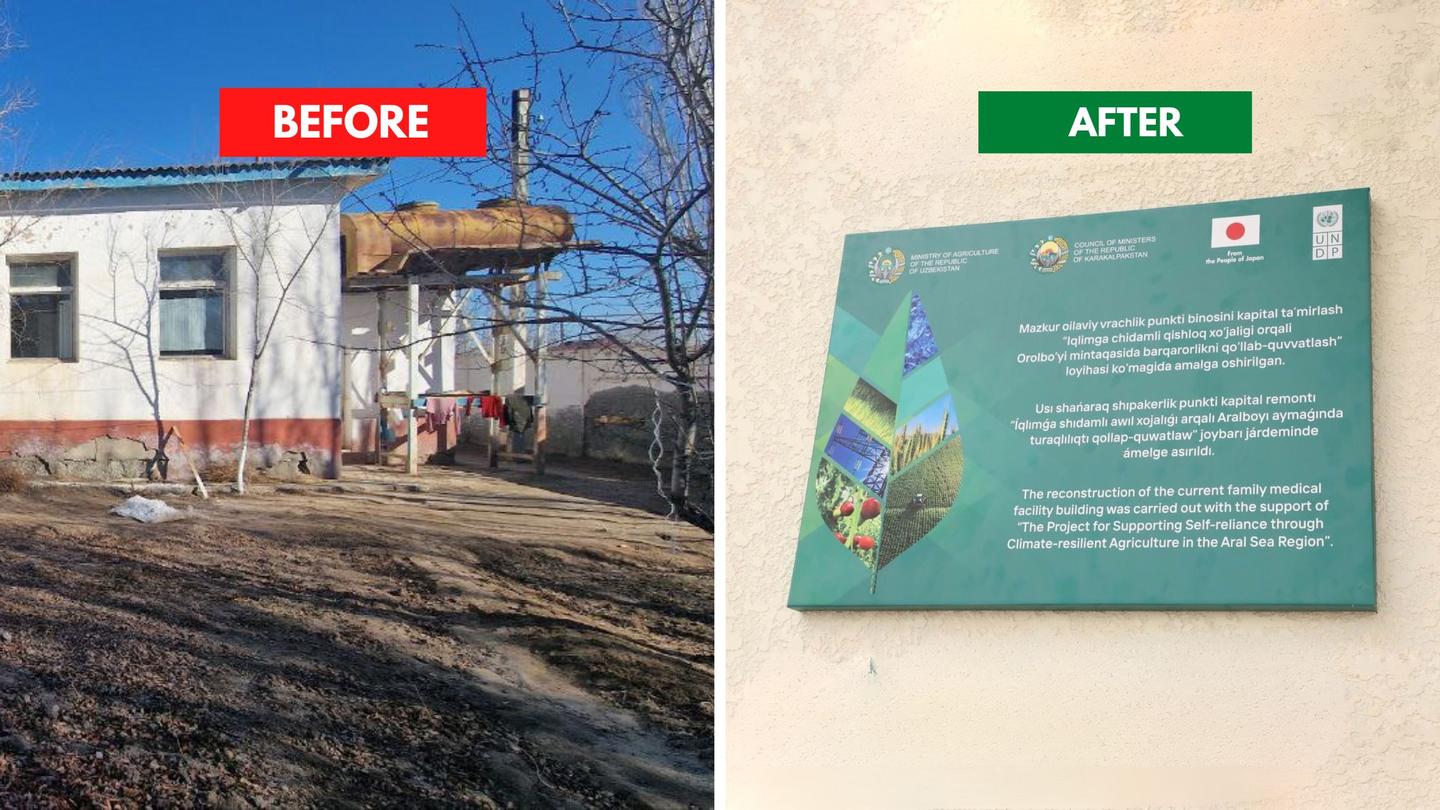
The Taza Baz family health clinic was completely reconstructed in four months. The building was expanded, with sewage, cold and hot water installed in every ward and office. An outdoor toilet was replaced with indoor facilities—a critical change for elderly patients and people with limited mobility who previously had to go outside in any weather. Instead of two beds, there's now a full day ward; instead of cold offices, warm equipped rooms.
Solar panels and a heater ensure energy independence—the clinic now operates without interruption even during power outages. Connection to the electronic polyclinic system and high-speed internet enable electronic medical records and prompt consultations with specialists from district and republican hospitals. A video surveillance system ensures patient and staff safety.
The reconstruction followed principles of inclusivity and universal access: conditions were created inside the building for free movement of all population groups. This guarantees equal access to medical services for people with limited mobility, elderly patients, and young mothers with strollers.
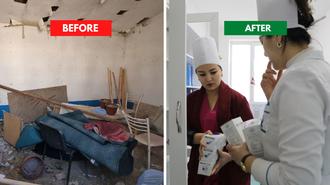
"Comparing before and after—it's like night and day," says Kutligul. "Now we have warm examination rooms, enough space for the day ward. I can see 50-60 patients a day."

Photo: UNDP Uzbekistan.
Kutligul monitors 1,886 patients from three communities with a total population of more than 6,000 people. Among her patients are 17 people with first-degree disabilities and severe illnesses, 20-25 with second-degree disabilities, and about 50-60 with third-degree disabilities. For them, proximity to the clinic is critically important. Every morning Kutligul travels to work from Karauziak district to Khojeyli district—a journey of several hours. Five days a week, for more than a year now.
"When I graduated, I was offered two positions to choose from. I chose Taza Baz," she says. "My friends were surprised: why travel so far? But I wanted to work where I was truly needed."
She has a five-year contract to work in the remote community. Many young specialists aren't ready for that—especially young women, from whom society expects to stay closer to family.
"My parents supported me. And when I saw the conditions, the clinic was working in, I knew I'd made the right decision," says Kutligul.
Now at 27, she is the senior physician of the family health clinic, managing three doctors.
"I used to hear: you're too young, you're a girl, it'll be too hard for you," she recalls. "But attitudes are changing. If you do your work well, if you're dedicated—gender and age don't matter when it comes to helping people."

Kutligul Esemuratova examines patients at the Taza Baz family health post.
Photo: UNDP Uzbekistan.
For Gulchekhra Zarimbetova, the clinic's reopening means the ability to conduct regular screenings. "Now we can detect problems early, when they can still be treated effectively," she says. "This saves lives. Restoring damaged health is always more difficult and expensive than preventing disease."
And Kutligul continues to board the bus every morning and travel from one district to another to treat people. "I remember lying in the hospital as a child. How the doctor cared for me. Now it's my turn to care for others," she says. "And I'm glad I can do it here, where my help is truly needed."
***
The Taza Baz experience demonstrates a model applicable to other regions affected by climate change. Solar panels provide energy independence, telemedicine connects remote communities with specialists, and inclusive design ensures access for all. Together, these solutions create a sustainable healthcare system even in the most remote communities.
***
Contact for additional information:
- Alisher Utemisov, UNDP Programme Manager in Aral Sea Region, alisher.utemisov@undp.org
- Gulnur Kaypnazarova, Public Relations Associate, gulnur.kaypnazarova@undp.org