
 Locations
Climate-resilient livelihoods strengthen peace, stability and social cohesion
Women at the forefront of climate, peace and security
March 5, 2026

Women engineers install solar panels in Mongolia, expanding access to clean energy and more efficient heating in rural communities.
Photo: UNDP Mongolia
In the hills of South Kivu in the Democratic Republic of the Congo, communities harvest edible caterpillars from trees. But years of conflict have depleted these forests. For women who depend on them to feed their families and earn an income, the loss has been especially severe, leaving fewer ways to cope as insecurity and environmental degradation deepen.
In crisis contexts, climate change is amplifying pressures that undermine peace and security. Droughts, floods and land degradation strain food systems and livelihoods, intensifying pressure on already scarce resources such as land and water, and increasing the risk of conflict. Conversely, in countries already affected by conflict, such climate shocks are deepening poverty, weakening institutions and making recovery even more difficult, creating a vicious cycle where climate stress and insecurity reinforce each other.
It is estimated that 1.1 billion people live in multidimensional poverty, 40 percent of them in countries affected by conflict, fragility or low levels of peacefulness. At the same time, nearly 8 in 10 people who are living in multidimensional poverty--87 million out of 1.1 billion--are directly exposed to climate hazards such as extreme heat, flooding, drought and air pollution.
Women face greater risks because they are more likely to rely on climate-sensitive livelihoods such as farming and forest produce collection, while having less access to land, finance and decision-making. As climate pressures and insecurity disrupt traditional livelihoods, men migrate in search of income or safety, leaving behind increasingly “feminized” communities where women assume expanded economic and social responsibilities, but without corresponding rights or protection.
When livelihoods collapse or families are displaced, women and girls are also at greater risk of domestic and sexual violence, early marriage and other forms of exploitation.
Yet these same shifts are opening spaces for women’s leadership, as they step forward to restore degraded ecosystems, rebuild livelihoods and strengthen social cohesion for more resilient communities.
Protecting livelihoods, strengthening social cohesion
In fragile and conflict-affected settings, climate-resilient livelihoods are not only a climate adaptation priority but also an important way to strengthen peace, stability and social cohesion.
Years of conflict have already weakened food systems and rural economies in Yemen, where climate change is now intensifying droughts and water shortages. Women in these communities carry traditional knowledge passed down through generations on managing and working with limited resources–skills that are becoming increasingly important as environmental pressures, insecurity and resources grow more scarce.
With support from UNDP, women farmers are being trained in scientific water resource management that can sustain agriculture in water scarce areas. Through Water User Associations and Groups, they are also playing an active role in managing shared resources and resolving water-related disputes within their communities, helping strengthen cooperation, social cohesion and stability.


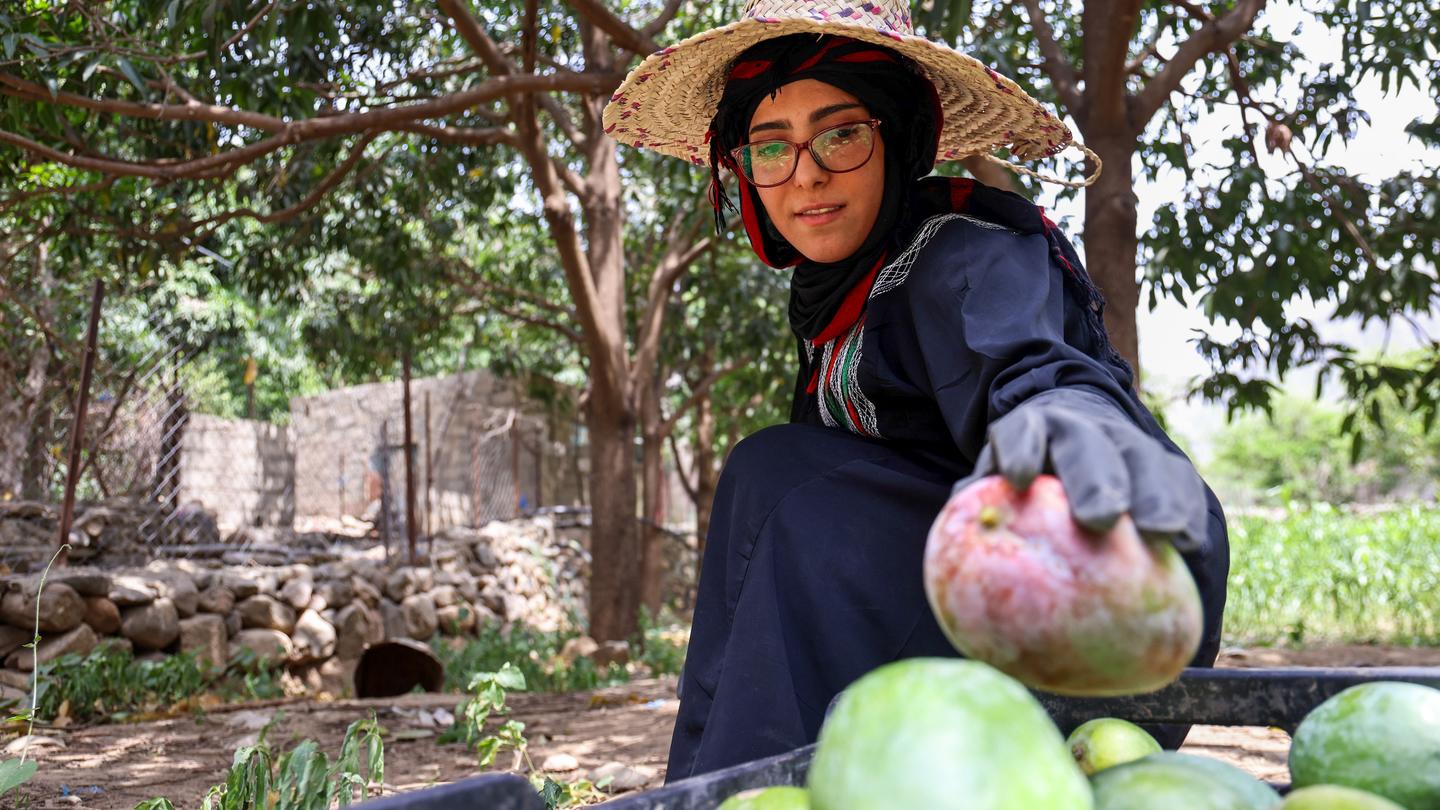


Similar efforts are underway in Chad. Through programmes supported by the Global Women, Peace and Security Initiative, more than 5,000 women have been trained and equipped to become financially secure, and more than 500 women have adopted climate-smart agricultural practices to cope with changing rainfall patters and land degradation.

Women-run agroecological hubs allow women to gain financial independence and to reshape the political and social fabric of their communities.
Photo: UNDP Chad
Supporting safety, dignity and recovery
Beyond livelihoods, climate resilience also strengthens safety and wellbeing in communities affected by violence and fragility.
Locally-led adaptation initiatives in Jamaica are empowering women by combining livelihood opportunities with safe spaces that offer psychological support and a sense of connection. A solar-powered greenhouse not only provides farming training and income opportunities, but is also a safe space where women affected by domestic violence can have open conversations.
Where economic insecurity and violence intersect, access to income, support networks and safe spaces reduces vulnerability and empowers women to reclaim their lives.


Leading resilient and peaceful futures
Women have long played a key role in shaping how communities respond to climate change, but often without recognition or remuneration. Acknowledging and strengthening their participation in local planning and institutions ensures that responses to climate, peace and security challenges reflect and address the needs of entire communities.
In Mongolia, women-led efforts are expanding access to clean energy and more efficient heating in rural communities, reducing pressure on forests and improving living conditions. Women’s participation in local planning and community institutions is ensuring that decisions about natural resource management are more inclusive, contributing to greater stability and resilience in remote areas.
Women at the heart of resilience and peace
The work of restoring caterpillar trees in South Kivu is about more than bringing back a source of food or income. In recent years, women have helped restore 440 hectares of forest. By restoring forests, managing natural resources collectively and rebuilding livelihoods, they are also helping strengthen stability and social cohesion.
As Veronique Bulaya, the project coordinator, notes, “Empowering women is crucial. When women are empowered, the entire community reaps the benefits, and this transforms future generations.”
These experiences are a reminder that women are central to solutions that address climate change, conflict and fragility. From protecting livelihoods and restoring ecosystems to strengthening safety, cooperation and local leadership, their participation is vital for stable, peaceful and inclusive societies.

Years of conflict have deforested large parts of South Kivu, DR Congo. Reforestation is providing incomes, improving food security and promoting social cohesion.
Photo: PIFEVA

Women-led and community groups have helped restore 440 hectares of forest in South Kivu, particularly the caterpillar tree, which is a vital source of food.
Photo: PIFEVA
Related
content
content


