Locations
EU and UNDP promote big data and artificial intelligence for provision of better public services
August 4, 2026

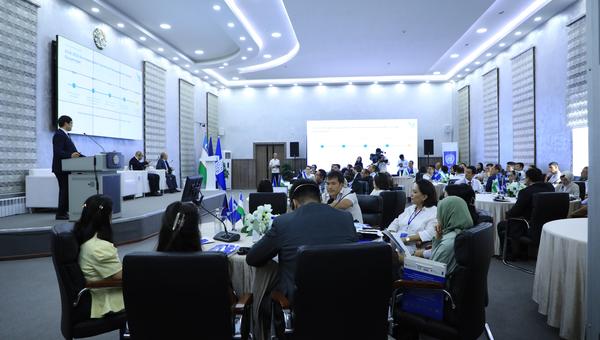
Group Photo of participants of seminar-training on “Big Data Analytics and Artificial Intelligence for Evidence-Based Public Administration”
Tashkent, 4 August 2026 – A three-day seminar on “Big Data Analytics and Artificial Intelligence for Evidence-Based Public Administration” has been launched in Tashkent in the framework of the European Union-funded project “Further Improvement of Public Services Delivery in Uzbekistan,” implemented by the United Nations Development Programme (UNDP) in partnership with the Ministry of Justice of the Republic of Uzbekistan. The seminar aims at strengthening the capacity of civil servants to use data and digital technologies in support of more effective, transparent, and citizen-oriented governance. More than 35 analysts and specialists from the government agencies and local authorities are attending the seminar to learn how to transform raw administrative data into meaningful insights that can support policy development, institutional performance monitoring, and service delivery through a practical and hands-on approach.
As Uzbekistan continues its digital transformation, the volume of data generated by public institutions is growing rapidly. With more than 760 electronic services now available through the my.gov.uz portal, public institutions have access to unprecedented amounts of information. The challenge today is not simply collecting data, but using it effectively to improve decision-making, enhance service quality, and better respond to citizens’ needs.

Opening ceremony of seminar-training on “Big Data Analytics and Artificial Intelligence for Evidence-Based Public Administration”
“Today, a real challenge is no longer collecting data, it is turning that data into reliable evidence that can support better policies, stronger institutions, and higher-quality public services. Across the European Union, data has become a strategic public asset. Our rich experience representing 27 EU Member States shows that digital transformation depends not only on technology, but also on the ability of civil servants to analyse, interpret, and use information effectively. This seminar reflects EU’s shared commitment to building those capacities while ensuring that emerging technologies, including AI, are used responsibly and ethically,” said Ms. Renata Wróbel, Chargée d’affaires a.i. of the Delegation of the European Union to Uzbekistan.
The initiative supports Uzbekistan’s broader reform agenda, including the implementation of the “Digital Uzbekistan – 2030” programme and the Strategy for the Development of Artificial Intelligence for 2024–2030, both of which emphasise the importance of evidence-based governance and data-driven public administration.
“As Uzbekistan continues to make significant progress in digitalizing public services, it is essential that the vast amounts of data generated every day are translated into practical insights for decision-makers. This training helps bridge the gap between data and action. By strengthening analytical skills and introducing modern AI tools, we are helping public institutions better understand citizens’ needs, identify bottlenecks, and design more responsive services. Ultimately, our goal is to support a public administration that is more efficient, transparent, inclusive, and people-centered,” said Ms. Akiko Fujii, UNDP Resident Representative in Uzbekistan.
By strengthening analytical and digital competencies within government institutions, the initiative contributes to the development of a modern public administration system capable of using data and innovation to improve public services, strengthen accountability, and enhance citizen satisfaction across Uzbekistan.


Background:
“Further Improvement of Public Services Delivery in Uzbekistan” project funded by the EU and implemented by UNDP with total budget of EUR 4,900,000 and implementation duration of 2024-2029 aims to address key challenges such as limited access to public services in rural areas, low digital penetration, and outdated institutional frameworks. It will do so through four strategic pillars:
- Transform institutional, legal, and regulatory frameworks underpinning the back office of the national public services delivery system.
- Enhance capacity of the back office institutions in public service delivery to ensure their effective operation at the national, regional and local levels.
- Conduct digital and user-centric transformation of the back office institutions to improve availability and quality of public services.
- Transform the system of local governance to ensure responsiveness, accountability and better operation of regional and local institutions functioning as back offices.
The project supports Uzbekistan’s reform agenda and contributes to the achievement of the Sustainable Development Goals (SDGs), in particular SDG 16 on strong institutions and SDG 9 on innovation and infrastructure. By 2029, the initiative seeks to conduct functional reviews of 11 back-office institutions, train 1,000 civil servants on inclusive and user-centric service delivery, digitally transform at least 35 public services, and establish 34 new public service zones in makhallas across the country. These comprehensive reforms will significantly enhance citizens’ access to efficient, transparent, and inclusive government services nationwide.
About the European Union. The European Union is an economic and political union of 27 European countries. It is founded on the values of respect for human dignity, freedom, democracy, equality, the rule of law and respect for human rights, including the rights of persons belonging to minorities. It acts globally to promote sustainable development of societies, environment and economies, so that everyone can benefit.