

 Locations
Who Cares? Young People Are Calling for a Fairer Care Economy in Uzbekistan
June 16, 2026


Who looks after young children when parents are at work? Who supports older relatives when they can no longer live independently? Who cares for family members with disabilities? In most households, family members, and most often women.
Uzbekistan is in the middle of a profound demographic and economic transition. With a rapidly growing population, rising life expectancy, and more than 36 million people depending in one way or another on care and social support systems, the care economy is becoming one of the most important policy arenas for the country’s future. Yet, as the new UNDP report “Caring for the Future: Insights from Uzbekistan” reveals, the existing care system - childcare, eldercare, disability services and paid care work - remains fragmented, underfunded, and heavily reliant on women’s unpaid labor.
But there is another crucial voice in this national conversation: young people. UNDP has gathered youth perspectives through consultations and an online survey reaching more than 500 respondents, 70% of which were female. The findings reveal a strong demand for gender-responsive reforms as over 90% of youth support integrating gender equality factors into public finance. Their message was simple but powerful:
“A fair society is impossible without redistributing care, investing in social services, and giving every child, woman, and family the support they need to thrive.”

This blog brings together the findings from the UNDP care economy report and youth consultations to explore how young people envision the future of care in Uzbekistan and the reforms they believe are needed to build a more equitable society.
The Care burden falls on women - and young people are concerned
Unpaid care work remains overwhelmingly gendered. Women in Uzbekistan perform more than twice as many hours of housework and childcare compared to men. This invisible labor has visible consequences in Uzbekistan:
- Women’s labour force participation decreased from 45.7% to 41.2% within the past decade.
- A gender pay gap - with women earning 34% less than men
- High NEET rates among young women aged 19-30 - approximately 74%.
- Interrupted careers due to childcare gaps, especially for children under 3.
Across all regions where youth consultations were held, participants described unpaid care as one of the largest barriers to women’s economic and social participation. Young men expressed concerns that traditional norms place unfair expectations on women, while young women emphasized that the lack of childcare services restricts both education and employment opportunities of women.
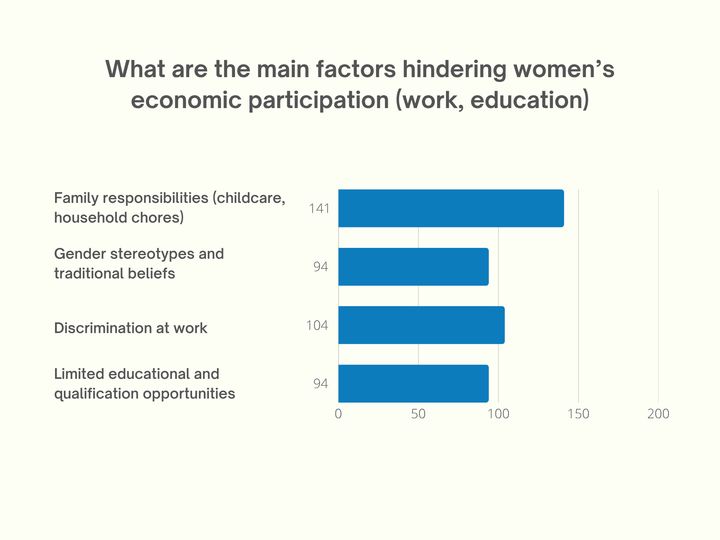
One participant from Samarkand put it bluntly:
“We cannot talk about equality if a girl must choose between studying and caring for siblings.”
Gaps in childcare - the country’s most urgent issues
The UNDP report highlights a critical service gap for children aged 0 - 3. While preschool coverage for ages 3 - 6 has expanded significantly, care for younger children remains limited and unaffordable.
During the youth consultations:
- 71% of respondents said lack of childcare is the biggest factor limiting women’s employment.
- Young couples expressed fear of economic instability if they have children.
- Many called for community‑based childcare centers and employer‑supported kindergartens.

This aligns with global evidence: childcare expansion is one of the most effective policies to increase women’s labour-force participation and reducing poverty.
Young people see elderly and disability care as key to social justice
Uzbekistan’s population aged over 65 is expected to triple by 2050. Disability prevalence is expected to rise, especially among older women.
Youth consultation findings reveal:
- Strong support for community-based elderly care so that older people do not feel isolated.
- Support for disability-inclusive services, accessible buildings, and transportation.
- Clear demand for care workers to receive proper training, fair wages, and legal protection.
Young participants often noted that care responsibilities for elderly relatives fall on women in the household, affecting girls’ schooling and young women’s ability to work.

Paid care work: young people want dignity for care workers
The UNDP report shows that care work - childcare, social work, domestic work - is undervalued and underpaid. Youth consultations echoed this concern.
Young people argue that:
- Care workers need better salaries, contracts, and social protection
- Domestic workers and nannies should not be informal
Attracting more men into care professions and challenging stereotypes about who provides care is important. Moreover, over 80% of youth support official recognition of unpaid care work. 63% of youth largely reject the belief that “Men should be breadwinners and women - mainly responsible for housework”.
This not only supports gender equality but also lays the foundation for a new labour market sector of the future.

Youth are ready to lead the transformation
One of the most inspiring outcomes of the consultations was the willingness of young people to play an active role in care‑sector transformation:
- Volunteering in community care programs,
- Participating in budget monitoring,
- Supporting advocacy for equal opportunities,
- Promoting positive social norms among peers.

As one of the participants noted:
"A fair Uzbekistan is one where care is recognized, shared, and supported - not carried silently by women and girls".
In conclusion, young people are calling for a gender-responsive social protection system that reflects the real pressures faced by families, including high childcare costs, insufficient disability support, limited parental leave, and gaps in social assistance. They advocate for universal, accessible care services supported by transparent and digital systems, alongside fair maternity and paternity protections, including the introduction of non-transferable paternity leave to encourage shared caregiving. Their vision also prioritizes investing in early childcare, professionalizing the care workforce, expanding inclusive services for persons with disabilities - especially in rural areas - and ensuring dignified, community-based support for the elderly. At the same time, they emphasize the need for behavior change initiatives to challenge gender norms and promoting equality within households, as well as greater youth involvement in budgeting and decision-making processes.

Their expectations align closely with UNDP's policy recommendations for improving the care system in Uzbekistan.
Uzbekistan stands at a critical crossroads. Investing in the care economy is not only a gender equality issue - it is a smart economic strategy, a social justice priority, and a foundation for sustainable development.
By listening to youth and acting on the recommendations of the UNDP care report, Uzbekistan can build a care system that is equitable, modern, inclusive - and ready for the future.


