Locations
From now until 25 April, your engagement unlocks real climate action—and helps grow it further.
Earth Day 2026: Turning Clicks into Climate Action for the Aral Sea
April 21, 2026

Image: UNDP Uzbekistan
From 21 to 25 April, UNDP Uzbekistan is running a global social media campaign, “One click = One tree,” to celebrate Earth Day (22 April) and drive climate action for the Aral Sea—a region still enduring environmental damage that reshapes the lives of millions. As part of UNDP’s Green Aral Sea Initiative, the campaign gives everyone the chance to unlock the planting of up to 1,500 pre‑financed saxaul trees on the dried Aral Seabed, restoring land and hope to local communities.
Here’s how it works: every like, comment, or repost on our campaign posts unlocks the planting of a saxaul tree—thanks to the generosity of Tashkent International School, which has already funded 1,500 trees ready for planting later this winter. Your single click is the trigger: it turns a digital action into a real tree, restoring land, rebuilding ecosystems, and supporting local livelihoods. This campaign proves how one small action—yours—can spark wider climate action and help build a healthier, more resilient future.
“The Aral Sea crisis is not a story from the past—it is a climate challenge that continues to shape lives and ecosystems today. This Earth Day, we are demonstrating the power of partnership—showing that when communities, organizations, and individuals unite, even the simplest actions can drive real restoration and resilience,” said Akiko Fujii, Resident Representative at UNDP Uzbekistan.
Once the campaign’s pre‑financed tree goal is reached, supporters who are inspired to deepen their impact will be able to fund additional trees through Every.org, a trusted donation platform. Donations directly support continued land restoration under UNDP’s Green Aral Sea Initiative, helping scale climate action beyond this Earth Day campaign.
Please consider donating by visiting this link: https://www.every.org/undp/f/restore-the-aral-sea
Why the Aral Sea Matters. Once the world’s fourth‑largest freshwater lake, the Aral Sea has lost nearly 90 percent of its water, largely due to unsustainable water use over the past decades. What remains is the Aralkum desert—a vast expanse of exposed seabed highly vulnerable to wind erosion and extreme weather.
Today, this desiccated landscape is a major source of toxic salt and dust storms. These storms carry fine particles contaminated with salts and agricultural chemicals, spreading across nearby towns and villages. As a result, communities face severely degraded air quality and elevated rates of respiratory illness, cardiovascular disease, eye disorders, and other long‑term health problems, with children and older people especially at risk.
Beyond these health impacts, the loss of the Aral Sea has damaged farmland, reduced agricultural productivity, and weakened local economies—deepening vulnerability in an already climate‑stressed region. The Aral Sea crisis is one of the world’s most severe environmental disasters and a continuing challenge for climate adaptation.
Restoring this landscape is essential to reducing climate risks and safeguarding both ecosystems and community well‑being.
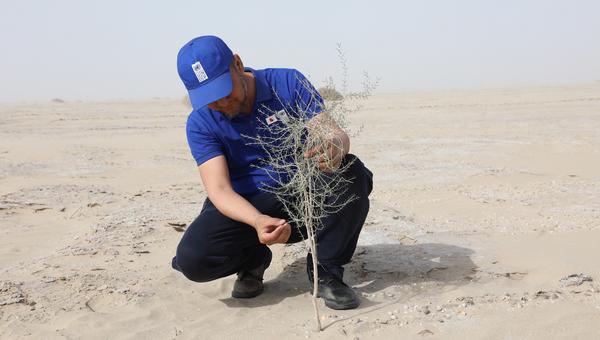
UNDP’s Green Aral Sea Initiative So Far. Through the Green Aral Sea Initiative, UNDP supports large‑scale land restoration on the former seabed by planting saxaul trees, a native species well-suited to harsh desert conditions.
Saxaul trees help stabilize degraded land, limit wind erosion, reduce dust and salt movement, improve soil quality, and store carbon—supporting ecosystem recovery and long‑term climate resilience in the Aral Sea region.
Since the launch in 2020, UNDP and partners have planted over 915,000 saxaul saplings across the dried Aral Seabed. These efforts show how nature-based solutions deliver broad benefits, strengthening landscapes and creating safer living conditions over time.
At the same time, large areas remain vulnerable, underscoring the need for continued restoration.

Tree planting is carried out in the winter, during optimal seasonal conditions, to ensure high survival rates and long‑term impact.
Photo: UNDP Uzbekistan
Working Together for Impact. This Earth Day campaign is made possible through the support of past and present partners whose contributions have helped advance restoration efforts in the Aral Sea region over the years. Their commitment has made it possible to turn long‑term vision into action on the ground—and to continue expanding impact through new, inclusive approaches.
“As a school, we believe education goes beyond the classroom- it's about helping young people understand their role as stewards of the planet and working together as a community to make local changes that have a global impact. Through the leadership of our student environmental group, Greener Tomorrows, we are proud to support UNDP's Green Aral Sea Initiative and this Earth Day campaign, which turns student engagement, shared values, and collective action into real climate impact with lasting benefits,” said Bill Kralovec, Director of Tashkent International School.
Join us this Earth Day to help restore the Aral Sea. Start by engaging with our campaign, sharing our story, and encouraging friends to act. If you’re able to, help fund the next trees as we scale impact together.