Locations
Author: Marjona Umarova
Stitching a New Beginning: How Barnokhon Uzokova Rebuilt Her Business After Migration
June 16, 2026

Photo: UNDP Uzbekistan
Today, the garment enterprise led by Barnokhon Uzokova in Zangiota district has become a source of income and employment for dozens of women. Among them are returnee migrant women, women working from home, and many young people eager to learn a profession.
Just a few years ago, however, Barnokhon could not have imagined this.
“I had to shut everything down. There were times when I did not know how to move forward.”
A Dream Shaped Early
Born in Kokand, a city known for its rich textile and craftsmanship traditions, Barnokhon Uzokova represents the fifth generation in her family to continue this legacy. From an early age, her path was shaped by practical experience and hard work as she helped her father with handicrafts and trade. At a time when materials were scarce and markets were limited, the family relied on resourcefulness, creativity, and constant effort.
“We had the means to buy the accessories needed for garment production, but there were no dedicated shops selling them. I would go to the markets where clothes were sold and find labels and other small items needed for production. In this way, I helped my father with his work and assisted with many other small tasks as well,” she recalls.
These early experiences taught Barnokhon much more than technical skills. They instilled in her a sense of responsibility, determination, and the ability to find solutions despite difficult circumstances. Over time, she developed a strong sense of independence and the belief that she could build something of her own through these efforts.
“Even as a child, I dreamed that one day I would have products of my own.”


Growth and New Challenges
That early childhood aspiration gradually became the foundation of her entrepreneurial journey. After moving to Zangiota district in the Tashkent region, she established a garment business producing classic women's clothing.
By 2022–2023, her business had expanded to two retail outlets, her products had begun reaching export markets, and the enterprise employed up to 70 people. Yet this growth took place without the systems needed to sustain the business over the long term. As competition intensified and markets increasingly shifted online, limited knowledge of legislation, financial management, and e-commerce began to hinder further growth.
“I did not have a sufficient understanding of legal and financial matters, and we were not operating in the online marketplace either.”
The impact soon became painfully clear. Workshops that had once been busy grew quiet, production slowed, and Barnokhon had to make difficult decisions she never imagined facing. Letting employees go after years of working together was especially hard. As financial pressures continued to grow and opportunities for guidance remained limited, the future of the business she had built from the ground up became increasingly uncertain.
“Honestly, I felt deeply discouraged but I knew I had to keep moving forward.”
Migration Experience
Faced with these challenges, Barnokhon made the hard decision to seek work abroad. In 2024, she spent eight months working in Türkiye and another two months in Kyrgyzstan. Life abroad, however, proved far more difficult than she had expected. She worked in three different jobs at the same time, including hospitality and customer service. Alongside this, she observed how textile enterprises operated and gained practical experience in her own field. Although she had gone abroad to earn a living, Barnokhon also viewed this period as an opportunity to expand her knowledge and learn from observation.
“My goal was to gain a deeper understanding of the textile industry, foreign production standards, and especially the machinery and equipment used in manufacturing, and to apply this knowledge in Uzbekistan.”
This experience enriched Barnokhon not only professionally but personally as well. It taught her patience, adaptability, and resilience. Despite the difficulties she encountered, she remained committed to her goals and tried to treat every challenge as a lesson.
Yet even with new technical knowledge and experience, one important task remained: transforming what she had learned into a systematic and sustainable business model.
Rebuilding with strategy
After returning home, Barnokhon had to rebuild much of her life almost from scratch. At the same time, her priorities had changed. Her goal was no longer simply to restart production, but to build a sustainable business capable of long-term growth. To do so, she began looking for opportunities that could provide professional knowledge, digital skills, and practical guidance on business strategy.
“I always wished there were a place where women could learn entrepreneurship, where someone would ask, 'What kind of support do you actually need?' and guide them accordingly,” she says.
She found such an opportunity through the first 2026 cohort of the Women Entrepreneurship Support Programme (WESP), launched under the HAMROH initiative and implemented by the United Nations Development Programme (UNDP). Barnokhon first heard about the programme through its grant opportunities and began exploring it further. As she took part in the training sessions, she realised that the exchange of knowledge and experience offered even greater value.

Photo: UNDP Uzbekistan
“At first, I was interested in the grant opportunity. But as I attended the training, I learned how to plan a business and exchange experiences with other entrepreneurs. This knowledge helped me look at my business differently,” she says.
Through the accelerator training, Barnokhon gained practical knowledge in financial management, marketing, business planning, and setting SMART goals. The programme helped her organise years of experience and think more clearly about her business and future goals.
“For me, one of the most important things I learned was how to set clear goals. When your goals are clear, you can always find a way forward.”
Creating Opportunities
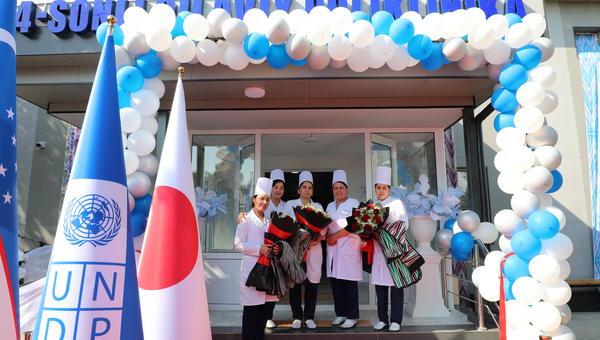
Barnokhon soon began applying these lessons into practice. Starting with a team of five employees, she established the “Women's Entrepreneurship Centre” and introduced an updated production model focused on import-substituting textile products.
Since then, through her garment production activities, Barnokhon has trained more than 150 women in vocational skills through the master-apprentice system. More than 30 women are currently employed directly at the center. Beyond generating income, her work expands women’s access to economic opportunities, particularly for returnee migrant women, women caring for children at home, and those facing barriers to formal employment.
Barnokhon's entrepreneurial activities also include women with disabilities who are able to work. In partnership with the Association of Disabled People of Uzbekistan, she supports women in producing handmade accessories, enabling them to participate in economic activity through flexible, home-based work.


Looking ahead
Today, Barnokhon is working to develop her own high-quality and sustainable clothing brand that meets international standards. While she previously produced garments for other brands, she is now focused on developing and scaling her personal brand and expanding her market reach internationally.
Yet her greatest ambition extends beyond business growth. Migration, hardship, and the experience of starting over gave her a deeper understanding of the realities faced by women going through similar circumstances. As a result, she has made it her mission to create new opportunities, particularly for women returning from migration.
“My biggest dream for the future is to establish a large factory and create more jobs for women like me who have returned from migration. I want them to be able to build stable livelihoods and earn a decent income in their own country.”
Barnokhon's journey shows that neither a business crisis nor migration defines a person's future. With knowledge, resilience, and timely support, difficulties can become pathways to new opportunities and lasting success.
Her advice to women considering entrepreneurship is simple:
“Every woman has inner strength and potential, even if she does not recognise it at first. So if you are thinking of starting something, even a small business, do not be afraid.”
About project
The Women Entrepreneurship Support Programme (WESP) is initiated by HAMROH – a Women’s Entrepreneurship Support company established by Presidential Decree, and implemented by UNDP with support from the Ministry of Economy and Finance of the Republic of Uzbekistan. The project contributes to advancing SDG 5, SDG 8, and SDG 10 by supporting women’s entrepreneurship, expanding access to decent work, and strengthening inclusive economic participation for women across Uzbekistan.