Locations
Uzbekistan Advances Integrated Water Management in the Aral Sea Region with New Lower Amu Darya Basin Planning Framework
June 3, 2026

Samarkand, 2 June 2026 — A new milestone in strengthening water security and ecosystem resilience in the Aral Sea region was reached today with the signing of the Concept for an Integrated Water Resources Management (IWRM) Plan for the Lower Amu Darya Basin.
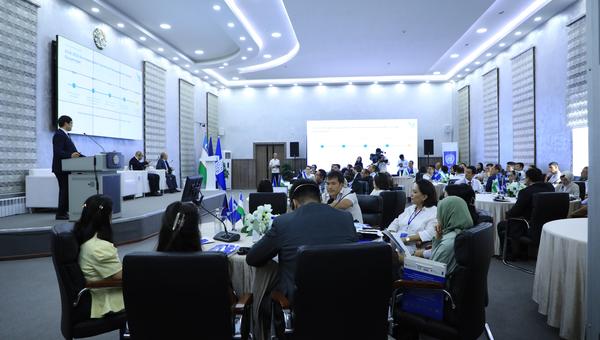
The Concept was signed during Eco Expo 2026 as part of a side event dedicated to restoring ecosystems in the Lower Amu Darya and Aral Sea Basin. Developed under the Aral Sea Wetlands project, the initiative is implemented by the National Committee on Ecology and Climate Change of the Republic of Uzbekistan in partnership with the United Nations Development Programme (UNDP) and the Global Environment Facility (GEF).
The document establishes the foundation for a more coordinated, science-based and sustainable approach to managing water resources in one of Uzbekistan’s most environmentally vulnerable regions.
The Concept was signed by high-level representatives of key national institutions, including Jusipbek Kazbekov, Deputy Chairperson of the National Committee on Ecology and Climate Change; Zakir Ishpulatov, First Deputy Minister of Water Resources; and Alisher Shukurov, Deputy Minister of Agriculture.
The inter-agency nature of the signing reflects the shared commitment of national stakeholders to strengthen cooperation across water management, agriculture, ecosystem conservation and regional development.

“The Aral Sea Basin remains one of the world’s most complex environmental challenges. However, today we can confidently say that farmers are adapting to a changing climate, while local communities are becoming active agents of transformation,” emphasized Alisher Shukurov, Deputy Minister of Agriculture, in his remarks. “Our experience demonstrates that climate-resilient agriculture and sustainable land management can advance hand in hand. Such an approach makes it possible to simultaneously restore degraded landscapes and create new economic opportunities for local populations.”
A central feature of the Concept is the transition from administrative approaches to water governance toward a river-basin management model. This means that planning and decision-making will increasingly be guided by the natural boundaries of water systems, hydrological realities, ecosystem needs and the interconnected interests of upstream and downstream users.
The future IWRM Plan will serve as a practical tool to assess water resources more systematically, improve water-use efficiency, reduce pressures on ecosystems, strengthen climate resilience and help balance economic, social and environmental priorities.

“Water connects food security, ecosystem health, economic resilience, and people’s well-being. This is why integrated water resources management is such an important tool for achieving the Sustainable Development Goals. We welcome Uzbekistan’s leadership in advancing a river basin approach to water management in the Lower Amu Darya and look forward to further strengthening our partnership to support the restoration and sustainable development of the Aral Sea region,” – noted Anas Qarman, Deputy Resident Representative of UNDP in Uzbekistan.
Pilot implementation of the future IWRM Plan will cover selected districts in the Lower Amu Darya Basin, including Alat and Karakul districts of Bukhara region, as well as Amudarya and Muynak districts of the Republic of Karakalpakstan. At the local level, the initiative will support innovative approaches to water demand management, digital water accounting, water-saving technologies and stronger engagement of farmers and communities in decision-making processes.


Promoting Practical Solutions for Ecosystem Restoration
The side event also served as a platform to showcase broader efforts under the Aral Sea Wetlands project aimed at restoring degraded ecosystems and strengthening the climate resilience of local communities.
The event brought together representatives of government institutions, international organizations, development partners and experts to discuss practical solutions for wetland restoration, biodiversity conservation, sustainable land and water management, and climate adaptation.
Participants highlighted the critical role of wetlands and riparian ecosystems in supporting biodiversity, sustaining livelihoods and helping communities adapt to climate change. Discussions focused on practical tools ranging from ecosystem restoration and land degradation neutrality approaches to improved inter-agency coordination and community participation.
During the technical session, international experts shared global knowledge and practical experiences relevant to the region. Joshua Brunn, International Technical Adviser to the Aral Sea Wetlands project, presented on the value of ecosystem services and nature-based livelihoods in the Lower Amu Darya. Hermann Kust, Senior Scientific Officer of the United Nations Convention to Combat Desertification (UNCCD), introduced planning tools and methodologies supporting land degradation neutrality. Vasiliy Lobkovskiy shared practical approaches to integrated land-use planning at the local level.
The Aral Sea Wetlands project supports the conservation and sustainable management of lakes, wetlands and riparian ecosystems across the Aral Sea Basin. The signing of the IWRM Concept marks an important step toward integrated, cross-sectoral and environmentally sustainable management of water resources in the Lower Amu Darya and reinforces Uzbekistan’s commitment to building a more resilient future for the Aral Sea region.