

 Locations
A Partnership Rooted in Action: UNDP, ACDF and Aral School Unite for Ecological Restoration in the Aral Sea region
February 27, 2026

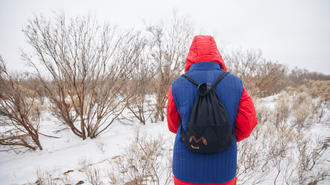
On 25 February, participants of the Aral School joined UNDP experts and foresters from the Karauzyak State Forestry Department to plant saxaul and other salt-tolerant species on land where a sea once stood. This field practice is the living embodiment of a partnership between those who study the future of the Aral Sea region and those who work every day to restore it.
This field activity is the direct result of an institutional partnership between Uzbekistan Art and Culture Development Foundation (ACDF) and UNDP Uzbekistan, formalised through a Memorandum of Understanding signed on 5 April 2025 in Nukus by Ms. Gayane Umerova ACDF Chairperson and Ms. Akiko Fujii UNDP Uzbekistan Resident Representative - on the sidelines of the inaugural Aral Culture Summit, where UNDP Assistant Secretary-General Ivana Živković also participated.

Ms. Gayane Umerova, Chairperson, Uzbekistan Art and Culture Development Foundation (ACDF): "The Aral School brings together disciplines that are rarely in the same room: design, ecology, science, culture and local knowledge. That intersection is where new solutions are born. Working alongside UNDP, we are able to connect that vision directly to practice — in the field, with communities, and with the next generation of people who will reframe what restoration means for this region and beyond."
Since January 2026, ACDF, UNDP and the Aral School have been building their partnership through a structured programme of joint activities - from mentorship sessions and knowledge exchanges to the field work on the dried seabed. Over the past weeks, both teams have engaged on themes central to the Aral Sea region: water governance, climate-resilient agriculture, ecosystem restoration, and community resilience.
Ms. Akiko Fujii, Resident Representative, UNDP Uzbekistan: "Restoring the Aral Sea region requires more than technical solutions. It requires institutions that share a common belief: that education, science and culture are not separate from ecological restoration, but inseparable from it. This is what unites UNDP and ACDF, and our partners at the Education Above All Foundation and the Ministry of Preschool and Secondary Education of Uzbekistan. When partners align around that goal and act on it together, that is when real change begins."


Aral School participants, UNDP Aral Sea experts and foresters from the Karauzyak State Forestry Department worked side by side on the dried seabed, each bringing distinct expertise to a shared prosperity. The Karauzyak team guided the practical planting process, drawing on years of experience in one of the world's harshest restoration environments. UNDP provided technical context on innovative planting methods and engaged 50 school students as Young Green Ambassadors through its EAA-funded “Empowering and nurturing leadership skills of youth through climate action education in Uzbekistan” project. Their participation was fully supported by the Ministry of Preschool and School Education, strengthening youth leadership in climate action and ecological restoration across Karakalpakstan.
Together, they planted saxaul (Haloxylon), the primary native species for seabed stabilization, alongside other halophyte species adapted to the extreme conditions of the Aralkum desert: high soil salinity, temperatures ranging from -30°C to +45°C, minimal precipitation, and relentless salt-dust storms.
Saxaul is uniquely suited to this environment. A single mature shrub retains up to four tonnes of migrating sand. Its root system reaches 10 to 15 metres deep, and each hectare of saxaul plantation absorbs over 1,100 kg of CO₂ annually. In 7-year-old saxaul stands, wind speeds near the surface reduce to near zero, directly limiting the toxic dust storms that affect the health of millions across the region. Seedlings were grown in local nurseries of the State Forestry Department, ensuring full adaptation to local conditions.




Five Years of Green Aral Sea — and the Scale of What Remains
This planting was part of the Green Aral Sea crowdfunding initiative, launched by UNDP on 11 March 2020. In collaboration with the Uzbekistan Art and Culture Development Foundation (ACDF) and the Aral School, 90,000 saxaul seedlings and other halophyte species are being planted across 90 hectares of the dried seabed, bringing new life to one of the world's most challenging landscapes.
Yet the dried seabed covers 2.7 million hectares on Uzbekistan's territory alone, the largest share among all Central Asian countries.
One dollar. One saxaul tree. 25 years of protection against desertification. Support the restoration of the Aral Sea: greenaralsea.org

About the Partners:
UNDP Uzbekistan has been working in Uzbekistan for over 30 years, supporting the country's sustainable development across four integrated areas: effective governance, inclusive and sustainable growth, environment and climate action, and gender equality. In Karakalpakstan, UNDP maintains a dedicated project office focused on the most pressing challenges of the Aral Sea region, including ecosystem restoration, climate-resilient agriculture, water governance, social infrastructure development, and economic empowerment of women and youth. More: undp.org/uzbekistan
About Uzbekistan Art and Culture Development Foundation (ACDF)
ACDF was founded in 2017 to promote Uzbekistan culture at home and abroad, developing and supporting initiatives in the fields of fine arts, architecture, literature, theatre, music, craft, design and dance. It is also the driving force behind the Aral Culture Summit – a new enterprise aimed at transforming the Aral Sea region through art, culture, design, and science, with a focus on social and ecological change.
Positioned at the forefront of Uzbekistan’s cultural development, ACDF is committed to fostering the cultural ecosystem of the country, driving the creative economy, and providing opportunities for practitioners on a local, regional and global stage. ACDF believes that culture and heritage are vital in shaping society, uniting communities, bridging generations, and facilitating cross-cultural conversations.
ACDF has successfully led the fourth edition of the World Conference on Creative Economy (WCCE) (2-4 October 2024), Uzbekistan’s participation in Expo 2025 Osaka- Kansai, Japan (April – October 2025), and the inaugural edition of Bukhara Biennial (September – November 2025). In March 2026, ACDF will open the Centre for Contemporary Arts in Tashkent. Other projects include the construction of the new National Museum of Uzbekistan designed by Tadao Ando, and the restoration and partial reconstruction of the Palace of the Grand Duke of Romanov. ACDF also launched “Tashkent Modernism. XX/XXI”, an ongoing research project documenting and protecting the city's modernist architecture, highlighted by two significant publications in collaboration with Rizzoli New York (published in 2024) and Lars Müller Publishers (published in 2025).
acdf.uz | @acdfuz
Aral School is an international educational initiative by ACDF. It is a multidisciplinary platform that brings together emerging practitioners from Uzbekistan, Karakalpakstan, and abroad. Working across architecture, urbanism, environmental science, biotechnology, climate research, media, and related fields, the programme invites participants to engage with the Aral Sea region as both a site of critical inquiry and a space of future imagination. Through collective research and situated practice, the initiative seeks to transform urgent ecological and cultural questions into long-term, sustainable frameworks for action. Directed by bioregional designer Jan Boelen. The first pilot course runs January–June 2026. Website: aralschool.uz
Karauzyak State Forestry Department is UNDP's implementing partner for the saxaul and halophyte planting on the dried Aral Sea bed.


