Locations
EU and UNDP support Master Planning in Fergana Region
April 2, 2026

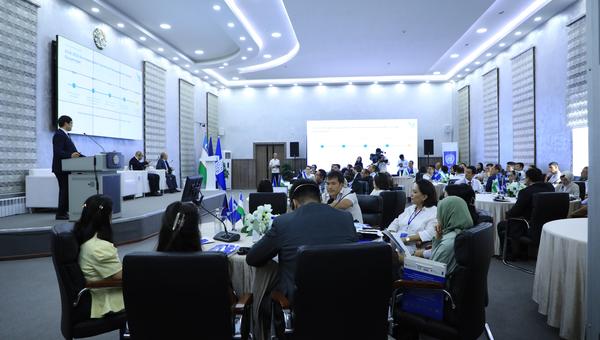
Fergana, Uzbekistan, 2 April 2026 – Within the framework of the project “Further Improvement of Public Services Delivery in Uzbekistan” funded by the European Union, implemented by UNDP in cooperation with the Ministry of Justice of the Republic of Uzbekistan, the Training of Trainers (ToT) on Master Planning has been launched.
The training is aimed to modernize regional development practices and establish a national cadre of experts capable of implementing international standards across Uzbekistan through equipping specialists with practical tools to design and implement modern urban planning frameworks that promote inclusive and resilient city growth. The curriculum focuses on advanced technical topics including spatial–economic reasoning, which integrates economic modeling into urban frameworks, and multi-sector integration to coordinate transport, tourism, and heritage considerations. Participants will also engage in a site visit to apply theoretical models to real-world scenarios, ensuring a hands-on transition to modern urban planning workflows.
The training marks an important step in translating urban development strategies into concrete projects that benefit local communities. By developing a network of qualified trainers, the initiative aims to ensure that modern, people-centred urban planning approaches can be applied in cities and regions across Uzbekistan.
Mr Azamat Salaev, Project Manager of the project “Further Improvement of Public Services Delivery in Uzbekistan” emphasized: “Further Improvement of Public Services Delivery in Uzbekistan” supports the Government of Uzbekistan in transforming and modernising public administration at the central, regional, and district levels. Today’s ToT aims to further improve the quality of public services and local development”.
Mr Shakhobiddin Sharipov, Head of Devision, Ministry of Economy and Finance, highlighted: “The Ministry of Economy and Finance is committed to modernizing our urban landscape using international best practices. By bringing together regional project offices and private sector experts, we are creating a unified methodological foundation for master planning. This initiative will ensure that infrastructure investments are strategically aligned with long-term economic growth and social inclusion”.


The three-day event (2–4 April) strengthens participants’ practical skills in modern urban planning, including the use of spatial data, GIS tools, and master plan procedures in Uzbekistan. Delivered by international experts at the request of the Ministry of Economy and Finance, the programme addresses key gaps in planning practices while promoting climate-resilient and inclusive approaches. By building a national pool of trainers, the initiative aims to improve the quality and consistency of urban development across all regions of the country.
Background:
“Further Improvement of Public Service Delivery in Uzbekistan” project funded by the EU and implemented by UNDP with total budget of EUR 4,900,000 and implementation duration of 2024-2029 is aimed to address key challenges such as limited access to public services in rural areas, low digital penetration, and outdated institutional frameworks. It will do so through four strategic pillars:
- Transform institutional, legal, and regulatory frameworks underpinning the back office of the national public services delivery system.
- Enhance capacity of the back office institutions in public service delivery to ensure their effective operation at the national, regional and local levels.
- Conduct digital and user-centric transformation of the back office institutions to improve availability and quality of public services.
- Transform the system of local governance to ensure responsiveness, accountability and better operation of regional and local institutions functioning as back offices.
The Project supports Uzbekistan’s reform agenda and contributes to the achievement of the Sustainable Development Goals (SDGs), in particular SDG 16 on strong institutions and SDG 9 on innovation and infrastructure. By 2029, the initiative seeks to conduct functional reviews of 11 back-office institutions, train 1,000 civil servants on inclusive and user-centric service delivery, digitally transform at least 35 public services, and establish 34 new public service zones in makhallas across the country. These comprehensive reforms will significantly enhance citizen access to efficient, transparent, and inclusive government services nationwide.
About the European Union: The European Union is an economic and political union of 27 European countries. It is founded on the values of respect for human dignity, freedom, democracy, equality, the rule of law and respect for human rights, including the rights of persons belonging to minorities. It acts globally to promote sustainable development of societies, environment and economies, so that everyone can benefit.