Locations
EU and UNDP promote Data Governance in Uzbekistan
September 24, 2025

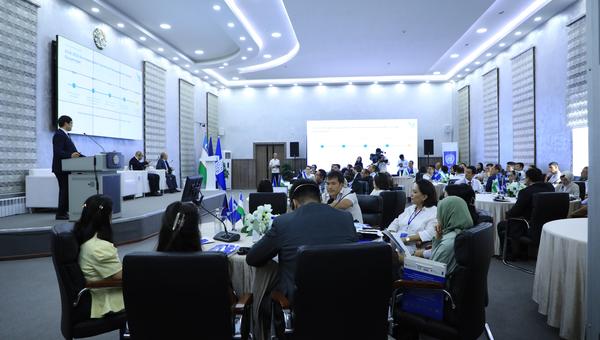
Tashkent, Uzbekistan – 25 September 2025 the European Union (EU), the United Nations Development Programme (UNDP), jointly with the Ministry of Justice and the Ministry of Digital Technologies of the Republic of Uzbekistan, launched a one-day multi-stakeholder workshop on “Assessing and Accelerating Data Governance in Uzbekistan” in the framework of EU-funded project “Further Improvement of Public Services Delivery in Uzbekistan” implemented by UNDP.
The event brought together more than 30 representatives from the state institutions, the private sector, civil society organisations, and academia to evaluate progress and define next steps in strengthening Uzbekistan’s data governance ecosystem. The workshop featured three thematic sessions on data governance principles and legislation, institutional roles and processes, and data infrastructure and interoperability.
H.E. Toivo Klaar, EU Ambassador to Uzbekistan stated that: “Good and transparent data management is a crucial issue for every individual, whether in Uzbekistan or in the EU. That is why the EU is funding a project that aims to drive digitalisation, strengthen governance, and ensure that public services in Uzbekistan become more accessible, efficient and responsive to the needs of every citizen. This also reflects the ambition of the EU’s Global Gateway Strategy, which promotes trusted and sustainable digital connectivity and aims to help Uzbekistan to build secure, inclusive and people-centred digital services.”
Mr. Anas Fayyad Qarman, UNDP Deputy Resident Representative in Uzbekistan, emphasised a critical role of data governance in digital transformation: “Strong data governance is not just a technical or legal matter. It is about trust, inclusion, and empowering people to fully benefit from the opportunities of digital development. Uzbekistan has made notable strides in this area, and we are proud to support the country in building a data ecosystem that is secure, transparent, and people-centered.”
These discussions assessed the current policy landscape, identified gaps in legal protections and implementation mechanisms, and explored opportunities for capacity development. Participants acknowledged important achievements such as the adoption of the Law on Personal Data, the creation of the Personalisation Agency under the Ministry of Justice, and the growing use of Uzbekistan’s Open Data Portal. At the same time, the dialogue highlighted persistent challenges, including fragmented systems, weak interoperability, and digital skill gaps—particularly among women and rural populations. The workshop provided a platform for cross-sector dialogue on how to develop a unified, inclusive, and effective data governance framework to support transparency, innovation, and data-driven decision-making across the country.


Background:
“Further Improvement of Public Service Delivery in Uzbekistan” project funded by the EU and implemented by UNDP with total budget of EUR 4,900,000 and implementation duration of 2024-2029 is aimed to address key challenges such as limited access to public services in rural areas, low digital penetration, and outdated institutional frameworks. It will do so through four strategic pillars:
Transform institutional, legal, and regulatory frameworks underpinning the back office of the national public services delivery system.
Enhance capacity of the back office institutions in public service delivery to ensure their effective operation at the national, regional and local levels.
Conduct digital and user-centric transformation of the back office institutions to improve availability and quality of public services.
Transform the system of local governance to ensure responsiveness, accountability and better operation of regional and local institutions functioning as back offices.
The Project supports Uzbekistan’s reform agenda and contributes to the achievement of the Sustainable Development Goals (SDGs), in particular SDG 16 on strong institutions and SDG 9 on innovation and infrastructure. By 2029, the initiative seeks to conduct functional reviews of 11 back-office institutions, train 1,000 civil servants on inclusive and user-centric service delivery, digitally transform at least 35 public services, and establish 34 new public service zones in makhallas across the country. These comprehensive reforms will significantly enhance citizen access to efficient, transparent, and inclusive government services nationwide.
For more information, please contact:
Jaloliddin Badalov
Communication Analyst UNDP in Uzbekistan Email: jaloliddin.badalov@undp.org
Malika Musaeva
Press and Information Officer / Delegation of the European Union in the Republic of Uzbekistan / Email:delegation-uzbekistan@eeas.europa.eu