Locations
Improving Public Services Together: EU and UNDP Review Reform Progress in Uzbekistan
December 5, 2025

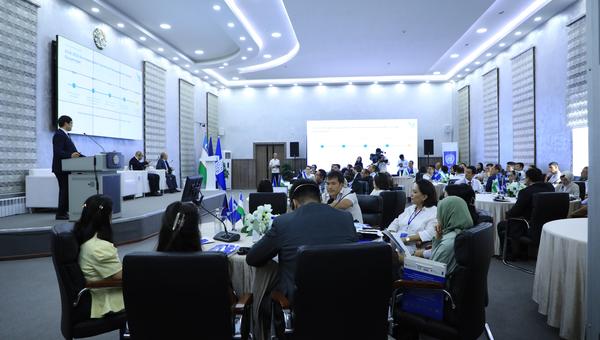
Tashkent, 5 December 2025 — The European Union (EU) and the United Nations Development Programme (UNDP), together with the Ministry of Justice of the Republic of Uzbekistan, convened the Project Board Meeting of the “Further Improvement of Public Service Delivery in Uzbekistan” project to review progress in 2025 and discuss priorities for 2026. The initiative, funded by the EU and implemented by UNDP and the Ministry of Justice, supports national efforts to make public services more efficient, accessible, and user-friendly, particularly for people in rural and remote areas.
Eldor Makhkamov, Head of Public Services Department of the Ministry of Justice of Uzbekistan, noted: “Our shared efforts are helping build a truly citizen-oriented public service system based on efficiency, accountability, and inclusiveness.”
In 2025, the project developed a Draft Law on Public Service Delivery, incorporated proposals on proactive, composite, and simplified services into Presidential Decree No. 157, and prepared two analytical reports on unjustified rejections and international best practices, and conducted a roundtable on recent developments in public service delivery. Capacity-building efforts were strengthened through training programmes that engaged 35 civil servants on Business Process Reengineering, 36 ICT specialists on Big Data and AI, 26 PR officers, and 27 journalists and bloggers on communication in public service delivery, along with assessments of two Regional Capacity Development Centers. A national methodology was also developed to measure user satisfaction and SDG-linked service quality.


Christos Marazopoulos, First Counsellor and Head of Cooperation of the EU Delegation to Uzbekistan, stated that “EU is proud to support the ‘Further Improvement of Public Services Delivery in Uzbekistan’ project which is aimed to strengthens public services, advances digital transformation, and promotes inclusive, citizen-centered governance, particularly for rural and remote communities. It reflects the EU’s broader partnership with Uzbekistan and Central Asia, including recent milestones such as the EU-Central Asia Summit and signing of the Enhanced Partnership and Cooperation Agreement. The EU remains committed to supporting modern, efficient, and people-focused public administration that delivers tangible benefits to all citizens.”
Anas Fayyad Qarman, UNDP Deputy Resident Representative in Uzbekistan, emphasized the project’s strategic role in national reform efforts: “This project reflects our shared vision for more effective, inclusive, and citizen-focused governance.”
Azamat Salaev, UNDP Project Manager, presented key achievements of the project, emphasizing advancements in legal reforms, institutional capacity, digital transformation, and people-centered local governance.
The project further supported digital, user-centric transformation by reviewing three priority services for optimization, completing two analytical studies on digitalizing court-registry interactions, developing a nationwide Data Governance Recommendation report, hosting a national data governance workshop with 37 participants, and conducting assessments of My.gov.uz services and PSC conditions in seven pilot regions. Efforts to strengthen people-centered local governance included the review of licensing and apostille services covering over 40,000 cases, master plan analyses for Nurabad (200 ha) and Kuvasoy (100 ha), assessments in three districts for establishing Public Advisory Councils, recruitment of seven Women’s Advisory Group members, and training of 30 WAG and PSC directors during an Autumn School on gender-responsive public service delivery.
Background:
“Further Improvement of Public Service Delivery in Uzbekistan” project funded by the EU and implemented by UNDP with total budget of EUR 4,900,000 and implementation duration of 2024-2029 is aimed to address key challenges, such as limited access to public services in rural areas, low digital penetration, and outdated institutional frameworks. It will do so through four strategic pillars:
Transform institutional, legal, and regulatory frameworks underpinning the back office of the national public services delivery system.
Enhance capacity of the back-office institutions in public service delivery to ensure their effective operation at the national, regional and local levels.
Conduct digital and user-centric transformation of the back-office institutions to improve availability and quality of public services.
Transform the system of local governance to ensure responsiveness, accountability and better operation of regional and local institutions functioning as back offices.
The Project supports Uzbekistan’s reform agenda and contributes to the achievement of the Sustainable Development Goals (SDGs), in particular SDG 16 on strong institutions and SDG 9 on innovation and infrastructure. By 2029, the initiative seeks to conduct functional reviews of 11 back-office institutions, train 1,000 civil servants on inclusive and user-centric service delivery, digitally transform at least 35 public services, and establish 34 new public service zones in makhallas across the country. These comprehensive reforms will significantly enhance citizen access to efficient, transparent, and inclusive government services nationwide.