

 Locations
Representatives of civil society organizations providing free legal aid strengthened their mediation and alternative dispute resolution (ADR) skills. The training aimed to expand access to justice and promote more accessible and effective mechanisms for resolving disputes.
CSO Representatives Strengthen Mediation Skills to Expand Access to Free Legal Aid
June 8, 2026

Photo: UNDP Uzbekistan/Rimma Mukhtarova
Tashkent Region, 3–4 June 2026 — Representatives of civil society organizations (CSOs) providing primary free legal aid services participated in a two-day training on mediation and alternative dispute resolution (ADR). The training aimed to strengthen the capacity of CSOs to apply modern conflict resolution tools and expand public access to quality legal assistance.
The relevance of this topic stems from the fact that, despite ongoing efforts to improve access to justice, recourse to formal dispute resolution mechanisms can still be a lengthy, costly, and complex process for many citizens. These barriers are particularly significant for women, persons with disabilities, residents of remote areas, youth, and other vulnerable groups, for whom financial, procedural, and informational constraints may substantially limit their ability to protect their rights and legitimate interests.
Against this backdrop, alternative dispute resolution (ADR) mechanisms are becoming increasingly important, enabling parties to reach mutually acceptable solutions without resorting to court proceedings. One of the most widely used ADR mechanisms is mediation—a voluntary and confidential process in which a neutral third party (mediator) assists disputing parties in establishing constructive dialogue and reaching an agreement. Such mechanisms are particularly effective in resolving family, employment, neighborhood, and other community-level disputes, providing faster and more accessible pathways to restoring rights and addressing grievances.
Uzbekistan has established the necessary legal framework for the development of mediation and other alternative dispute resolution mechanisms, including the Law of the Republic of Uzbekistan “On Mediation” and a range of measures aimed at strengthening the relevant institutional framework. However, the potential of these instruments at the local level has not yet been fully realized. Therefore, strengthening the capacity of civil society organizations and free legal aid providers in the field of mediation is of particular importance, helping to expand access to effective, citizen-centered dispute resolution mechanisms.


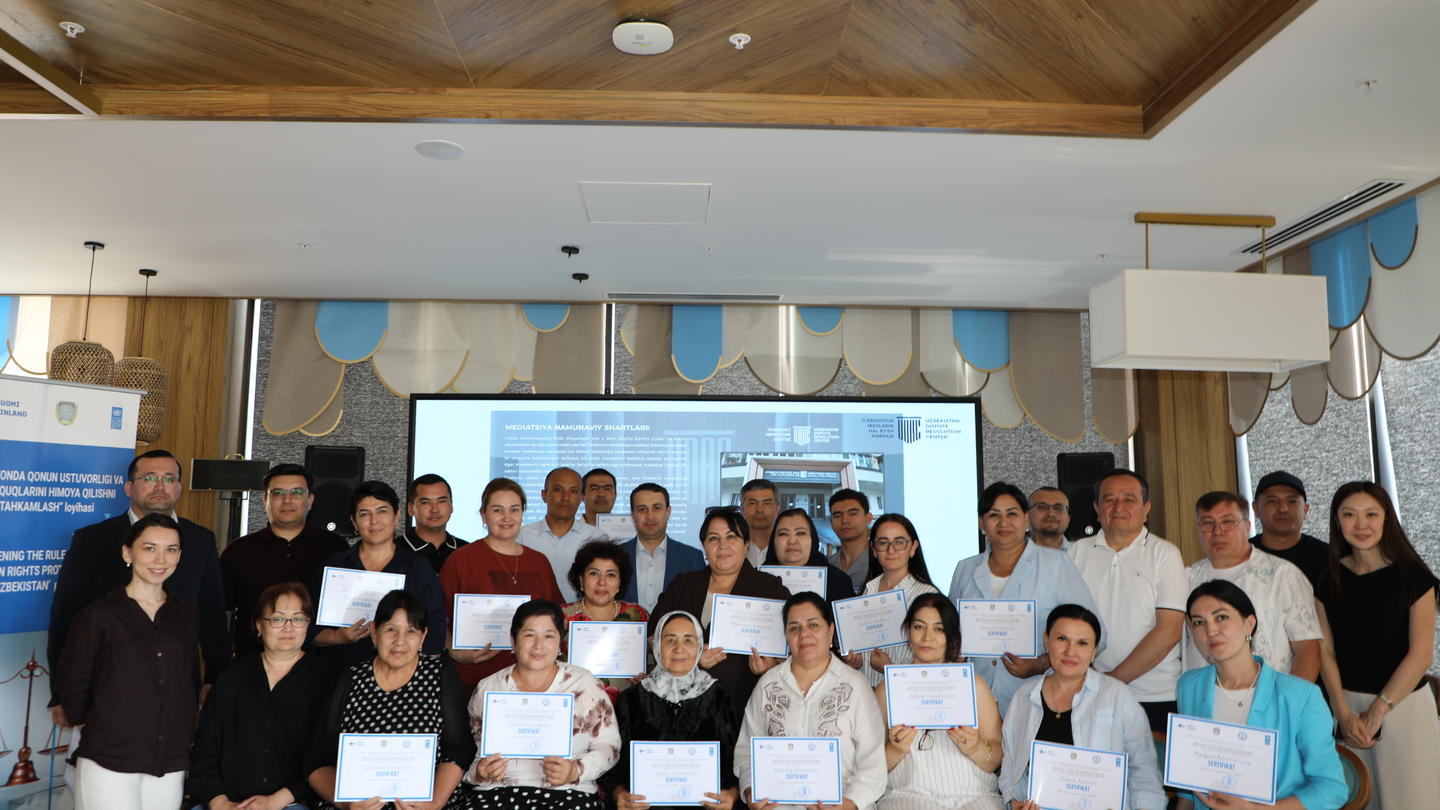




The training was designed to enhance the practical skills of CSO representatives in mediation and conflict management. Participants explored both international and national experiences in the application of ADR mechanisms, learned about the principles and stages of mediation, the role of mediators, and the practical use of ADR within free legal aid services.
Special attention was given to developing practical competencies, including active listening, effective communication, conflict analysis, negotiation techniques, and facilitation of dialogue between parties. The programme featured interactive sessions, group exercises, mediation simulations, and discussions of real-life cases from legal aid practice.
The application of mediation tools is expected to contribute to broader access to justice, particularly for vulnerable population groups, by providing more accessible, efficient, and user-centered mechanisms for dispute resolution.
The training was organized within the framework of the UNDP project “Strengthening the Rule of Law and Human Rights Protection in Uzbekistan”, implemented in partnership with the Ministry of Justice, the Office of the Ombudsperson, and civil society organizations, with financial support from the Ministry for Foreign Affairs of Finland.


