
 Locations
Shaping climate solutions and demanding change
Women human rights defenders powering climate justice
December 9, 2025

In Iraq, with Hawa's organization for Relief and Development, preparations are underway to adapt eMonitor+ and train women-led organizations to monitor online violence.
Photo: UNDP Iraq
Across the globe, women environmental defenders lead the fight for a just and sustainable future. They steward resources, protect and restore forests and other landscapes, challenge extractive industries and push for policies and investments that put people and planet first.
But this leadership comes at a cost.
From Indonesia to Kenya, Uganda to Iraq, and the Philippines, women defenders are among those facing sharp escalation of digital violence. The attacks are rooted in discrimination, compounded by lack of recognition, exclusion from decision-making spheres, and with insufficient access to services, funds and justice.
During this year’s 16 Days of Activism against Gender-based Violence, and on the heels of climate COP30 where countries adopted a renewed Gender Action Plan that specifically included activities to support and protect women defenders, UNDP and its partners shine a spotlight on women defenders and advocates as agents of change. New efforts to monitor and address digital violence, strengthen civic spaces and reform policies to improve protection is underway, ensuring women's priorities and voices are at the heart of a sustainable, equitable and peaceful future for all.
Supporting defenders, protecting the future
The risks and threats against women environmental defenders persist because systems fail to protect those who defend our planet. Changing that requires bold, collective action and strategies that are grounded in women’s real lives and priorities.
UNDP partners with women’s groups in over 100 countries, including many focused on environment, clean energy and climate action.

In the Philippines, the Manila Observatory is using eMonitor+ to document online abuse, transforming data into advocacy and policy recommendations.
Photo: UNDP Philippines
UNDP’s initiative, Strengthening Women’s Civil Society and Environmental Human Rights Defenders’ Political Participation and Influence for a Just, Green Future partners with women-led organizations in five countries to bolster their efforts. The initiative focuses on three interlinked pillars:
- Leveraging technology to fight online abuse and amplify advocacy
- Supporting resilient civic spaces where women can act without fear
- Influencing policy at every level, aligned for gender equality and a healthy planet
By supporting women defenders and civil society organizations in Kenya, Uganda, Iraq, Indonesia and the Philippines, the initiative is strengthening national environmental and protection frameworks and introducing digital tools to monitor and counter online violence that is used to diminish their efforts. The goal is to create integrated systems that are durable; embedding safety, voice and influence to enable women to shape environmental solutions and climate action.
Leveraging technology for protection and advocacy
While technology has helped connect and amplify advocacy across the globe, it also poses unique threats to women defenders. Evidence shows that gender-based violence is used to diminish or control women’s efforts and influence, including to protect the environment. Digital spaces have become battlegrounds for women defenders, where harassment and disinformation aim to silence voices and distort climate debates.
With UNDP’s flagship eMonitor+, an AI-powered tool that tracks hate speech and technology-facilitated gender- based violence, UNDP is using technology to equip defenders with new data and information to counter attacks and enhance evidence-based advocacy. In the Philippines, the Manila Observatory is using eMonitor+ to document online abuse, transforming data into advocacy and policy recommendations.
In Indonesia, the National Commission on Violence Against Women is using data from eMonitor+ to inform rapid response mechanisms and strategies to strengthen institutional accountability.
“Women are at the frontlines of environmental protection, yet they face systematic risks and violence. This project ensures their voices influence policies for a greener, safer future.” - Antonio Gabriel La Viña, Deputy Director, Manila Observatory
In Iraq, with Hawa's organization for Relief and Development, preparations are underway to adapt eMonitor+ and train women-led organizations to monitor online violence, ensuring defenders can advocate safely in increasingly digital convening spaces.
In Kenya, the Women Human Rights Defenders Hub is advancing inclusive climate governance through legal empowerment and digital accountability. Leveraging the eMonitor+ platform, findings are being digitized and tracked in real time to strengthen evidence-based advocacy.
Over the five countries, in a span of one month, eMonitor+ has identified more than 1,500 online attacks against women defenders. Analysis offers valuable insight into shaping campaigns that advocate for stronger protections and drive legal reforms to combat all forms of gender-based violence in these countries and beyond.

In Kenya, UNDP is supporting a comprehensive gender-responsive legal analysis of the national environmental framework, identifying systemic gaps and opportunities for reform.
Photos: UNDP Kenya
Building resilient civic spaces
Civic space is where power is contested and where defenders need the strongest protections. Ensuring that women environmental human rights defenders can influence policies, governance and finance processes and act without fear is crucial for effective governance and policymaking.
Across the Asia-Pacific region, women environmental human rights defenders are confronting intensifying climate impacts alongside rising online violence and increasingly constrained civic spaces. UNDP together with civil society organizations, defenders and national and regional partners, are developing a framework for rights-based digital transformation, strengthening the rule of law and reinforcing people-centred justice and security.
In Kenya, the initiative is breaking new ground by conducting a comprehensive gender-responsive legal analysis of the national environmental framework, identifying systemic gaps and opportunities for reform. This approach is enhancing transparency and coordination, enabling defenders and community groups to engage government agencies and development partners in reinforcing civic space, environmental rights and climate justice at both national and county levels.
In Uganda, dialogues organized by UNDP with FIDA Uganda and Action for Development have amplified the voices of women and youth environmental defenders. The results were concrete; integrating gender responsive conservation into development plans, drafting community bylaws on land use, and creating two new networks--the Mt Elgon Environmental Human Rights Defenders Association and the Wanale Community Environmental Defenders Forum, actively involving women defenders. These networks mentor peers, share evidence and track commitments, ensuring grassroots priorities shape policy.

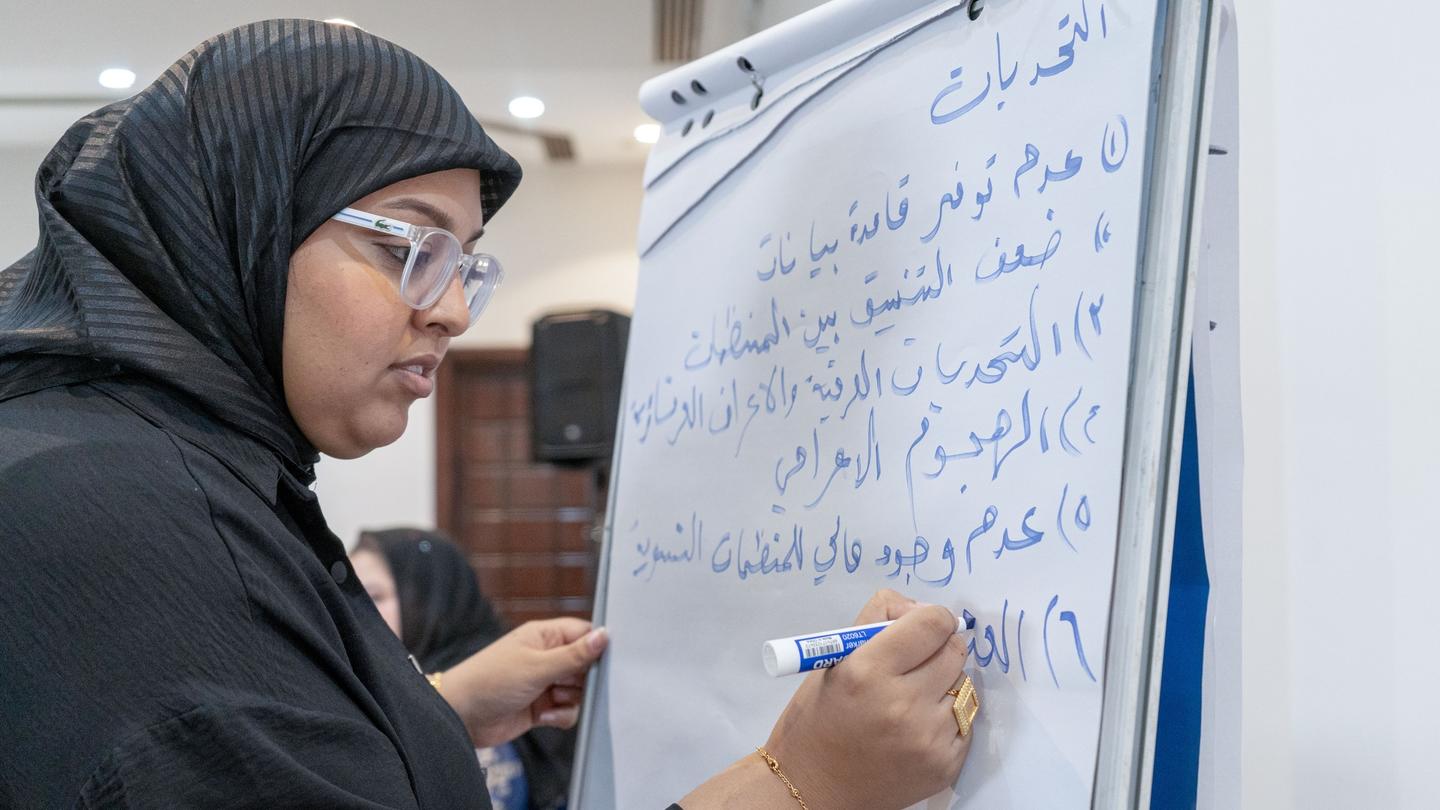

By supporting women defenders and civil society organizations in Iraq, UNDP is strengthening national environmental and protection frameworks and introducing digital tools to monitor and counter online violence.
Photo: UNDP Iraq
Influencing policy at all levels
Creating safe spaces, both online and off, is critical for activists and human rights defenders, especially women, to drive meaningful change. Yet lasting transformation depends on policies and legal frameworks that safeguard civic space and guarantee digital rights for all. These frameworks must recognize and accelerate gender equality, not only as a development priority, but as a cornerstone of democracy and effective governance. This foundation enables societies to lead bold action, whether advancing climate solutions or conserving and sustainably using biodiversity, ensuring outcomes that serve both people and the planet.
Indonesia offers a compelling example of systemic reform. It is developing the Ministerial Decree on the Protection of Women Environmental Human Rights Defenders, led by the Ministry of Human Rights, and operationalizing the Rapid Response Mechanism with the National Commission on Violence Against Women, the National Human Rights Commission and the Witness and Victim Protection Agency. It is designed to ensure timely and coordinated responses to threats, an essential safeguard for women defenders who challenge powerful interests in land and natural resource governance.
In Uganda, national dialogues have advanced commitments to harmonize natural resource laws with the proposed Human Rights Defenders Bill and to integrate climate justice priorities into local and national planning. These efforts show how advocacy informs integrated policy reform, with women’s priorities and gender equality at their core.
Regional efforts are also underway. UNDP and The African Women's Development and Communication Network, FEMNET convened a landmark forum on feminist perspectives to shape a just transition across sub-Saharan Africa. It calls for transformative climate finance and gender-responsive legal frameworks, a bold step toward systemic change. In Arab States, UNDP and partners are developing a Gender, Climate & Security Nexus regional framework and guidance note which aims to support policy coherence and provide a tool for strengthening support to civil society.
What more can be done?
To turn commitments into further action, governments and partners must move beyond rhetoric and implement concrete measures that protect women defenders, strengthen civic spaces and embed gender equality across climate and environmental policies, plans and funds:
- Governments must adopt and enforce gender-responsive protection frameworks for defenders, such as Indonesia’s forthcoming Ministerial Decree on Women Environmental Human Rights Defenders.
- Tools such as eMonitor+ can help countries and partners identify opportunities for integrated governance and policy frameworks for climate action, nature protection and gender equality.
- Climate and environment finance can align investments for gender equality by prioritizing women-led solutions and partnering with women’s groups--key to ensuring risks like gender-based violence are addressed.
The experience, expertise and priorities of women defenders is key to a clean, healthy, sustainable and safe planet. Without their voices, climate solutions risk perpetuating the very inequalities that fuel environmental degradation.
Protecting those who protect our planet is a prerequisite for a just and green future.
Special thanks to Denmark, Luxembourg and the Republic of Korea, partners to UNDP’s Governance, Peacebuilding, Crisis and Resilience (GCPR) Funding Window, for making this work possible.


