
 Locations
New report counts the staggering human and economic cost, and what is possible through peace
The Sudan war at three: The price a nation is paying
April 15, 2026

Nearly 6.9 million Sudanese were pushed into extreme poverty in 2023 alone, as a direct consequence of conflict.
Photo: UNDP Sudan
A generation robbed of progress
When armed conflict erupted in April 2023, Sudan was already counted among the world's most fragile states. Three years later, the statistics have grown harder to absorb as each one adds another human life lost, another family displaced, another child out of school, another community mourning loved ones or slipping into poverty.
Nearly 6.9 million Sudanese were pushed into extreme poverty in 2023 alone, and as a direct consequence of the fighting. Per capita income has fallen to levels not seen since 1992. Extreme poverty is now worse than at any point in the 1980s.

A trader offers bread for sale at the a gathering site for displaced people near Gedaref Town, Gedaref State.
Photo: UNDP Sudan
To understand the true cost, a new report 'Beyond the Conflict' from UNDP and the Institute for Security Studies, released just before the third anniversary of the war, has modelled where Sudan would be today had the fighting never started.
It makes for depressing reading but also poses a challenge; where do we go from here? What can be done now to minimize suffering? And are we ready for peace when it finally arrives?
Even under the most optimistic scenario—peace in 2026—Sudan would still suffer a cumulative GDP loss of US$18.8 billion by 2043, equivalent to $752 per person. The war has not just cost lives and livelihoods, it threatens to consume the future.
Some people won't see that future. With over 70 percent of healthcare facilities shut in conflict areas, the infant mortality rate is already 44.5 deaths for 1,000 live births and is projected to climb further before any recovery is possible. We've seen outbreaks of cholera and diseases such as HIV and TB are on the rise.
Some people won't be fully prepared for future challenges. Around 19 million school-age children have had their education interrupted, a demographic scar that will shape Sudan's workforce, its health and its civic life for decades. Universities have been burned down and looted. Training programmes and apprenticeships have been abandoned and millions are losing out on years of practical experience as the country waits for peace.
The cost of more years of war
The report does not offer only a snapshot of the present. It models three futures. The darkest, and the one that must be prevented, is a protracted conflict in which fighting continues until 2030.
If that happens, Sudan's total GDP in 2043 would be just $23.1 billion, representing losses of $34.5 billion compared to a no-conflict trajectory. An additional 34 million people would fall into extreme poverty by 2043, more than the entire population of Ghana.

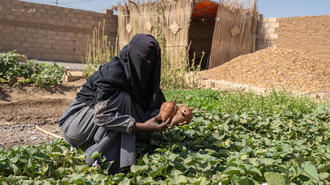
Water is severely limited in many places, risking the spread of cholera, diarrhoea and other diseases.
Photo: UNDP Sudan

Around 75 percent of Sudan's medical facilities have shut down since the war began.
Photo: UNDP Sudan
Even if peace arrives in 2026, without wider transformation, and what the report calls the ‘Current Path’, the outlook is deeply troubling. GDP per capita would fall further to $1,941 by 2035 before recovering modestly to $2,384 by 2043, still below 2023 levels and lower than Sudan achieved in the 1990s.
Extreme poverty under this scenario would worsen to nearly 60 percent of the population by 2030, approximately 34 million people, declining only slowly to 38.8 percent by 2043. Sudan would miss every major Sustainable Development Goal target. The demographic dividend that a youthful population could provide would not materialize even by 2043.
What peace and transformation could still deliver
Sudan is a country of formidable, mostly unrealized assets. It has 19.8 million hectares of arable land. It has Nile River and Red Sea access. It has a youthful population that, given education, healthcare and opportunity could drive growth for decades. None of these assets have disappeared.
The report's ‘Sudan Rising’ scenario models what happens when peace in 2026 is paired with a coordinated transformation across various sectors; governance, health and sanitation, education, agriculture, manufacturing, infrastructure, trade and finances. The projections are striking as a rigorous quantification of what Sudan's endowments make possible

Graphic: UNDP
Under the ‘Sudan Rising’ projection, GDP reaches US$58.2 billion by 2043—US$19.3 billion above the current pathwith per capita incomes rising to US$3,176. Some 17.3 million more people would be lifted out of extreme poverty by 2043. Life expectancy would rise an additional 4.2 years to 77.3 years. Average economic growth would reach 5.0 percent per year, more than double the current path's 2.4 per cent.
The biggest single-sector gains come from agriculture, which is capable of lifting 4.7 million people out of poverty, and governance reform, which could lift up 4.8 million people. These are not separate levers. They reinforce each other. Stable governance provides an environment for agricultural investment; more productive land generates the revenue base that allows governance to improve.
The Beyond the Conflict report does not stop at diagnosis. It sets out concrete areas where coordinated action by Sudan's future government, international donors and the humanitarian community can unlock the ‘Sudan Rising’ scenario.




Graphic: UNDP
Three years in, hope is not yet lost
Sudan's war has already taken more than most nations endure in a generation. The people forced from their homes, the children who have never returned to school, the harvests left ungathered, the clinics that closed—these losses are real and they are already locked in.
But the report is clear that the trajectory is not fixed. Sudan has land, waterways, a young population and a diaspora with skills and capital. The institutions that would need to harness those assets are damaged, not destroyed. What the next year produces, whether a path toward peace and reform, or a continuation of destruction, will determine which version of 2043 becomes real.
The difference between the worst scenario and the best, as this report shows, is not marginal. It is 34 million people in poverty or 17 million lifted out of it. It is a country that reaches 2043 poorer than the 1990s, or one that has found its footing.
In any scenario, UNDP will be here to support the people of Sudan, now and in long term, just as we have throughout the crisis, implementing programmes with local partners that boost livelihoods and resilience, widen access to healthcare and basic services, deliver clean energy and environmental protection, and improve peacebuilding and governance. With more than 130 staff working in 10 offices, our projects operate in tandem to deliver a result that is greater than the sum of its parts, empowering communities to help themselves, supporting national services to keep running and helping Sudan prepare for the whatever the future may bring.




Related
content
content


