
 Locations
RIGHTING THE WRONGS
Making justice work for women

Equal treatment before the law is a fundamental human right.
Yet for millions of women around the world, the path to justice remains full of obstacles. Women hold just 64 percent of the legal rights that men have. And in practice, even where equal treatment before the law is achieved, it does not always translate into fair outcomes for women.
This leaves women unprotected, with consequences that extend across society. But legal systems that actively foster gender equality help build social cohesion and support economic growth. It’s no coincidence that countries with stronger legal protections for women tend, on average, to be more stable and more prosperous.
UNDP works with countries and partners to close the gender justice gap by strengthening legal institutions and networks, translating laws into impact in women’s lives and addressing social and cultural norms that hinder progress. Meaningful progress on gender justice is essential for moving the world closer to fulfilling the promise of peace and prosperity for all, as outlined in the Sustainable Development Goals (SDGs).

Justice systems
At the institutional level, justice systems must be inclusive and equitable, giving women real avenues to exercise their rights and take action. While much progress has been achieved, this work remains unfinished. SDG 5, which aims to achieve gender equality, shows that no country has closed gaps in legal frameworks, public life, protection from violence, economic opportunities nor family law, and over half of all countries still have gaps across all these areas.
During crises or conflicts, justice systems come under strain and women’s rights are often the first to be eroded. If left unaddressed, this can deepen inequality, undermine public trust and limit the system’s ability to deliver justice. Strengthening courts and legal aid services is therefore crucial, not only to make justice systems more adaptable, resilient and capable of meeting people’s needs, but to ensure that women are not left furthest behind when systems are most under strain.
With support from Germany, the Netherlands, and the United Kingdom, the UNDP–UN Women Gender Justice Platform is helping to close the gender justice gap. Over 300,000 people—most of them women—have accessed justice and security services through the Platform, showing how targeted efforts can make justice systems more inclusive and responsive.
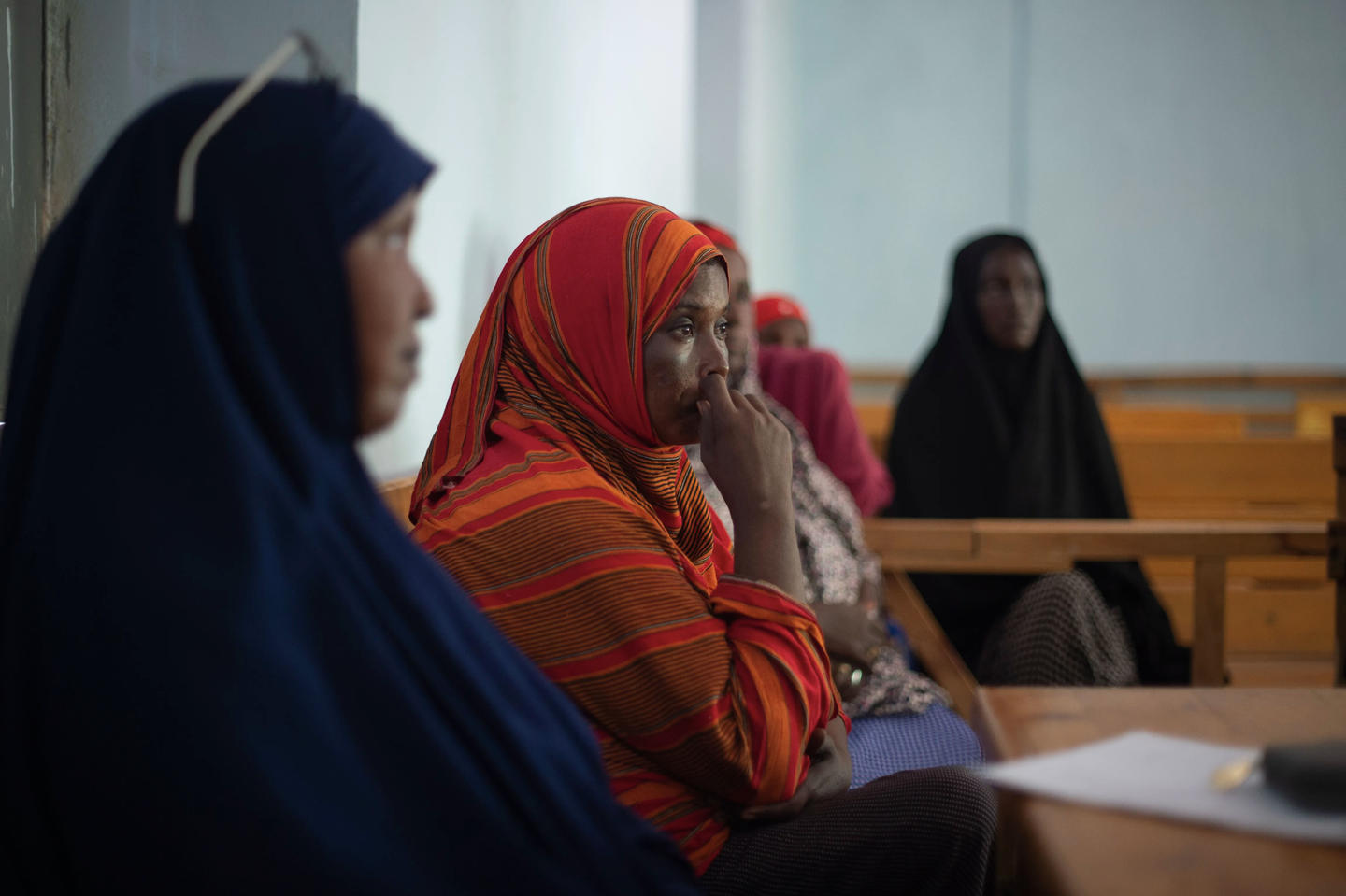
Women attend court proceedings at the Garowe courts in Puntland, Somalia. Expanding women’s access to legal processes is a key goal of initiatives such as the UNDP–UN Women Gender Justice Platform, which works to close the global gender justice gap.
The growing presence of women at all levels of the judiciary is also strengthening the system from within. From judges and lawyers to policymakers, evidence shows that women's leadership builds public trust, enhances legitimacy, encourages equitable decision-making and delivers better outcomes. In the aftermath of a conflict, women’s participation is crucial for reconciliation and peacebuilding, making peace agreements more durable and recovery more inclusive.
Celebrating concrete changes in policies, services and workplaces that advance gender equality, UNDP’s Gender Equality Seal for Public Institutions is supporting 117 public institutions across 36 countries, thanks to partners including the Republic of Korea, Luxembourg, the European Union and others. UNDP’s forthcoming Global Women in the Judiciary Dashboard tracks women’s representation in courts and other critical areas across more than 120 countries.
However, sustaining this momentum requires smart investments and gender-responsive budgeting. Justice reform has long been underfunded, yet evidence shows that proper investments can reduce time and costs, while alleviating uncertainty. To help close the funding gap, UNDP works with nearly 30 countries through its Equanomics initiative, helping decision-makers shape budgets and public finances to provide adequate resources for gender equality and stronger justice services.

Eurasia
An equal future
UNDP’s Equal Future platform is amplifying women's impact in politics and public administration.
The platform collects and analyses data on women’s participation and leadership in 19 countries and territories. It gathers good practices and success stories around gender equality and meaningful inclusion of women in decision-making.

Yemen
Empowering women mediators
In Yemen, women face significant barriers to claiming fundamental rights, including access and representation in the justice system. With 80 percent of disputes resolved through community-based mechanisms, UNDP has supported women mediators and paralegals to provide services through customary and informal networks.
With support from Germany and the Netherlands, the project has achieved a new level of impact: women paralegals have resolved up to 3,000 cases, ranging from family and inheritance disputes to land and labour issues, strengthening community trust and helping to lay the foundation for a more inclusive legal system.

Legal frameworks
Even today, girls across much of the world can legally marry before they turn 18. Across many legal systems, definitions of rape still rely on evidence of force or coercion, rather than centring consent, leaving significant gaps in protection. More than 45 countries continue to have at least one legal provision that discriminates on the basis of sex, such as denying women the right to confer nationality on a non‑citizen spouse on the same terms as men. And in 61 countries, at least one law restricts women from performing the same jobs as men.
Many legal frameworks continue to entrench injustice, but laws, policies and practices can be and reshaped to meet the needs of women. They can strike down discriminatory rules, guarantee equal rights in both public and private life and hold people accountable when women’s rights are violated.
Such reforms produce ripple effects that extend far beyond the courtroom. Family law reforms adopted since 1970, for instance, have helped open economic opportunities for more than 600 million women. A similar shift came after the 1995 Beijing Declaration and Platform for Action, with governments making progress on laws against gender-based violence. Today, 162 countries have domestic violence measures, and 147 have protections against workplace sexual harassment.

A woman paralegal in Yemen meets with a community member as part of a locally led conflict-resolution process, helping people access justice where formal courts are distant or costly.
But without implementation and accountability, even the most advanced reforms and policies risk remaining only on paper. In this context, the Convention on the Elimination of All Forms of Discrimination Against Women provides governments with standards to identify discriminatory laws as well as monitor progress.
Solid data and evidence are key to understanding how laws really function and where they fall short. By examining trends, outcomes and gaps, governments can pinpoint discriminatory rules, evaluate the effectiveness of existing policies and craft reforms that strengthen women’s rights.
UNDP and its partners work to support countries in this ongoing effort. UNDP’s Gender Justice and the Law initiative, in partnership with UN Women, UNFPA and ESCWA, helps track gaps in areas such as property rights and protection from violence, providing evidence and guidance to modernize outdated frameworks. Working with the Korean National Police Agency, UNDP also supports 12 countries in tackling digital forms of gender-based violence, combining legal reforms with cyber investigation tools, specialized police training and awareness campaigns to strengthen cooperation for justice.

South Sudan
Parliament in action
In South Sudan, Parliament passed two laws ensuring women have a seat and a voice in the country’s main bodies delivering transitional justice: the Commission for Truth, Reconciliation and Healing and the Compensation and Reparations Authority.
These laws allow women, including survivors of sexual violence, to shape reparations and co-lead the country’s path to justice, reconciliation and peace. Consultations organized by the Gender Justice Platform ensured women’s voices were included in drafting the laws, showing how legal reforms can strengthen justice in fragile settings.

Pakistan
Safe digital spaces
UNDP is partnering with the Government of Pakistan to strengthen laws addressing technology-facilitated gender-based violence.
The initiative brings together government agencies, the judiciary, law enforcement and civil society to ensure that women can safely engage in digital spaces. This includes addressing cyberstalking and emerging threats like deepfake pornography, while strengthening enforcement mechanisms.

Cultural barriers
Stigma, fear or informal dynamics sometimes shape who speaks up, whose claims are believed and who is ultimately protected by the law.
Even when existing laws affirm women’s rights, their effectiveness is often restricted by persistent social and gender norms. Fewer than 1 in 5 survivors of gender-based violence are able to pursue formal justice, often due to intimidation or social stigma. As of 2024, 51 of 92 countries where female genital mutilation is practiced have enacted legal prohibitions, yet enforcement remains uneven, particularly in communities where the practice continues to be socially reinforced.
In fragile contexts, women often face heightened obstacles to asserting their rights, from weakened legal systems to language and cultural barriers. UNDP tackles these challenges through people‑centred Rule of Law programmes that bolster human rights and community security.

Women's representation and leadership is critical to creating inclusive legal systems and countering social and cultural norms that prevent women from accessing justice. Raihan Mukhametzhanova serves as a forester in the Ile-Alatau National Park in Kazakhstan.
Poverty, limited education and geographic isolation often intersect with gendered discrimination to prevent women from exercising their rights. In rural or remote areas, legal services may be scarce or non-existent. The costs associated with pursuing justice, such as travel, legal fees or lost income, compete with basic needs such as food, medicine or childcare. Language barriers are also a factor, especially for Indigenous or migrant populations, making it harder for women to navigate legal procedures or access support.
Overcoming these obstacles requires cultural norms to evolve alongside more equitable justice systems and inclusive laws. It calls for broader social and economic change that empowers women to claim their rights and participate fully in society. This means investing in education to build women’s knowledge and confidence to pursue redress for injustices; improving infrastructure so essential services, including justice, are easier to access; and reducing poverty to strengthen women’s financial independence and participation in public life. Together, these steps help create the conditions for gender equality in justice systems–moving beyond rhetoric to impacting real lives.

Tanzania
Practical tools
Discriminatory customs and socio-cultural barriers in Tanzania often leave women unaware of their rights and the justice mechanisms available.
UNDP and UN Women, with support from Sweden, helped develop the country’s first Gender Bench Book on Women’s Rights. Today, it serves as an accessible, practical guide for judicial officers, helping them uphold and protect women’s rights more effectively.

Haiti
Mobile courts
Mobile courts are helping to end impunity around sexual and gender-based violence in remote northern Haiti.
UNDP and UN Women are bringing justice to remote areas, where high travel costs and slow proceedings limit access. A collaboration with the Ministry of Gender and civil society groups, mobile courts also raise public awareness about gender-based violence and promote changes in behaviour and social norms.
Securing rights, advancing justice
Righting the wrongs means making justice work for women, because justice is the foundation of human development, sustainable growth and gender equality.
Reforming discriminatory laws and policies, equipping institutions for gender justice, and expanding women’s leadership and influence in justice systems are not ends in themselves. They are the conditions under which real change becomes possible, to the benefit of us all.
Learn more about UNDP’s work on gender justice.
Transforming Lives Through Partnerships
People and governments trust UNDP to tackle development challenges, drive innovation, and build resilience in times of crisis and conflict. These efforts are made possible through the unwavering support of our partners, especially those contributing to flexible core funding, enabling us to create a sustainable, lasting impact worldwide.
