

 Locations
EUROJUST, PACE Justice Project facilitating Caribbean focal points network
UNDP-EU Collaboration Advances Judicial Cooperation in the Caribbean
July 9, 2026

EUROJUST Vice President, José de la Mata, at the workshop for Caribbean EUROJUST Focal Points on International Legal Cooperation in Criminal Matters between the Caribbean Region and the European Union.
UNDP Barbados and Eastern Caribbean
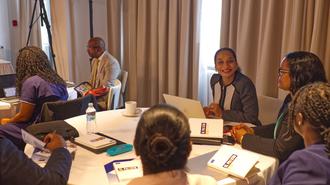
BRIDGETOWN, Barbados – Caribbean jurisdictions are expanding the range of tools at their disposal to strengthen cross-border judicial cooperation and improve the region’s capacity to respond to transnational organized crime through a collaboration with the European Union Agency for Criminal Justice Cooperation (EUROJUST). On 25 – 26 June, EUROJUST Focal Points representing nine Caribbean countries gathered in Barbados for a regional workshop on International Legal Cooperation in Criminal Matters between the Caribbean Region and the European Union.
The two-day workshop was organised by the Partnership of the Caribbean and European Union on Justice (PACE Justice) Project, which is funded by the European Union and implemented by the United Nations Development Programme (UNDP), and the Europe-Latin America Assistance Programme against Transnational Organised Crime (EL PACCTO 2.0), in collaboration with EUROJUST. Through this initiative, partners aim to strengthen channels of trust, efficiency and practical cooperation between Caribbean and European justice institutions.
The workshop brought together justice sector representatives, prosecutors, legal professionals and regional security partners and key stakeholders to deepen their understanding of EUROJUST mechanisms, and the role of EUROJUST Focal Points in supporting complex cross-border investigations and prosecutions – exchanging practical experiences on the challenges and opportunities linked to international judicial cooperation. Participants also examined the mandate and functions of EUROJUST, its cooperation with non-EU states and the role of regional organisations such as the Caribbean Community Implementing Agency for Crime and Security (CARICOM IMPACS) and the Regional Security System (RSS) in supporting efforts to counter organised crime.
Additionally, they were taken through a simulation exercise resulting in a discussion around how the process would be adapted to each jurisdiction.
Who are EUROJUST Focal Points
EUROJUST Focal Points are vital bridges between national authorities and international cooperation mechanisms, helping to facilitate communication, coordination and access to practical tools that support complex cross-border investigations and prosecutions. Their establishment and consolidation in the Caribbean region have significant potential for bi-regional legal cooperation.
What they do
• Facilitate execution of judicial cooperation requests
• Clarify national legal provisions and advise on legal requirements
• Facilitate contacts with competent authorities in their country
• Participate/facilitate coordination meetings and joint investigation teams
• Strategic engagements (exchanges, workshops, study visits)
• Address requests to EUROJUST for assistance
Participating Caribbean countries are: Antigua and Barbuda, Bahamas, Barbados, Belize, Guyana, Jamaica, St. Kitts and Nevis and St. Lucia.
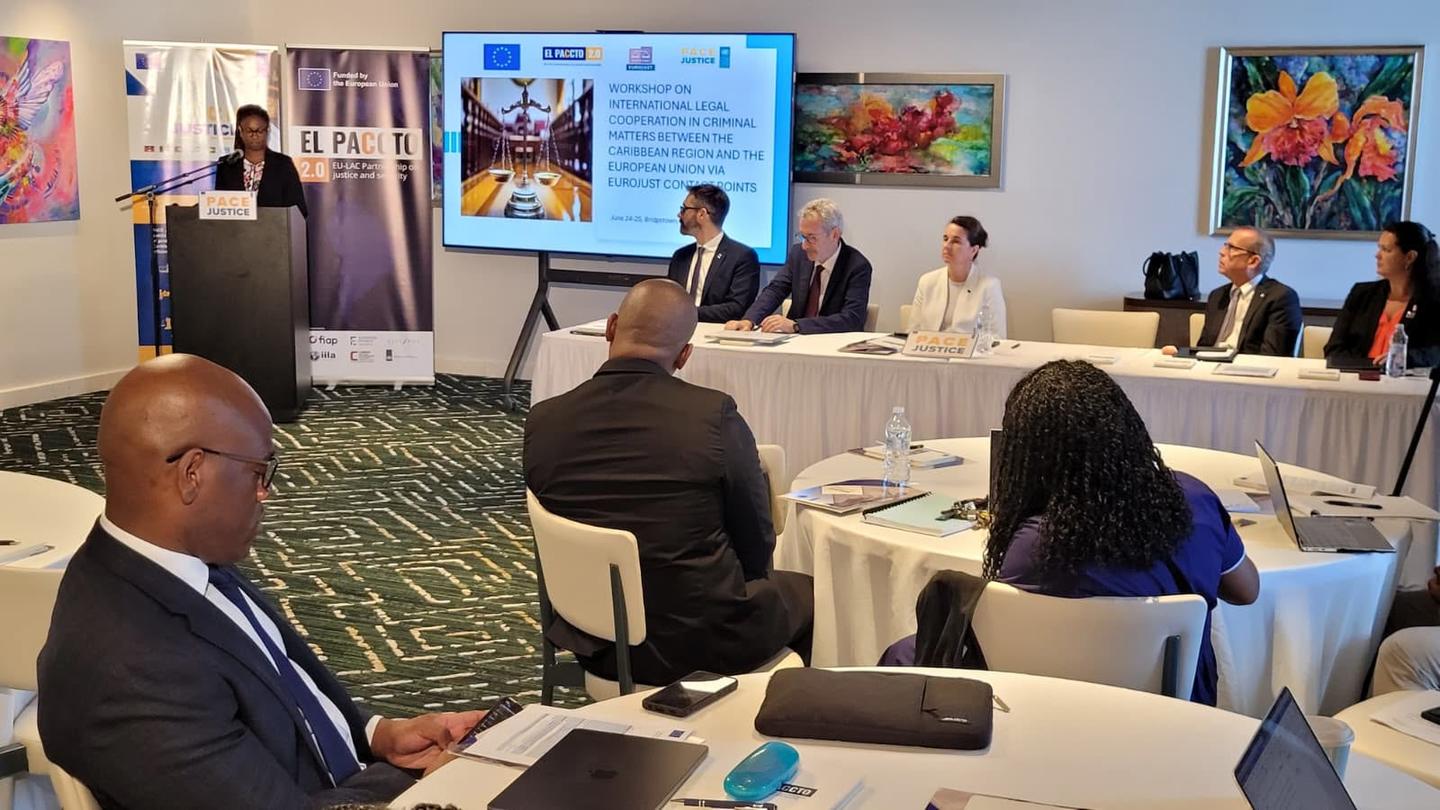
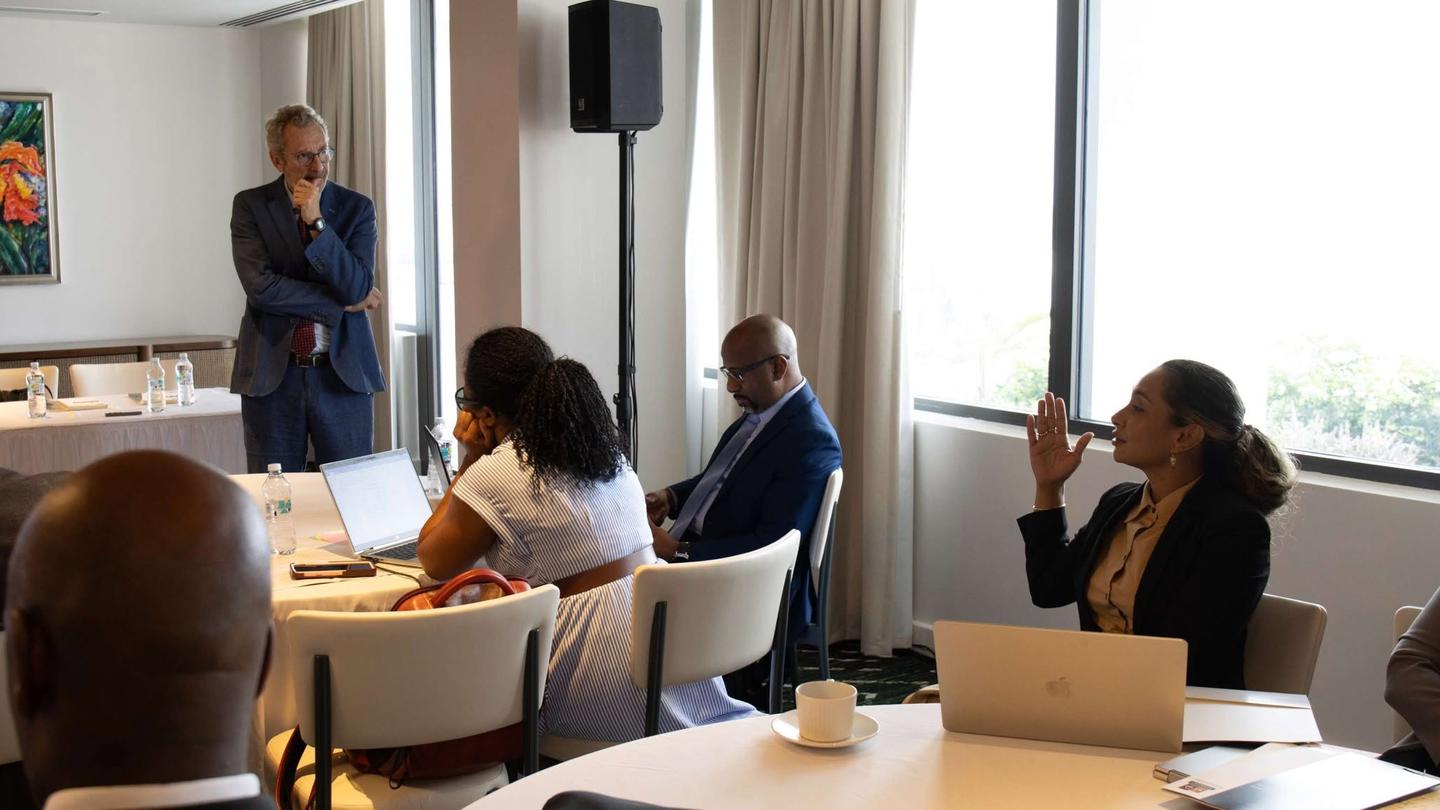

Speaking at the opening of the workshop, United Nations Resident Coordinator for Barbados and the Eastern Caribbean, Simon Springett, underscored the importance of strengthening networks to keep pace with realities on the ground. He said, “At times, the most important outcomes of a workshop such as this are not the presentations, but the personal connections that are made and can be called on when a complex case requires urgent coop eration. Those connections matter. Criminal networks do not respect borders; they are well connected and resourced. It is practical cooperation that makes justice work across our borders. When all institutions work together, justice moves that much faster.”
He added: “This is why the partnership with the UNDP PACE Justice Project and EL PACCTO 2.0 are valuable. They help turn international cooperation from a principle into a practical tool – one that prosecutors and justice officials can use to solve real cases and, importantly, deliver legal results.”
Resident Representative (a.i) of UNDP Barbados and the Eastern Caribbean, Stephanie Ziebell expressed satisfaction that the PACE Justice Project was supporting in this important initiative. She noted that EUROJUST provides Caribbean jurisdictions with an additional tool for addressing transnational crime, complementing existing mechanisms such as mutual legal assistance, extradition arrangements and police-to-police cooperation.
“The ability of countries to communicate effectively, share information efficiently, and coordinate action across borders is critical,” she said, adding, “When a case before a Caribbean prosecutor or court involves evidence, assets, suspects, or witnesses located within the European Union, EUROJUST can facilitate contacts with relevant authorities, support judicial cooperation processes, assist in resolving jurisdictional challenges, and help identify the most effective legal pathways for advancing investigations and prosecutions.”
Head of the Delegation of the European Union to Barbados, the Eastern Caribbean States and the OECS, H.E. Fiona Ramsey, said: “Organized crime covers a variety of methods - virtual assets, maritime security, cyber-crime, human trafficking, firearms trafficking, corruption and the criminal misuse of emerging technologies - which are all challenges that transcend our national boundaries and require coordinated international responses.
The establishment of this network of EUROJUST Focal points provides and reflects a shared understanding that justice cannot stop at borders, and effective responses to transnational crime require trust, cooperation, and common purpose. They are mandatory if we are to deprive the criminal networks of the financial resources that further sustain their activities in the region.”
EUROJUST Vice President, José de la Mata, reassured that the individuality of jurisdictions would be respected, even as cooperation deepens. He said, “To fight organized crime efficiently, it is not enough to work in silos. We need to work together, with excellent links, knowledge, cooperation and coordination, as they are essential between the European Member States and the Caribbean region. It is encouraging to see the commitment and dedication of the islands involved, who have appointed their Focal Points and participated in this workshop. I appreciate they are distinct and separate jurisdictions who will need to tailor our mechanisms accordingly.
Javier Samper, EL PACCTO 2.0, Director stated: “The establishment and consolidation of EUROJUST Focal Points in the Caribbean region has the potential to be a gamechanger for bi-regional legal cooperation. Organized crime represents a direct, systemic threat to our democratic structures and the safety of our citizens. It alters the economy, attempts to infiltrate state institutions, and targets vulnerable populations. Facing an interconnected threat requires a unified front.”
About UNDP
UNDP is the leading United Nations organization fighting to end the injustice of poverty, inequality, and climate change. Working with our broad network of experts and partners in 170 countries, we help nations to build integrated, lasting solutions for people and planet. Learn more at undp.org/barbados or follow at @UNDPBarbadosEC.
About PACE Justice
The Partnership of the Caribbean and the European Union on Justice (PACE Justice) Regional Programme is implemented by the United Nations Development Programme (UNDP) with funding from the European Union. The PACE Justice Programme will improve efficiency of criminal justice administration in the Caribbean by enhancing the institutional capacities of prosecutors, courts, police, and prisons. Learn more at go.undp.org/PACEJustice
About the European Union Agency for Criminal Justice Cooperation (EUROJUST)
An Agency responsible for supporting and strengthening coordination and cooperation between judicial authorities of the Member States in relation to serious crime affecting two or more Member States or requiring a prosecution on common bases. www.eurojust.europa.eu
About the EU
The European Union is the political and economic union of 27 member states sharing freedom, democracy, equality and the rule of law as common principles and values. The EU seeks to promote peace and stability, human rights and sustainable development, and support resilient democracies around the world. Learn more at www.eeas.europa.eu/delegations/barbados
