Locations
Author: Rimma Mukhtarova
From Observer to Master: How Sohiba Kayumova Broke Gender Barriers and Built a Women’s Craft School
March 18, 2026

Photo: UNDP Uzbekistan / Rimma Mukhtarova
The Beginning: When Curiosity Is Stronger Than Tradition
When Sohiba Kayumova got married in 1989, entrepreneurship was the last thing on her mind. In her husband’s family, craftsmanship was part of everyday life — he worked with wood, producing doors, furniture, and carved interior elements.
In the late 1980s in Uzbekistan, woodworking was widely perceived as a male profession. Gender roles were clearly defined by social norms: women were expected to focus on household responsibilities and decorative crafts, while physically demanding and technical professions remained largely dominated by men. Limited access to professional training, the absence of role models, and deeply rooted social expectations created structural barriers that restricted women’s participation in such fields.
At first, Sohiba never planned to become an entrepreneur – she simply observed.
"I watched how my husband worked with wood. At first, I helped him. Later, I wanted to learn it myself," she recalls.
What began as simple curiosity gradually grew into a passion. In the early 1990s — during the economic uncertainty that followed the collapse of the Soviet Union, when many families were seeking additional sources of income — Sohiba began learning the craft seriously.
A Journey Through Doubt
Balancing childcare, household responsibilities, and learning a demanding craft was not easy. Woodworking requires physical strength, precision, and patience. The tools are heavy, the wood is hard, and mistakes can be costly — once a piece of material is damaged, it cannot be restored.


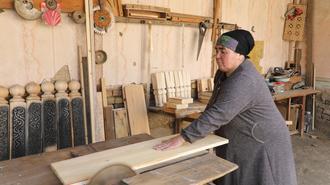


With limited access to professional training and no formal mentors, Sohiba learned through observation, practice, and repetition. She began with small decorative items — carved boxes, frames, and interior ornaments — selling them in local markets. The income was modest, but every sale reinforced her confidence: her work was valued.
The early years tested her resilience. Beyond the physical demands, she also had to overcome doubts — both her own and those of others. Step by step, order by order, she strengthened her skills and built a reputation as a skilled artisan.
The Breakthrough: An Exhibition That Changed Everything
The turning point came in 2007, when a regional crafts exhibition was announced.
"I suddenly felt courage inside me. I decided - I will participate," she says.
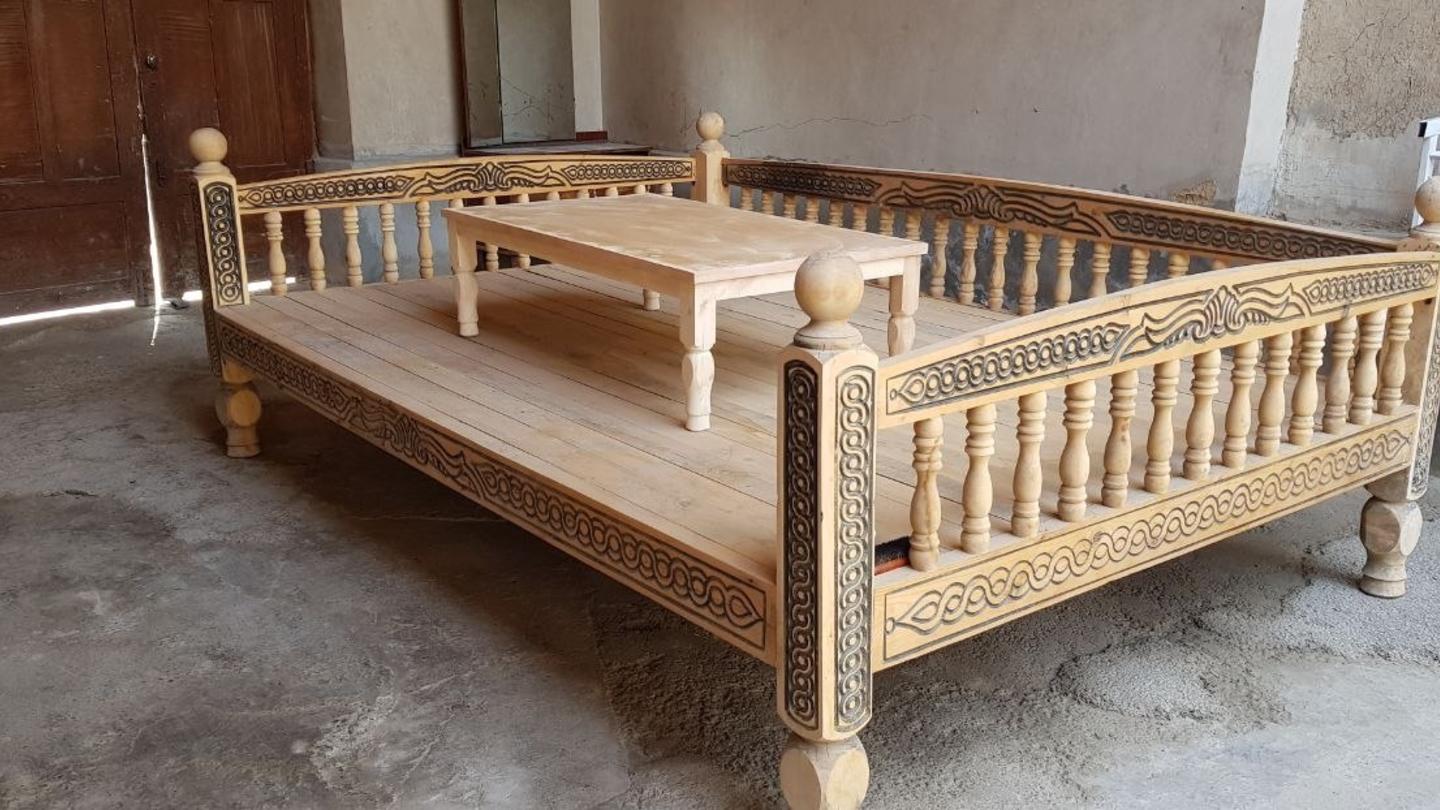


She presented 70 original works, representing years of dedication and accumulated expertise. Tables with traditional carvings, doors decorated with geometric patterns, and furniture that combined functionality with artistic design. Each piece reflected her unique style — precise lines, deep carvings, and respect for national ornamentation.
The exhibition brought not only recognition but also new opportunities. Sohiba received her first major orders, established professional connections, and joined the national artisans’ association. Membership gave her access to exhibitions, government support programs, concessional loans, and training opportunities.
This marked an important transition — from an informal artisan to a recognized entrepreneur.
Scaling Up: From Small Crafts to Furniture Production

Photo: UNDP Uzbekistan / Rimma Mukhtarova
As demand grew, so did the scale of her work. Sohiba moved from decorative items to larger pieces - tables, beds, carved doors, and built-in wardrobes with traditional patterns.
She learned to purchase materials independently, evaluate the quality of wood, negotiate with suppliers and clients, and manage budgets and production timelines.
Yet something was still missing.
She had skills. She had orders. She had clients.
But the business lacked structure. There was no financial planning, no growth strategy, and no systematic management. Everything relied on intuition and experience rather than structured business planning.
Transformation: From Artisan to Entrepreneur
In 2025, Sohiba participated in the Women Entrepreneurship Support Programme (WESP) - an initiative designed to strengthen the business and leadership skills of women entrepreneurs. The programme is implemented by Hamroh in partnership with the United Nations Development Programme (UNDP) and the Ministry of Economy and Finance of Uzbekistan.
The programme targets women who already run businesses but need stronger management skills, strategic thinking, and access to modern business tools.
The five-week programme included modules on business planning, marketing, financial management, strategic development, and leadership.
"I always knew how to work with my hands. But through the programme, I learned how to manage a business," Sohiba says.
The training helped her develop a systematic understanding of business — from financial accounting and production planning to pricing strategies and client management.
Equally important was the community she became part of. Interaction with other women entrepreneurs, exchange of experiences, and peer support strengthened both her professional network and her confidence.
Creating Jobs: From Student to Mentor
Today, Sohiba’s workshop employs 15 apprentices, mostly women and young people, many of whom had never worked with tools before.
"When a woman holds a tool for the first time and realizes she can do it, you can see confidence appear in her eyes. It is not just a skill — it is the realization of her own strength."
Training in her workshop provides full immersion into the profession. Apprentices learn to work with different types of wood, study traditional Uzbek carving techniques, develop their own designs, operate modern tools, and participate in real production orders.
Many of her former students have already opened their own small workshops or found employment in larger furniture production companies. Sohiba does not fear competition — she believes the market is large enough for everyone.

Photo: UNDP Uzbekistan / Rimma Mukhtarova
Looking Ahead: From Workshop to Craft School
Sohiba is not stopping here. Her products already combine traditional wood carving with modern market demands. She is working to expand exports to neighboring countries, demonstrating that cultural heritage can become a sustainable source of income and economic growth.
Her long-term goal is to open a craft school where young people and women — including those from socially vulnerable families — can learn a profession, gain financial independence, and preserve traditional techniques for future generations.
"I want that in ten years there will be not five, but fifty women wood-carvers in our region. Woodworking should stop being considered a ‘man's job’ and simply become a craft for anyone who has the skill and passion."
Today, Sohiba Kayumova is more than a master woodworker. She is a leader, mentor, employer, and role model for hundreds of women who see in her story proof that traditions do not limit us — they can inspire us, when there is courage and support to follow one’s own path.
Her journey demonstrates how personal initiative, institutional support, and an enabling environment for entrepreneurship can generate sustainable economic and social impact.
This story was prepared within the framework of the Women Entrepreneurship Support Programme (WESP), implemented by Hamroh in partnership with the United Nations Development Programme (UNDP) and the Ministry of Economy and Finance of Uzbekistan.