

 Locations
Trust Is Built Face to Face: How Lebanese Youth Are Taking Fact-Checking Into the Streets
February 20, 2026

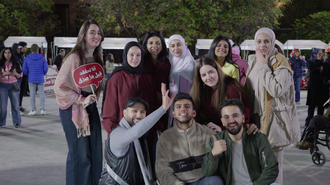
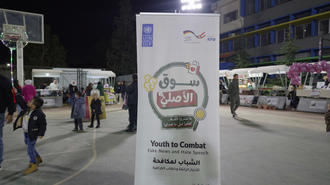
On a busy Sunday morning in Jiyyeh, Chouf, the smell of coffee drifts through a small local market as young volunteers arrange a hand-painted sign: Souq El-Asli—The Authentic Market. Instead of produce, they offer conversation.
Residents are invited to sort headlines into “true,” “misleading,” or “false.”
One man laughs, then pauses. “We share things so fast,” he says. “We forget to ask who wrote them.”
For the youth leading the activity, that pause is the point.
Why Media Literacy Had to Go Offline
After months of training in fact-checking and ethical reporting, participants reached a shared realization: misinformation spreads online—but trust rarely does.
“Digital tools alone can’t rebuild confidence,” one participant explained. “Trust is built face to face.”
So they took media literacy out of workshops—and into the street.
"Reality on the ground is not what we see on social media. Human interaction is simpler and more genuine".Amal Nasrallah, participant
Turning Markets into Civic Spaces
Under a UNDP initiative implemented with the Dawaer Foundation and supported by the German Government through KfW Development Bank, youth designed Souq El-Asli—an offline campaign bringing fact-checking into everyday public spaces.
Across seven regions of Lebanon, the markets reached over 3,000 local actors.
“Designing and implementing the campaign from scratch was a very special experience,” said Zeinab Hussein. “It was the first time I worked on a real campaign like this.”
People did not arrive expecting a lesson. They stayed because the conversations felt familiar.
“When it happens in a place you already trust,” one youth organizer said, “you listen differently.”
Crossing Divides Screens Reinforce
For many participants, the markets were as transformative as the training itself. Youth travelled to regions they had never visited, working with communities they previously knew only through social media.
“Online, differences feel bigger,” said one participant from North Lebanon. “Standing together in the market, they disappeared.”
Ahmad Hallaloo reflected on the sense of unity that emerged.
“Although we came from different areas, during the training and the markets we felt like one family,” he said.
Others described how stereotypes dissolved through proximity.
“Places stopped being points on a map,” said Joyce Horkos. “They became people, names, and stories.”




Dialogue as Prevention
By grounding media literacy in dialogue rather than debate, the initiative showed that countering misinformation is not only about correcting falsehoods—it is about rebuilding trust.
Amal Nasrallah described the experience as revealing.
“Reality on the ground is not what we see on social media,” she said. “Human interaction is simpler and more genuine.”
The approach also generated local demand. Following interest from the Sahel Zahrani local committee, in South Lebanon, a dedicated fact-checking training was organized for 30 local journalists, strengthening community-level verification capacity.
“As much experience as we already have in journalism, this training was essential,” one participant noted. “It updated our tools and reminded us that verification must evolve as misinformation evolves.” (Jana Badran, Journalist, Kawthariyet Siyyad)
Another journalist emphasized the institutional role of local actors: “This training showed us how important municipalities are in supporting accurate information. Local authorities and local journalists are often the closest to the people, so their commitment to credible communication really matters.” (Hisham Hoteit, Journalist, Babliyati media platform)
Additional testimonials shared:
“We realized that misinformation doesn’t only circulate online, it spreads quickly within communities. Strengthening local journalists means protecting social cohesion at its roots.” (Salam Badreddine, Manager of Sahel Zahrani Municipality Federation and Head of Disaster Management Committee in South Governorate)
A Social Response to a Social Challenge
Through youth leadership, offline engagement, and ethical media practices, Souq El-Asli markets offered a clear lesson: misinformation is not only a communications problem.
It is a social one—and trust, rebuilt face to face, remains the strongest counter-narrative.
Related
content
content


