

 Locations
Inside Lebanon’s Crisis Coordination Room
March 19, 2026

Inside Lebanon’s Crisis Coordination Room:
Disaster Risk Management Unit
Following the renewed escalation of hostilities in 2026, Lebanon is facing a rapidly evolving crisis marked by widespread displacement and mounting pressure on communities and services.
To respond effectively, decisions must be coordinated in real time — every hour, every day.
At the Grand Serail, Lebanon’s Disaster Risk Management (DRM) Unit brings together government institutions, responders, and partners in a single coordination space. Screens flicker with live data. Phones ring. Updates come in from across the country. What may look like a response on the ground begins here — in real time.
Established in 2010 under the Presidency of the Council of Ministers, the DRM Unit serves as the country’s national coordination hub, supported by UNDP in strengthening systems for preparedness, coordination, and crisis response.
When the latest escalation unfolded, the National Emergency Operations Room was activated in the early hours of 2 March 2026 — and has been running 24/7 since.
One system, across the country
From Beirut to the most affected areas across the region, the DRM connects institutions at national and local levels into one unified effort — anchoring a nationally led response.
Inside the room, representatives from key ministries and national institutions — including the Ministry of Social Affairs, Ministry of Education and Higher Education, Ministry of Public Health, Ministry of Interior and Municipalities, Civil Defense, the National Council for Scientific Research, and the Lebanese Red Cross — sit side by side with partners, sharing information, aligning priorities, and guiding action.
Beyond it, governorate-level DRM units and municipalities translate these decisions into action on the ground.
Different actors. One response.


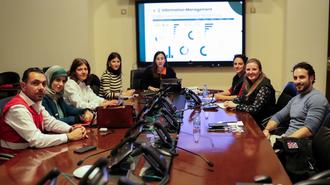


Where information becomes action
Every update matters.
Displacement figures shift by the hour. Shelters fill up. Needs evolve. Through real-time tracking systems, the DRM monitors where pressure is building — and where support must go next.
This is how authorities prioritize, allocate resources, and adjust efforts as needs evolve — helping ensure that assistance is timely, targeted, and effective.
Each data point drives a decision. And behind every decision, people.
Communication for Trust
In parallel, the DRM plays a critical role in public communication — ensuring that information is timely, accurate, and trusted.
Through regular situation updates, real-time dashboards, and verified information on shelters, services, and assistance, it provides a common operational picture for both decision-makers and the public. This helps reduce confusion, counter misinformation, and guide people to the support they need.
By aligning messages across institutions and partners, the DRM ensures that communication is not fragmented — but consistent, clear, and grounded in facts.
In a fast-moving crisis, information is not just support. It shapes decisions, influences behaviour, and ultimately becomes part of the response itself.
Join the DRM WhatsApp Channel. Follow DRM on Instagram & Facebook.
Read more about the Strengthening Disaster Risk Management Capacities Project.


