

 Locations
How a Sumy Oblast community is implementing ideas with help from international partners
Konotop: a city with the strength to return to life
March 24, 2026

Despite war and devastation, modern-day Konotop has inherited a courageous capacity for recovery from previous centuries. The community views the full-scale invasion not just as a trial, but as a challenge, meeting it with resilience, solidarity, and resolve.
In 2022, Konotop was under siege for 40 days. Today, it continues to wake up to the sound of air-raid sirens, but also to the rumbling of morning buses, as life in the city never stops.
More than 80,000 residents live here, alongside several thousand displaced people. Most remember the early months of the invasion vividly, when the city sat on the brink of occupation with its supply routes severed.
Residents recall the blockade as a feverish state of uncertainty met with a stubborn determination to overcome it: “It was terrifying, but we stood our ground.”
The strength of the community and support from international organizations, including the United Nations Development Programme (UNDP) in Ukraine, are helping the city rebuild, create health care and educational spaces, develop youth projects, and build a future.
The community rebuilds
In the spring of 2022, neither medicine, food, nor hygiene products could reach Konotop. Shops with empty shelves resembled scenes from a horror film, and leaving the city or bringing in humanitarian aid was only possible via select routes, and even those were not always available. Locals shared preserves and produce, providing food to families in need.
It was during this trying period that a key transformation occurred within the community: a shift from chaotic volunteer efforts to coordinated project work. Over time, the city identified a need for a dedicated institution to manage reconstruction.

The Recovery and Development Office, opened in October 2024 with support from UNDP and the Government of Sweden, brought together specialists from executive authorities, municipal managers, NGO representatives, and business leaders. In total, nearly 30 people are constantly involved in sourcing development ideas. The office provides a regulatory framework, training programmes, and a physical space, including a conference hall, focus group rooms, equipment, and furniture.
Anastasiia Zahorodnia, Head of the Recovery and Development Department of the Konotop City Council’s Economic Office, and Liudmyla Hapieieva, Head of the Economy Office, report that since its opening, the Recovery and Development Office has attracted over UAH 300 million (~US$6.9 million) for the community and ensured the implementation of 54 projects.
Focus areas for the Konotop Recovery and Development Office include alternative energy (solar stations for critical infrastructure), medical rehabilitation (renovating wards and updating equipment), energy efficiency, water supply, creating safe educational spaces in shelters, and modernizing schools, alongside support for business and civic initiatives. They note that the office’s work is yielding tangible results.

“The office was our first large-scale initiative implemented in cooperation with UNDP, and the second one was the Project Management School. It focused on uniting the public sector and executive authorities, and fostering new partnerships. It is an excellent training programme,” Anastasiia said.
The first cohort of the Project Management School, supported by UNDP and the Government of Denmark, ran from May to August 2025. Participants included both municipal staff and civic activists who worked in teams to solve tasks and develop mini-projects.
Two projects presented by the school’s graduates have already received donor support. Starting in 2026, the school will begin regular enrolments for new students.
The community cares
For three years, a palliative care unit has operated at the Konotop Central District Hospital, where beds are almost never vacant. Patients with severe diagnoses receive round-the-clock care. Until recently, however, medical staff had to move patients on stretchers into old hospital vehicles for transport. This changed when the hospital received a specialized vehicle equipped with a lift and transport equipment.
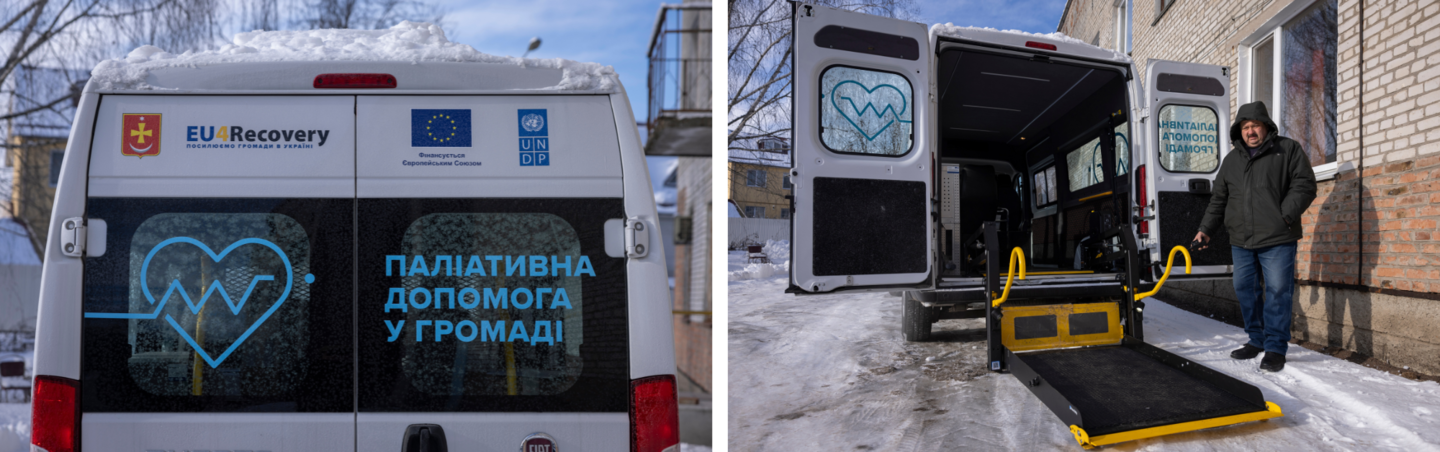
The vehicle was delivered to the community as part of the flagship EU4Recovery partnership between UNDP and the European Union (EU).
Sabina Sakhniuk, the hospital’s head nurse, has worked here for over 30 years and recalls a time before palliative care was established. The hospital has 17 departments and 400 beds, and she describes the creation of a dedicated space for the most critically ill patients as one of the most significant changes.

With the new vehicle, medics can not only bring patients to the inpatient ward but also visit them at home. Previously, the burden of care fell on relatives, who were often forced to leave work, leading to physical and mental exhaustion.
“I am certain that a person should be born and die with good care and in dignified conditions. That is why we created this palliative inpatient unit. It houses patients whose illnesses are no longer treatable, but we are duty-bound to help them, manage their pain, provide care, and ensure good conditions so they can live without physical suffering,” Sabina said.
The community creates
Olha Levchenko is the Head of the Youth and Sports Department at the Konotop City Council. Her focus is on the community’s youth policy. Together with her team, she organizes events, training sessions, concerts, and workshops. She stayed in the city during the siege with her daughter and her mother, who was recovering from surgery. She remembers the period for the coordinated actions of the local government and the population.
“There was fear, but no panic,” she recalled.

This fostered a belief that the community’s youth are not passive; they stay in the community and, more importantly, initiate change. The idea for a media centre in Konotop originated with members of the youth council. The project was eventually supported by UNDP and the Government of the Kingdom of the Netherlands. This led to a dedicated space with lights, backdrops, microphones, and open access for young people.
“Some students film trending videos for social media there, others create content about city events. It is so successful that we see more and more people at youth events, and initiative groups are appearing in schools,” she said.
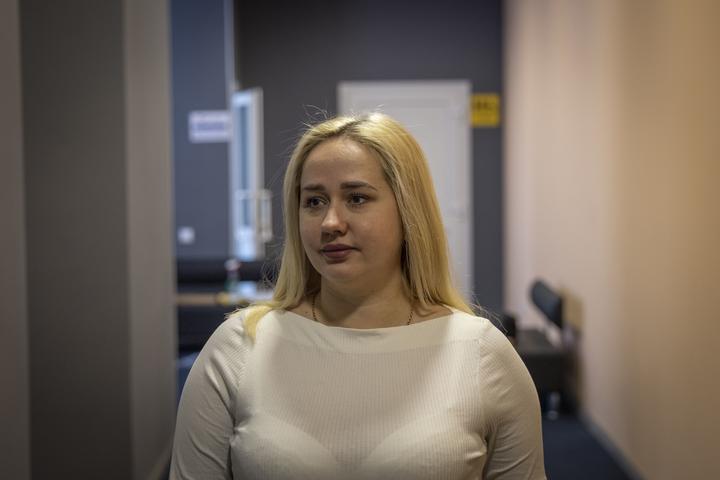
Olha also heads the Community Engagement Working Group in Konotop, which brings together teachers, rescue workers, officials, and business representatives. Created with UNDP assistance, similar groups operate in other communities to help Ukrainians find development and investment solutions during the war.
“UNDP and its partners train the team on how to work with the community and write project proposals. Some of these applications have already won grant competitions for our organizations. We can feel an increase in activity and influence,” Olha shared.
In collective meetings, they address community needs and pool resources for volunteer initiatives, such as assembling supply packages for soldiers at the front, supporting the youth council, and finding partners among businesses.
“I love my city and I want to do something useful for its development. We are also inspired by our youth, although it is a pity that the war forced them to grow up so quickly,” Olha added.
The community unites
In the basement of the Konotop Higher Vocational School, a projector plays a cartoon. At one end of the room, students watch intently; at the other end, different students discuss tomorrow’s test, whispering and sharing things on their phones.
Most present are residents of the local dormitory, some of whom were forced to flee their homes because of the war.

The “Safety Territory” space was created by students for students, so they could spend air raids in an atmosphere of community rather than in darkness and overcrowded conditions. Kateryna Yena, a 19-year-old fourth-year student, is studying what may seem to be a not very “woman-like” speciality — electrical installation and maintenance. She says the idea for the space came to her spontaneously.
“I thought it would be good to have something in the basement. At least a projector. Together with colleagues, we prepared a grant application and the project was supported. When we first turned on the projector, I felt it was all worth it. We can show presentations during classes and watch films during raids in our free time. The most active visitors — students from the dormitory — have noticeably bonded. They have their own little group now because they are always at events together,” Kateryna said.
She knows the Konotop youth scene well and notes a lack of places for young people to gather, which is why “Safety Territory” is so valuable.
Support from UNDP and the Government of the Kingdom of the Netherlands helped equip this dormitory shelter with a multimedia projector, laptop, acoustic system, charging stations, and board games. It serves as both a multifunctional classroom and a psychological hub. During long raids, learning continues alongside art therapy sessions, games, and film screenings.

Tetiana Nahulo, a school’s methodologist, became the space coordinator. She notes that the war has affected the psychological state of the youth population, with many experiencing high anxiety and panic attacks. The 450 students mostly follow a blended learning model: theory is taught remotely, but practical skills cannot be acquired online.
“We are needed here. Our students are needed, too. After victory, reconstruction awaits, and who will rebuild Ukraine? Graduates of institutions exactly like this one,” Tetiana asserted.
The community teaches
A seven-year-old boy focuses on learning how to turn on a computer and type his first emails. In another corner, a teenage girl confidently vacuums a rug, mimicking the movements shown to her by specialists. The local Centre for Comprehensive Rehabilitation for Children and People with Disabilities received modern equipment: a specialized chair for children with musculoskeletal disorders, a sensory board, a laptop, and even a vacuum cleaner. This was part of a new location created through the Konotop community’s participation in a project supported by UNDP and the Government of the Kingdom of the Netherlands.
“It is vital for children with disabilities to have social and domestic skills. To master them, however, they need help from specialists and parents. This is the centre’s task. Our children need more than rehabilitation. They need to live a life as close to ordinary as possible,” social worker Tetiana Trotska explained.
The centre works with children from birth to age 18, currently caring for 150 children and providing lessons that cover tidiness, self-care, table manners, and using appliances. Those are the first steps towards independence.
Specialists note that the equipment has allowed for a new teaching approach. They can now immerse children in real or simulated situations using visual models of behaviour, graphs, and illustrations to create a clear living context.

Parents are pleased that their children can expand their knowledge and skills, and learn something new.
“Our vacuum cleaner doesn’t sit idle now: my child takes it and cleans. He is proud of what he can do,” one of the mothers said.
The room designed here resembles a small model of a home, a place where a child learns to live on their own. In this space, their independence is born.
The community supports
Every Ukrainian community today needs a point of return from the front. In Konotop, this is based at the Territorial Centre for Social Services. In a small hall, a psychological training session for the wives of servicemen is underway. In another office, a specialist advises veterans on paperwork. Some veterans perform exercises with a physical therapist, while others play board games and talk about life.

Every day, the “Unity and Strength” veteran space, created with support from UNDP and the Government of the Kingdom of the Netherlands, is visited by former soldiers returning to civilian life, families of the missing, and families of the fallen. Some come to avoid being alone with their thoughts, and others need answers to specific questions.
It is an inclusive environment helping veterans navigate psychosocial adaptation. It offers legal advice, tips on starting your own business, psychological support from therapists, and opportunities for sports or rehabilitation activities.
The most telling results are the stories of those who were supported here.
One veteran, discharged for health reasons, returned to Konotop to find his wife had removed him from their home registration. Outside, it was -17°C. He sought help at the rail station, and kind passers-by decided to call the veteran space specialist. What followed happened quickly: accompaniment, disability registration, hospitalization, and finding housing. A man who was sleeping on cold benches just a day earlier was given a chance at a new life. The most important thing the space provides for veterans is a sense of solid ground.

Veteran Andrii Lyskov was discharged due to injury. People told him he was starting a new life, but he recalls those first months as the hardest.
“It felt like I was standing between two worlds, and no one was waiting for me in either. Everything changed after I first walked into the veteran space as a client seeking support. Over time, I realized that my story could be a lifeline for someone else,” he explained.
Andrii became a specialist in supporting demobilized personnel. His job is now to meet those who have just returned, helping them navigate documents and explaining where to turn. He understood that veterans needed someone beside them who had walked a similar path.
***
Konotop knows the sound of a Shahed drone all too well. Konotop knows what a high-rise entrance destroyed by shelling looks like. At the same time, the sense that life continues is everywhere: some people have joined volunteer efforts, while others support the home front, organize cultural and youth events, or attract investment. They overcome challenges and constantly learn to change the community, taking responsibility for its future.
This material was prepared as part of the flagship EU4Recovery partnership between UNDP and the EU.
Photo credit: Maksym Kishka / Reporters / UNDP in Ukraine
Related
content
content


