

 Locations
How Learning Transforms a Community: The experience of Khmeliv in Sumy region
April 22, 2026

In 2022, the Khmeliv community in Sumy region experienced occupation: Russian troops reached its territory, and for 10 days the community was effectively blockaded. The Head of the Village Council, Petro Panchenko, says that, fortunately, Russian forces did not have time to commit war crimes against people’s lives or health, although they did damage and loot local shops. All the destruction from that period has since been repaired, he adds, as has the home of a local resident that was damaged in January 2026 when a drone exploded nearby.
During the invasion, around 500 internally displaced persons arrived in the community, including several large families with children. Today, 5,600 people live in the Khmeliv community. And since January 2026, residents have been able to apply for internal and international passports without leaving the community.
That’s the result of one of the projects aimed at improving the quality of life for residents that Khmeliv has implemented with the support of UNDP and the Government of Japan. It all began with a Recovery and Development Plan, drawn up by the community with UNDP’s expert support.
How the Recovery and Development Plan reshaped priorities
Khmeliv’s cooperation with UNDP began in 2023, when it joined a pilot project on local-level recovery and development planning. Natalia Baliura, First Deputy Head of the Village Council, describes the cooperation with UNDP as a stepping stone that helped the community define its recovery priorities.

<em>Natalia Baliura, First Deputy Head of the Village Council</em>
“To keep up with the times, you need to keep learning, attend events and exchange experience,” Baliura says. “When you work and feel that you’re supported, it brings results. UNDP provided us not only with training, but also with support in implementing projects. And when you see results, it motivates you to do even more. Since 2023, we have been learning, writing project proposals, and implementing them.”
As part of its cooperation with UNDP, Khmeliv prepared a Recovery and Development Plan.
“Developing the plan gave a strong impetus to further work,” Baliura explains. “We conducted sociological surveys and learned the views of our residents. Thanks to the plan, we better understood the specifics of our future work. To independently ensure its development on such a scale would have been extremely difficult.”
The “Passport Office”

Setting up a workstation for processing passport documents at the local Administrative Service Centre (ASC) was one of the community’s key projects under the Recovery and Development Plan. In wartime, access to documents has become a matter of security and fundamental rights. The ability to obtain a passport within the community is critically important for older people, large families and internally displaced persons, for whom travelling to district centres can be a serious challenge.
“We now receive calls from other regional centres asking how we managed to do this and who we approached,” says Head of the Village Council Petro Panchenko. “It raises the community’s profile. It’s convenient for our residents: there’s no need to travel elsewhere or stand in queues. You can book an appointment by phone, come at your scheduled time, and submit your documents.”

“Some people apply for passports to travel abroad for medical treatment,” says ASC administrator Oleksandr Sporysh. “Others do it just in case, because if you suddenly need to travel, you cannot get the document in a day. Overall, more internal passports are issued than international ones. The process is not complicated, and the equipment provided by UNDP helps us work quickly.”

Among those who applied for an international passport is Oleksii Ryk, Head of the Land Relations Department of the village council.
“I’m planning a business trip to Moldova on community matters,” Ryk says. “If I hadn’t been able to apply here in Khmeliv, I would have had to travel to nearby Romny and take time off work. I’m glad it can be done locally: it’s close, convenient and without queues. A fellow resident from Kharchenkiv applied for an ID card and said she was very happy that everything could be done within the community.”

Acting Head of the ASC Serhii Karpenko explains that the equipment for the “passport office,” as well as a workstation for issuing driving licences — which is planned to open soon — was provided by UNDP and the Government of Japan.
“This includes two computers, three monitors, two cameras, two printers, a printer for driving licences, devices for fingerprinting and electronic signatures,” Karpenko says. “We currently provide 105 services, and it’s encouraging to see the range of opportunities in the community expanding. Receiving services locally eliminates ‘intermediaries’ and makes the process transparent for all residents.”

Petro Panchenko, Head of the Village Council
Panchenko jokes that he will be the first to come to the ASC to renew his driving licence once the service becomes available, as his current one is worn out.
“Issuing both passports and driving licences are basic services,” Panchenko says. “For us, ‘building back better’ is not just about restoring what was lost, but about creating services that meet European standards – even in a small village.”
A community learning to overcome challenges
After receiving UNDP training in project management, the community began actively seeking opportunities and applying for grants. Since then, it has implemented three projects, with two more underway and ten more in development.
Baliura shows a children’s room set up in the local House of Culture: just a year ago it was a storage space, and now it is a play area for children.
“The community needed a space for children,” Baliura explains. “Around 400 children live here. We carried out renovations, and the ‘Proliska’ humanitarian mission, with support from UNHCR, provided equipment. The shelter in the House of Culture is also equipped with blankets, torches and water containers that were donated.”

Olena Makarets, Director of the House of Culture
With only one playground in the community, this room was much needed, says House of Culture Director Olena Makarets. “It has different types of toys,” she says. “Children need to communicate and socialise. Children from three years old to teenagers come here — we have games consoles and cartoons. We draw, sculpt and dance. Specialists, including psychologists, also visit.”
Panchenko adds that in 2023 the community began working to attract support for large families displaced by the war. Around 30 families have found a new home in Khmeliv, making the development of child-friendly and recreational infrastructure a key priority.

In 2025, the head of the Smilivskyi starosta district, Tetiana Andrushchenko, completed project management training. The project she developed as part of the programme — to equip a sports ground — successfully passed the selection process, received support and is now being implemented.
The Head of the Village Council’s Land Relations Department, Oleksii Ryk, also completed the training. His project — to install solar panels at the lyceum — has been approved, and preparation of the project documentation is currently under way.
“The community is consistently working to strengthen its human capacity and build competencies in project development. Our goal — to involve as many specialists as possible in training and active project design — will enable us to attract additional resources and implement development initiatives effectively. We aim to create conditions in which the Khmeliv community is a comfortable place to live and grow, where residents have the opportunity to build their future right here,” Baliura notes.
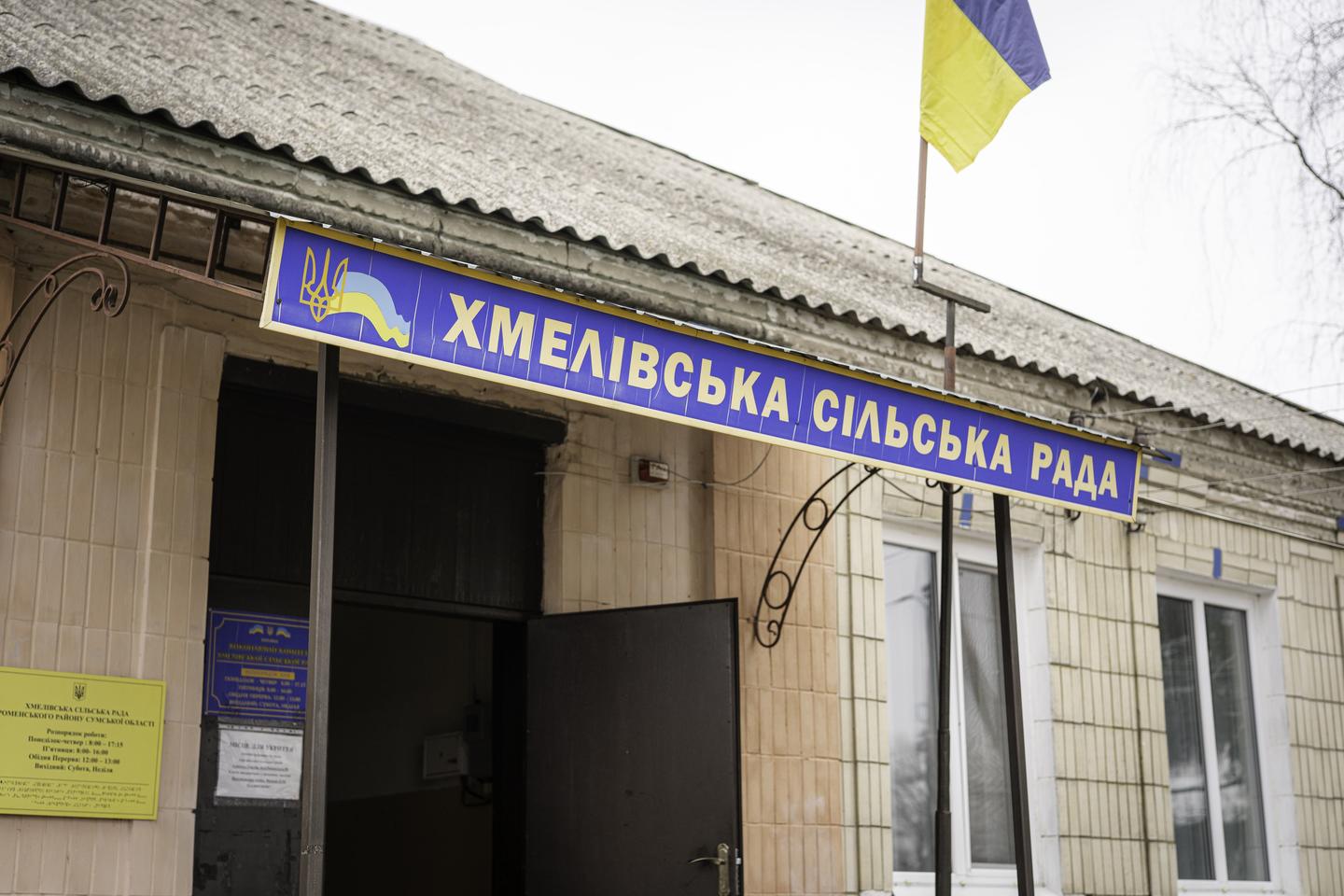
Since 2023, UNDP, with financial support from the Government of Japan, has been providing comprehensive assistance to Ukrainian communities. Initially, 10 pilot territorial communities took part in the project. In 2024, the initiative expanded to include 20 additional communities from across Ukraine.
Within this support framework, the pilot communities have developed strategic planning documents, anti-corruption programmes, and communication strategies; received training in project management; and strengthened their capacities in strategic communications, media literacy and countering disinformation.
UNDP, with funding from Japan, has also supported recovery and development projects in several communities by providing much-needed equipment. As a result, communities have not only strengthened their institutional capacity but have also successfully attracted funding to implement practical initiatives.
Photo credit: Stanislav Pantelei / UNDP in Ukraine
Related
content
content


