

 Locations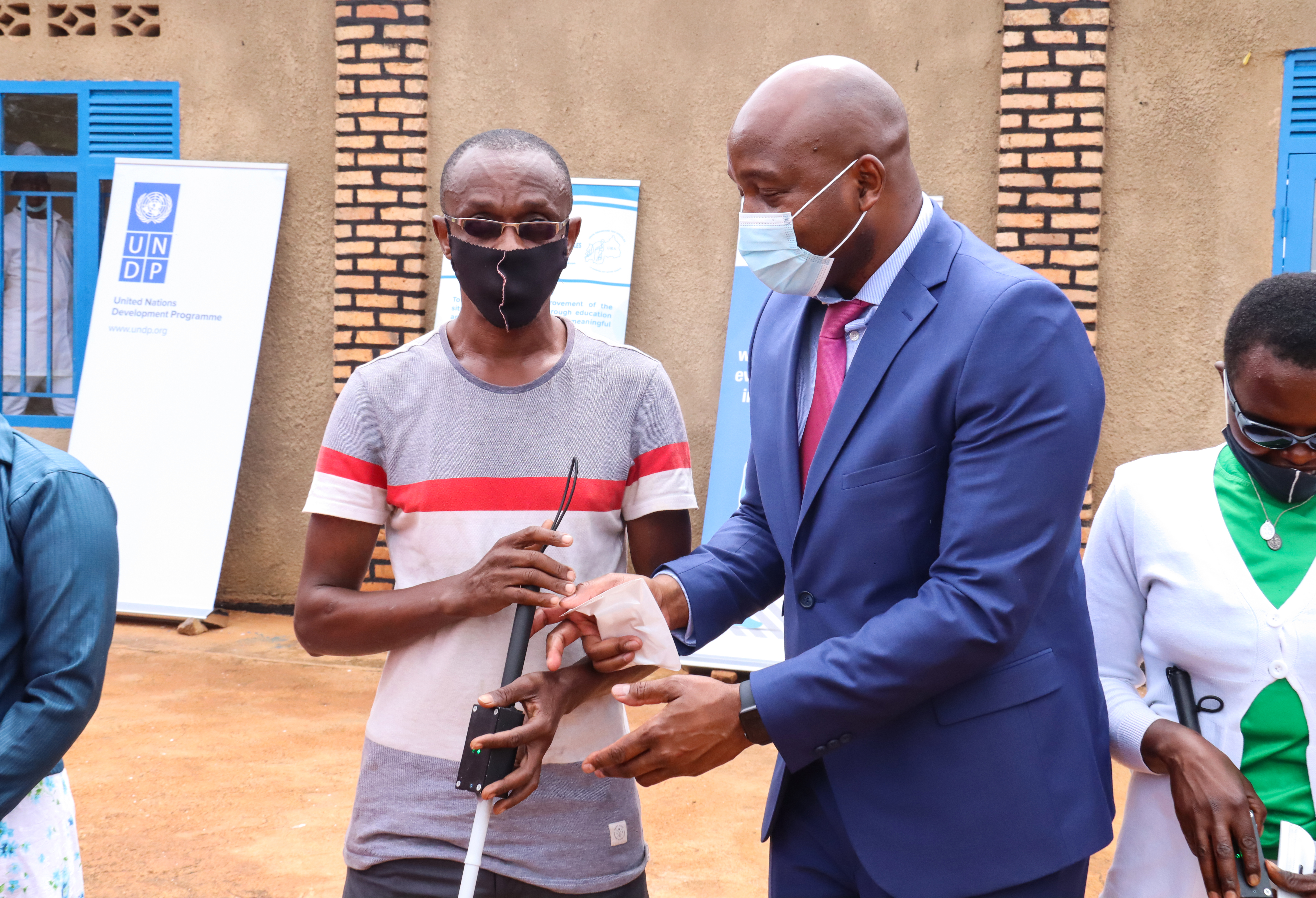
Mr. Maxwell Gomera, the Resident Representative of UNDP in Rwanda handing over a Smart White Cane and its charger to one of the persons with vision impairment
Life is on hold for Rebecca Sumaya. Everyday tasks, such as walking by herself are daunting. But even with a walking cane, she finds getting around difficult, frequently stumbling and sometimes falling into ditches.
Her daughter (Sudgati Umutesi) regularly acts as her guide, but when she is at school, Sumaya must find her way around by herself.
Rebecca’s case is not an isolated one. Persons with visual impairment in Rwanda and across the continent find navigating around places hard.
The possibility of them bumping into obstacles, knocking things over and hurting themselves is real, frustrating and can have frightening consequences.
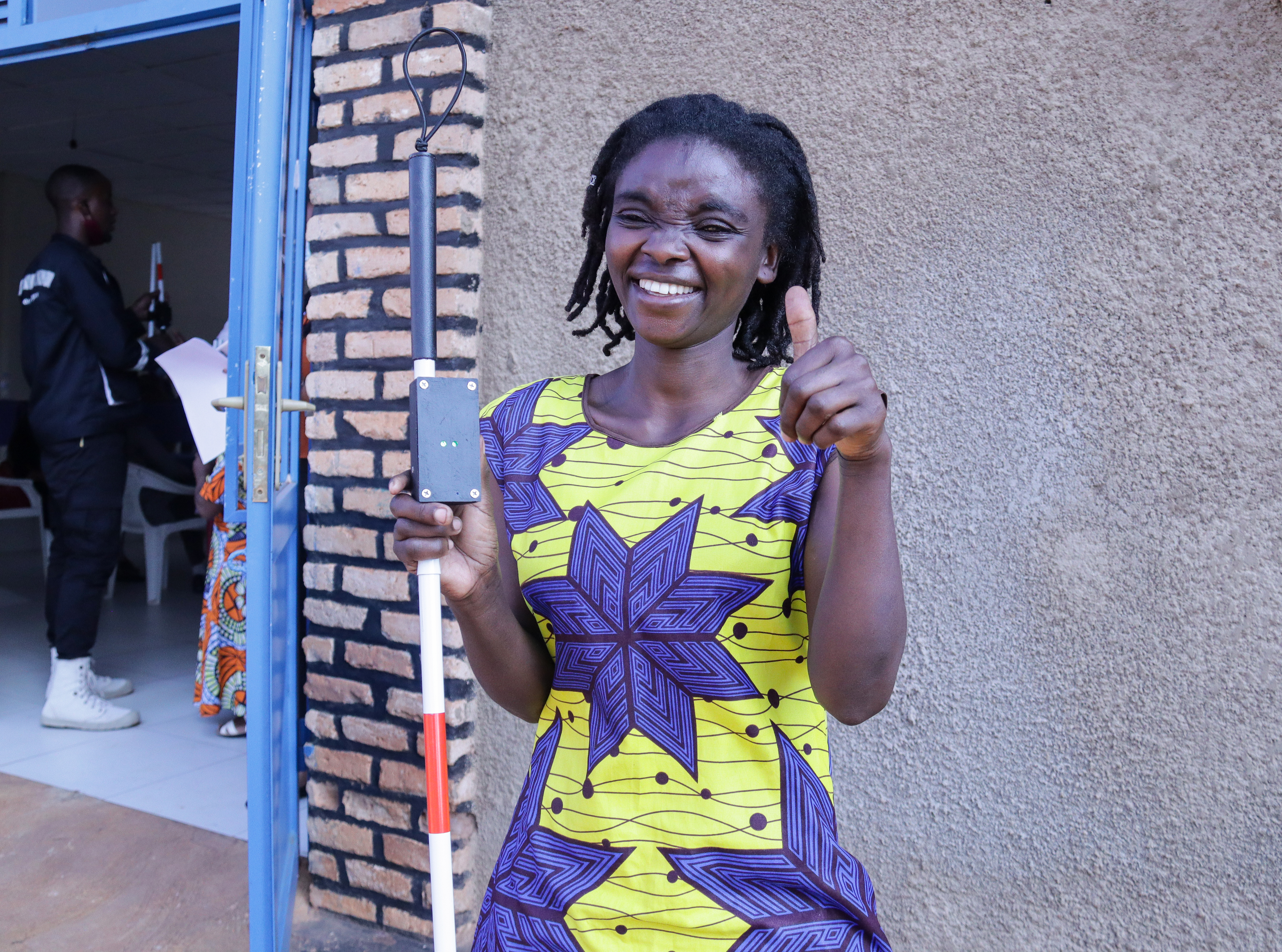
Sumaya Rebecca, used to rely on her daughter to move around. The White Smart Cane has improved her mobility independence
Excellencies, ladies, and gentlemen it feels me with hope, and gives me great pleasure and honor to be here today along with partners and colleagues to engage a purpose that I know is close to our hearts - the empowerment of persons with disabilities in Rwanda.
Form the onset, I would like to express my sincere gratitude to Rwanda Union of the Blind (RUB) for hosting this event and for an effective collaboration with UNDP.
I also want to thank the Ministry of ICT and Innovation, the Ministry of Youth and Culture and Beno holdings for their collaboration and providing an enabling environment.
I am grateful to all of you who positively responded to our invitation.
Excellencies, colleagues, we have all been showing up to solve society’s most critical problems for decades. Building strong and just societies is hard work.
But most especially in the context of this past year and 10 months where COVID-19 has increased vulnerability, we need to shift gears.
It is work that must be done. As we emerge from the pandemic, we can reset how we solve society’s biggest challenges. Today’s event contributes to that reset.
Last year, in partnership with HVP Gatagara (an institute that hosts people with disability), Liquid Telecom (a private broadband company) and One UN, UNDP provided 11 Smart Boards and broadband access to three HVP Gatagara schools serving a total of 1,366 students, including 494 students with disabilities.
This initiative is transforming the learning experience for the students, making it easier and more friendly, and widening their learning spectrum.
Today, together with the Government of Rwanda and in partnership with Rwanda Union of the Blind (RUB) and Beno Holdings, we are launching a Smart White Cane (SWC) which is expected to transform the lives of the visually impaired by increasing their mobility independence.
This should also boost their confidence, dignity, and enable them to expand their social and economic activities.
The new high-tech white cane is the first of its kind to be made in Rwanda.
It uses ultrasonic ranging technology to detect obstacles in 1.2 meters and alert the user through vibrations and sound.
It has sensors, which can help the user to differentiate day and night.
The GPS functionality is to identify the geographic location of the user. This feature also facilitates to track the smart white cane in case it is lost.
It has reflectors that inform other road users that the cane user needs special assistance.
There are more than 650 million people in the world with some sort of disability and this number increases as the population ages. Until now, many of them have lived their lives depending on others.
In Rwanda, according to the Fourth Rwanda Population and Housing Census (2012) there are 446,453 persons living with disabilities out of which 57,213 are persons with visual impairment.
This equates to just under 5% of the population over and this number could be more now.
Ladies and gentlemen, it is for Rebecca’s and many of those living with visual impairment challenges that UNDP through its Accelerator Lab sought to leverage technology to ease movement for the visually impaired.
Persons with disabilities do not only need our compassion but our actions, to positively contribute to their wellbeing and development.
For the UN and UNDP, the inclusion of people with disability is central to the promise of the 2030 Agenda on Sustainable Development. If we are to “Leave No-one Behind”, let us start by empowering people with disabilities, promoting their rights and improving their living conditions
We should not rest until there is change, at scale. Here and everywhere.
Over the past few years, we have been proud of our partnerships with organizations that empower persons with disabilities.
I wish to congratulate all our partners for the outstanding work they have done to improve the lives of persons with disabilities. We are proud of the results we have seen. However, challenges remain.
So today, I will leave you with one challenge to reflect on:
What could we accomplish if together we invested in all of our brain power?
Through this initiative UNDP wanted to first test if the technology can solve the challenge.
The Smart stick we launched today is a pilot project. We now want to engage our partners to bring down the cost of producing the smart cane – and to take it to scale
Rebecca is 29. She is very young and has a whole life ahead of her.
If we can make a small difference in her life, we would have enriched humanity. PLEASE take a stand today for Sumaya and people like her.


