Locations
When Development Listens, Partners, and Delivers: Clean Water Comes to Karakalpakstan's Remote Communities
February 25, 2026

The artesian well in front of School №23 in Kostruba, drilled in the 1970s, where the new water station will be built.
The road to Kostruba community doesn't exist yet, at least not as an established one. To reach this community in Takhtakupir district, you travel to where Karakalpakstan's northern edge meets the Kazakhstan border, then continue until the landscape becomes a patchwork of sandy paths connecting scattered homesteads. Here, 280 kilometers from Nukus city, residents have learned to adapt to what they have: no paved roads connecting homes to the district center, no mobile phone signals, and most critically, no access to clean drinking water.

Map showing the 280-kilometer route from Nukus city to Kostruba, a community bordering Kazakhstan
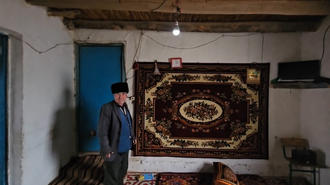
Alauatdin Serkebaev sits on a bench outside his home, where he has been sitting for the past twenty-four years, watching the dust rise from the Kyzylkum Desert and settle over everything. His hand rests on his abdomen, where surgeons removed his pancreas in 2019. He served as head of the Kostruba community for those twenty-four years. His wife, Bagdash, is now preparing for the same surgery. His younger brother, Berdimurat, lives near the school at the edge of the settlement. Berdimurat recently underwent pancreatic surgery as well. Three members of one family. The same organ. The same community. The same water.
"The underground water level has dropped over the years," Alauatdin says. "The salinity keeps rising. People here have kidney stones. Liver stones. We have been drinking this water our whole lives because there is no alternative."
Studies on health in the Aral Sea region consistently document elevated rates of kidney, liver, and biliary disease linked to decades of consuming highly mineralized and contaminated water. Pancreatic conditions, often triggered by gallstones, follow the same pattern.
When the UNDP team arrived in Kostruba to conduct a Community Development Plan workshop, they gathered residents at School No. 23, the only building in the community with Wi-Fi, and the only place where a signal connects the community to the outside world. There, they asked a question that had not previously been part of community discussions: What does this community need most? The responses came clearly and in a deliberate order. First, drinking water. Second, solar capacity. Third, mobile connectivity. And fourth, roads.


"We have an artesian well in front of School that was drilled back in the 1970s," explained Temirbek Tolegenov, head of the village council of citizens. " We've been drawing water from that well, but without proper filtration systems, it's not safe to drink."
That well represents both Kostruba's challenge and its opportunity, existing infrastructure that, with proper investment, can serve the community for decades to come.
Walk through Kostruba today and you'll find photovoltaic panels installed under UNDP's "Clean Energy for Rural Communities in Karakalpakstan" project over two decades ago, still generating electricity. These solar systems from 2003 to 2007 continue powering lights and televisions in several households, requiring only battery replacements around the ten-year mark.
"The first priority is to bring safe water close to people's homes, the second challenge remains solar energy. If we could upgrade current solar capacity, it would significantly improve daily life and open new opportunities for everyone", says Alauatdin.


Kostruba is not alone in this story. The "Enhancing Resilience of Remote Communities in Aral Sea Regions of Uzbekistan" project, funded by the generous support of the Coca-Cola Foundation and implemented by UNDP, addresses water challenges across three remote communities. In Kostruba, the project is constructing a new water station that will serve 27 households with a daily capacity of 24,000 liters. A ten-member initiative group, including Asylzat Zhametova, has been established to monitor the construction and ensure the system functions for decades to come. In Community Karabayli, where 101 households and 496 people struggle with deteriorating infrastructure, the project is rehabilitating existing water systems. In Community Daukara, rehabilitation work will reach 502 households and 2,503 people. Both Karabayli and Daukara have also expressed strong interest in water-saving agricultural technologies, particularly hotbeds with drip irrigation systems for backyard vegetable production. Similar initiative groups have been established in both communities to oversee rehabilitation work and long-term maintenance.
"My children will drink this water. My grandchildren will drink this water. We saw how those solar panels from 2003 still work today because people taking care of them. We will do the same with this drinking water station. Make sure it serves Kostruba for the next generations", says Ms. Asylzat Zhametova, a mathematics teacher at School, a member of the initiative group.
The road to Kostruba does not appear on maps yet. But Alauatdin Serkebaev is still here, in the community he led for twenty-four years, in the house where he recovered from surgery, waiting for the pump to be installed above a well that has held clean water underground since the 1970s. He knows what water does to a body when it is wrong. He is waiting to find out what it does when it is right.


Background: Since 2011, UNDP and the Coca-Cola Foundation have maintained a longstanding partnership supporting vulnerable communities across Uzbekistan. In Karakalpakstan, this partnership has consistently focused on the region's most pressing challenges — including during the COVID-19 pandemic, when the Coca-Cola Foundation provided $200,000 to procure life-saving ventilators for the republic's health system. In 2022, the Foundation invested $150,000 in clean drinking water infrastructure across three communities: a water supply network was constructed in Hilol settlement, Urgench district (Khorezm region); desalination equipment was installed in Maily Balta settlement, Kosterek VCC, Chimboy district; and existing water desalination systems were upgraded in Shogirkol settlement, Atakol VCC, Takhtakupir district. The current project, "Enhancing Resilience of Remote Communities in Aral Sea Regions of Uzbekistan", extends this commitment by rehabilitating and constructing water infrastructure across three of Karakalpakstan's most remote communities: Kostruba, Karabayli, and Daukara.
***
Contact for additional information:
- Alisher Utemisov, UNDP Programme Manager in Aral Sea Region, alisher.utemisov@undp.org
- Gulnur Kaypnazarova, Public Relations Associate, gulnur.kaypnazarova@undp.org