

 Locations
UNDP-backed community forum discusses how to protect people from climate-driven disasters
Georgian municipalities join national efforts to reduce climate threats
December 20, 2019
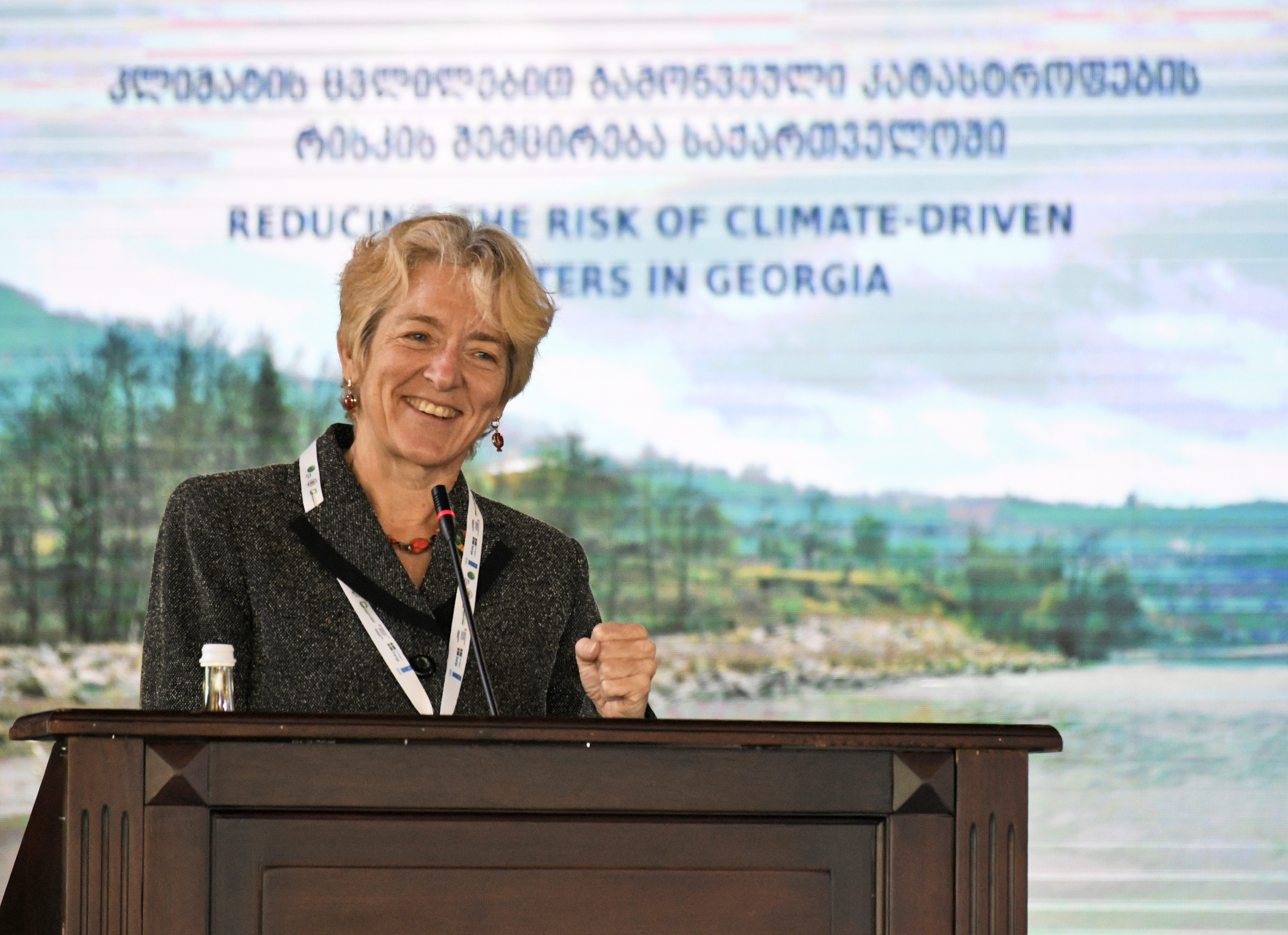
Photo: Vladimir Valishvili/UNDP
Representatives of 13 Georgian municipalities facing a high risk of flooding and other climate-driven disasters met in Kachreti on 19-20 December 2019 to discuss the threats they face and the potential solutions at a community forum organised by the United Nations Development Programme (UNDP) in partnership with the Environmental Information & Education Centre of Georgia’s Ministry of Environmental Protection and Agriculture (MEPA).
The community forum was the first of its kind under a new USD 74 million programme implemented by UNDP and MEPA with funding from the Green Climate Fund (GCF), the Government of Georgia and the Swiss and Swedish development agencies. This seven-year programme aims to reduce the risk of floods and other climate-driven disasters in all 11 of Georgia’s major river basins, provide direct protection to more than 1.7 million people and assist the country in building a climate-proof future.
“Engagement of local municipalities is the key to achieving success under this unprecedented national programme,” said Deputy Minister of Environmental Protection and Agriculture Solomon Pavliashvili. “Countering our common challenge of climate change requires a combination of measures built around systemic policy approaches and active involvement of the society.”
“People tend to assume that someone else far away in the capital is responsible for protecting them from natural disasters,” said UNDP Head Louisa Vinton. “The engagement of the responsible national authorities is crucial, but local communities also have a key role to play in prevention and response.”
Participants in the forum were briefed on programme components, which include sophisticated satellite-based river basin mapping to identify the locations at highest risk of natural disasters; the modernization and re-equipping of the country’s hydrometeorological forecasting and observation system; the creation of a nationwide early warning system; community-level awareness-raising and education; and investments in protective infrastructure and other nature-based structural measures.
The 13 municipalities attending – Lagodekhi, Signagi, Akhmeta, Gori, Telavi, Abasha, Senaki, Samtredia, Khobi, Kobuleti, Ozurgeti, Lanchkhuti and Chokhatauri – have already been identified as high-risk areas and will be among the first to receive direct support from the programme in designing and constructing disaster-prevention infrastructure. Ultimately 100 municipalities will receive support.
The importance of communication, cooperation and coordination among the many different government agencies with responsibility for disasters was another focus of the discussions. Among the entities represented at the forum were the National Environmental Agency under MEPA; the National Security Council; the Emergency Management Service under the Ministry of Internal Affairs; and the Roads Department of the Ministry for Regional Development and Infrastructure.
The municipalities were represented not only by local government officials but also activists from community and non-governmental organizations and university and other educational personnel. The discussions showed that disaster risk is a topic of deep and immediate concern for local communities, and that the need to build climate resilience is recognized as an urgent priority for Georgia.
Media contacts
- Sophie Tchitchinadze, UNDP, +995 599 196907, sophie.tchitchinadze@undp.org
- Ira Sulava, UNDP, +995 599 579105, irine.sulava@undp.org
- Nana Chinchilakashvili, Ministry of Environmental Protection and Agriculture, +995 599 502619, nana.chinchilakashvili@mepa.gov.ge
Related Content


