

 Locations
UNDP and CAITEC Co-host Forum on Empowering the Global South for Strengthened Sustainable Modernization
December 18, 2025
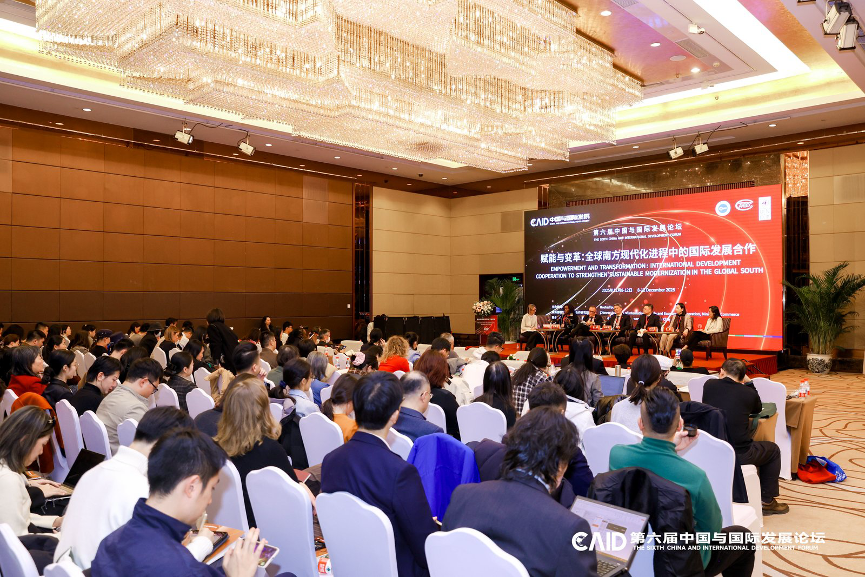
The Sixth Forum on China and International Development, themed “Empowerment and Transformation: International Development Cooperation to Strengthen Sustainable Modernization in the Global South,” officially concluded in Beijing.
Beijing, December 18, 2025 – The Sixth Forum on China and International Development, themed “Empowerment and Transformation: International Development Cooperation to Strengthen Sustainable Modernization in the Global South,” officially concluded last week in Beijing.
Co-hosted by the United Nations Development Programme (UNDP) in China and the Chinese Academy of International Trade and Economic Cooperation under the Ministry of Commerce of China (CAITEC/MOFCOM), the Plenary Forum convened representatives from the government, diplomatic community, international and social organizations, as well as research institutes and the private sector. Participants engaged in in-depth discussions on how empowerment-oriented international development cooperation can better support countries in the Global South in advancing sustainable modernisation pathways aligned with national priorities and the 2030 Agenda for Sustainable Development, amid a rapidly evolving global environment.

Since UNDP China first co-hosted the CAID Forum with CAITEC/MOFCOM in 2022, the Forum has evolved into one of the key annual events in China’s international development cooperation sector. At this year's Forum, the two institutions further solidified their collaboration by renewing a new “Statement of Intent (2026-2030),” which will provide a framework for their ongoing partnership to facilitate knowledge generation and exchange events on international development cooperation for the SDGs.

“There is an urgent need to explore innovative financing solutions, such as blended finance mechanisms, that can help unlock long-term, affordable lending,” said Beate Trankmann, UNDP Resident Representative in China, in her welcome remarks. “By combining technical expertise with more diversified financing flows, international partners can leverage these approaches to better support developing countries in advancing their own structural transformations.”

“Countries in the Global South are currently at a critical juncture as they explore modernisation pathways aligned with their national contexts,” said Wang Xuekun, President of CAITEC. “China’s proposals for the 15th Five-Year Plan underscore support for greater solidarity and collective self-reliance among the Global South, including expanded development assistance and the provision of more international public goods.”
During the guest remarks session, UN Under-Secretary-General for Economic and Social Affairs Li Junhua, Member of the National Committee of the CPPCC Qian Keming, Deputy Director General of the Department of Outward Investment and Economic Cooperation, MOFCOM, Qian Chunying, Director-General of the Global Development Promotion Center Tang Ying, Ambassador of Somalia to China H.E. Hodan Osman Abdi, also delivered speeches. They provided valuable insights from various perspectives on enhancing partnerships and expanding collaborations to advance the SDGs, as well as opportunities for deepening China’s IDC reforms.
During the keynote speech session, speakers examined the evolving landscape of international development cooperation with a focus on reform, innovation, and partnership. The exchanges addressed broad strategic themes, including empowerment-oriented cooperation, knowledge generation, and impact assessment, highlighting pathways to strengthen country capacities, enhance the effectiveness of development assistance, and deepen cooperation between China and partner countries in support of the SDGs.
The Forum further advanced in-depth exchanges through two thematic roundtable discussions. Roundtable I examined how empowerment-oriented development cooperation can support Global South countries in their sustainable development transitions, discussing opportunities and constraints while exploring diverse financing approaches, strengthening country ownership, and enhancing development impact through innovative partnerships beyond traditional aid modalities. Roundtable II focused on the role of knowledge generation and evidence-based approaches in enhancing country capacity and delivering context-specific development solutions in the Global South, emphasizing the need for robust assessment frameworks to evaluate the long-term impacts of international development cooperation on governance capacity, innovation systems, and entrepreneurial ecosystems.
The insights and policy recommendations generated through these discussions will be consolidated by CAITEC to inform future reform measures, policy development, and implementation strategies, contributing to impactful decision-making at both policy and programmatic levels.
Related
content
content


