

 Locations
A Ukrainian furniture company has reduced losses and accelerated production with support from UNDP and the Government of Sweden.
Systemic Changes That Work: Lviv-based family business increases profits by 30%
January 29, 2026

Photo: VITIUK FURNITURE
VITIUK FURNITURE is a Lviv-based family business with a history spanning more than 25 years, specialising in the production of custom cabinet furniture. Over the years, the team has struggled with common production hurdles: materials were lost, hours were wasted searching for tools, equipment sat idle, and workers spent energy correcting recurring errors. The impetus for change came from a simple realisation: production processes were not working systematically, the space was disorganised, and a lack of instructions and material accounting led to constant failures.
The team realised that it would be impossible to overcome these challenges without a systematic approach. "To put it very modestly: the best solution was to attend training and immediately apply the principles of lean production in practice," says Oksana Tsymbala-Vitiuk, the head of VITIUK FURNITURE.

Oksana Tsymbala-Vitiuk is presenting her business development plan. Photo: Serhii Perepelytsia / UNDP in Ukraine.
A new production philosophy
To address these issues, the company chose the training programme “Lean Production for Exporters” at the Smart People Business School, organised with the support of UNDP and funding from the Government of Sweden. Even the initial analysis demonstrated that a significant portion of the problems was related to material loss, equipment downtime, and human error. Instead of putting up with the chaos, the team decided to change their production philosophy.
During the training, employees began to apply lean production tools – from the “5S” method to the “5 Whys” analysis and value stream mapping. They organised the workspace according to the five basic principles of waste-free production: Sort, Set in Order, Shine, Standardise, and Sustain.
Then, the company identified the root causes of their problems by repeatedly asking "Why?" and visualised all the steps in their processes – from the initial customer request to order fulfilment.
“Thanks to this, we saw the real causes of our failures and were able to build a new working logic,” Tsymbala-Vitiuk says. “We gradually changed the production space: tools were given dedicated places, leftover materials were accounted for and classified, and work areas received clear rules for organisation and maintenance.”
A one-third increase in profits
The changes were first piloted in the cutting and edging area, where materials for furniture production are processed. Within a week, the team saw that the new storage and labelling system, combined with standardised instructions, had reduced the time spent searching for materials and setting up equipment.
Success made it possible to extend the update to the entire cutting and gluing process – specifically, for the manufacturing of wooden parts, machine-cutting graphic images, and applying surface films. Previously, these areas suffered from the clutter of waste, and constant errors.

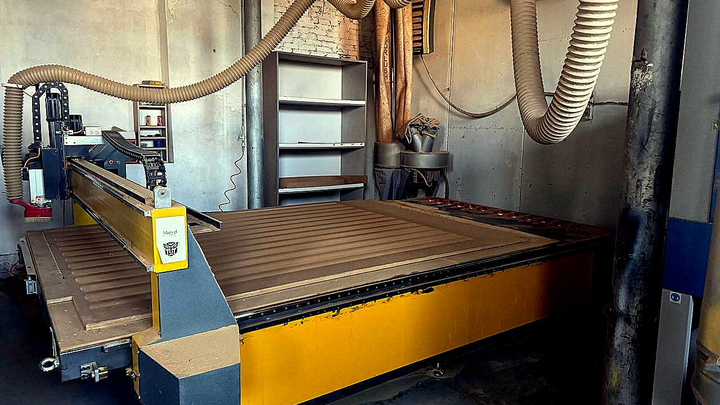
Photo: VITIUK FURNITURE
The results were immediate: time savings of 20%, a 15% reduction in waste, and a 10% decrease in defects. Errors have decreased by almost a quarter because standardisation and clear instructions have made the processes predictable. This also improved the company's bottom line: monthly profits increased by 30%. The pace of order fulfilment also improved, dropping from 20 days to 15 days. The company can now process a third more orders per month – without having increased its workload.
A systematic approach cuts losses
These changes have turned production into a predictable and stable system, Tsymbala-Vitiuk concludes.

Certificate award ceremony following the successful completion of the "Lean Production for Exporters" training programme. Photo: Serhii Perepelytsia / UNDP in Ukraine
“Now, the workday begins with the preparation of a workspace where every tool and material is clearly marked,” she says. “Thanks to this systematic approach, equipment runs smoothly, and the loss of time and resources is minimised, making production more sustainable.”
“I’m grateful to Smart People Business School for the excellent organisation and for creating the conditions to improve our production! We’re also grateful to the Government of Sweden and UNDP for the opportunity to access high-quality education among those who are passionate about their work!”
This story was prepared within as part of the “Enhanced Partnership for Sustainable Recovery (EPSR)” project, which is funded by the Swedish government through the Swedish International Development Cooperation Agency (SIDA) and implemented by UNDP in Ukraine.
Related
content
content


