

 Locations
Two new studies reveal how blind people in Ukraine use assistive technologies, and highlight best practices from the EU for regulating web accessibility. One key recommendation is to extend digital accessibility requirements to the private sector.
How to develop digital accessibility in Ukraine: Digital Transformation Ministry presents results of study
December 14, 2023
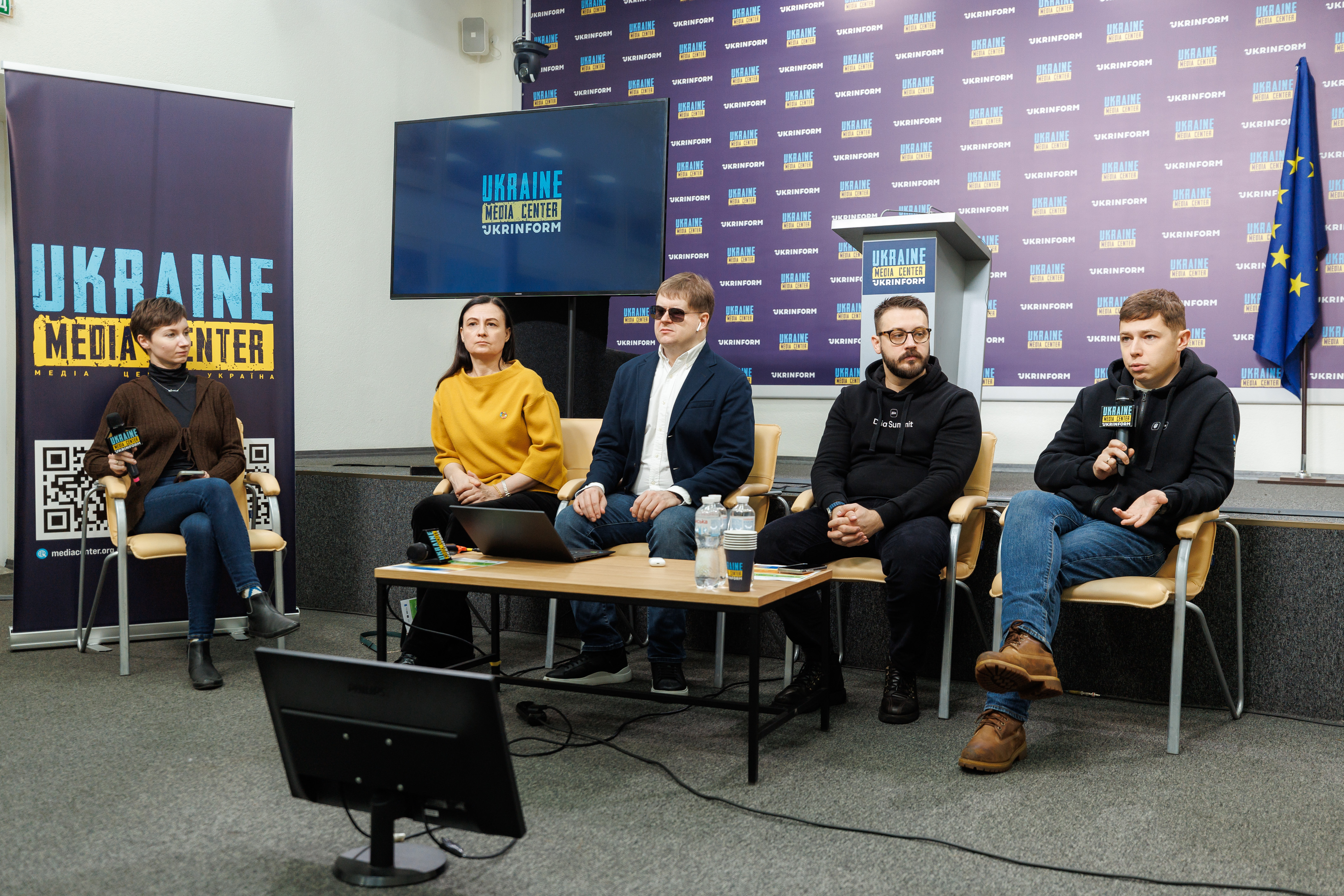
Photo: Andrii Krepkykh / UNDP in Ukraine
Kyiv, 14 December 2023 – Ukraine’s Ministry of Digital Transformation presented today in Kyiv the results of two studies carried out with the support of partners that will help to more effectively develop the digital accessibility of electronic resources.
- “Digital Accessibility Legislation, European Best Practices” analyses how web accessibility is regulated in the European Union, as well as in five European countries: the United Kingdom, Denmark, Germany, France and Sweden. The report reveals how the system of state regulation of web accessibility is built in these states, and what their legal requirements, responsible bodies and powers are;
- “Use of assistive technologies by people with disabilities” studied how people with disabilities (primarily the visually impaired) in Ukraine use assistive technologies, what problems they face, and what needs they have. The study also reviewed the available text-to-speech technologies that support the Ukrainian language.
Mstyslav Banik, the head of the Digital Services Development at the Ministry of Digital Transformation of Ukraine, noted that as a result of the war, more and more people are partially or completely losing their hearing and sight.
“Active hostilities, explosions – all this affects the health of our defenders and civilians. It is important to ensure that digital services are accessible to them. Therefore, the Ministry of Digital Transformation pays considerable attention to increasing the accessibility of state digital resources in the country, so that all citizens can use them without barriers,” Banik said. “This research offers important insights into determining in which directions we should move further in order to more comprehensively promote digital web accessibility in the state. Digital accessibility should also be increased in the private sector as well, so that people have unhindered access to all electronic products in the country.”
Tetiana Lomakina, Advisor and Presidential Commissioner for a Barrier-Free Environment, said that digital accessibility is a key direction for building a truly barrier-free society in the country.
“The war proved how important electronic services are – services that enable people to get the help they need from the state quickly and safely,” Lomakina said. “That is why it is critically important to ensure that all Ukrainians have access to such digital services, no matter what impairments – permanent or temporary – they might have. So it’s important that not only the state, but also the private sector takes measures to increase the digital accessibility of their electronic products.”
Both studies contain recommendations as to which European practices in digital accessibility should be implemented in Ukraine, and in which areas it is advisable to develop auxiliary digital technologies. One recommendation based on European best practices is to develop a draft law on digital accessibility that would cover both public digital services and digital services from private companies. In particular, such services include transport, digital communication, audio-visual media, banking and e-commerce services.
In recent years, the Ministry of Digital Transformation, with the support of the United Nations Development Programme (UNDP) in Ukraine and Sweden, has carried out a number of important legislative initiatives, noted Volodymyr Brusilovskyi, manager of UNDP’s DIA Support project, which supports digitalization in Ukraine. The goal of the new legislation is to lay the foundations for improving the situation with web accessibility in the public sector.
“A web-accessible product is one that can be used by people with temporary or permanent impairments – vision, hearing or cognitive – primarily those people who use smartphones and computers with assistive technologies, including people who have been injured and traumatized by the war,” Brusilovskyi said.
“To do this, developers must keep in mind a range of user groups, and make sure to meet web accessibility requirements. This is especially important now, during the rapid development of digitalization, because we mustn’t leave part of the population without access to digital products by making these services inaccessible.”
“At the same time, web accessibility should become a universal norm, not a luxury, and not only in the public sector, but also in the private sector. These joint efforts will help ensure there is comprehensive barrier-free access to digital services for everyone in the country.”
Earlier in June 2022, a new state standard for web accessibility developed by project partners entered into force. A resolution adopted by the Cabinet of Ministers of Ukraine in July 2023 obliged executive bodies to comply with its requirements. The international guidelines on web accessibility, on which the standard was based, were also translated into Ukrainian for the first time.
Dmytro Popov, UNDP in Ukraine’s consultant on web accessibility and the author of both studies, noted that they demonstrated what the needs of blind people are when using assistive technologies, and the differences in their experiences with those of blind people abroad. For example, the survey confirmed that there is an urgent need to improve speech synthesizers (text-to-speech, or TTS) technologies in Ukraine, as they directly affect whether blind users are able to receive digital services in Ukrainian.
In addition, speaking ATMs turned out to be the most popular technology – as stated by more than half of the respondents (52.8%). It is therefore necessary to regulate the accessibility of ATMs for people with disabilities.
“The results obtained (by the studies) relate not only to the sphere of state policy – they are also quite practical things,” Popov said. “Such as, for example, the need to upload to sites not only PDFs, but also text files in MS Word format, or to develop products for smartphones first, according to the ‘mobile-first’ principle. These are tips that all developers and content managers can apply, and they will be important for blind people.”
The analysis of European legislation in the field of web accessibility and the study of the use of assistive technologies by people with disabilities were carried out by experts from UNDP in Ukraine at the initiative of the Ministry of Digital Transformation of Ukraine. Financial support was provided by the Government of Japan as part of the DIA Support project, which UNDP is implementing with funding from Sweden.
Media inquiries
Yuliia Samus, UNDP Ukraine Communications Team Leader, yuliia.samus@undp.org


