

 Locations
Where Water Security Begins
March 22, 2026

Chornobyl Radiation and Ecological Biosphere Reserve.

Climate change is making water one of the most vulnerable resources in the world. Even regions that were considered water‑secure just a few decades ago are today facing droughts, soil degradation, and growing wildfire risks. These challenges show that traditional approaches to water management no longer work as they once did. Current approaches to water security should not be limited to engineering solutions alone—such as pumping stations, canals, reservoirs, and dams. In reality, water security begins much earlier, with the landscape’s ability to store water, retain it in soils, and gradually release it back into water systems. Natural ecosystems play a key role in this process – above all peatlands, which are among the most effective natural “water reservoirs.” It is precisely this capacity that determines the resilience of territories to droughts, floods, and fires.
Peatlands are one of the key – yet overlooked – elements of water infrastructure. They have a direct impact on groundwater levels, including near‑surface groundwater, on the risks of peat and forest fires, and on the overall climate resilience of regions. Historically, however, these areas have been viewed primarily as sites for drainage rather than as instruments of water and climate policy.
It was precisely these issues – the role of peatlands in regulating water regimes, reducing risks, and enabling the transition to sustainable land‑use models – that were the focus of a practical discussion during a workshop for water‑management professionals. The workshop was jointly organized by the United Nations Development Programme (UNDP) in Ukraine and the Ministry of Economy, Environment and Agriculture, with support from the Global Environment Facility (GEF).


Workshop for water‑management professionals “Peatland Management with Consideration of Sustainable Livestock Practices and the Implementation of Paludiculture in Ukraine”. Photo: UNDP in Ukraine
Peatlands of Ukraine: Why we cannot afford to lose them
For a long time, peatlands rarely attracted public attention. Even today, they are often perceived as low‑productivity or problematic lands – difficult to use, inconvenient for planning, and effectively “no‑man’s land.” At the same time, these areas are among the most valuable natural ecosystems, on which water security, climate resilience, and the well‑being of many communities directly depend.
In the second half of the twentieth century, large areas of peatlands in Ukraine were drained through land‑reclamation systems as part of the prevailing economic model of the time, which focused on bringing as much land as possible into agricultural use or extracting peat as a resource.
Large‑scale drainage of peatlands took place mainly between the 1960s and the 1990s. Today, we are dealing with the consequences of this policy – disrupted water regimes and widespread peatland degradation across vast areas.
To understand why peatlands are such a crucial element of modern environmental and economic policy, it is important to look at their role in a broader context.

Degraded peatlands in Polissia / Photo: UNDP in Ukraine
Peatlands as natural climate infrastructure
Peatlands cover less than 3 percent of the Earth’s land surface, yet they store almost twice as much carbon as all the world’s forests combined. In their natural, water‑saturated state, they accumulate organic carbon over thousands of years, effectively functioning as long‑term natural carbon stores. Drainage fundamentally alters this role. When groundwater levels drop, peat begins to mineralize, releasing the stored carbon in the form of greenhouse gases. According to various estimates, degraded peat soils can emit 30-40 tonnes of CO₂‑equivalent per hectare each year. In other words, drained peatlands cease to be a climate asset and instead become a long‑term source of greenhouse gas emissions.
For Ukraine, peatlands represent one of the country’s most important forms of natural capital. Before large‑scale drainage, their total area was estimated at around 3 million hectares. Today, nearly one‑third of these territories have been drained. As a result, peatlands are directly linked to Ukraine’s ability to meet its international climate commitments and to adapt to climate change.
Equally important is the water‑regulating function of peatlands. Thanks to their structure, peat soils can retain large volumes of water – absorbing it during periods of heavy rainfall and gradually releasing it during dry spells. This helps smooth seasonal fluctuations, maintain groundwater and surface‑water levels, and reduce the risks of floods, droughts, and fires.
When peatlands degrade, this function is lost. Water drains more rapidly from the landscape, small rivers and wells dry up, and agricultural landscapes become more vulnerable to climate extremes. For local communities, this does not translate into abstract environmental damage but into very real consequences: water scarcity, crop losses, and additional costs for fire suppression and the restoration of degraded land.
Fires as a symptom of a disrupted water regime
Peat fires are often perceived as natural disasters. In most cases, however, they are a direct consequence of drained peat soils. This problem is well known to residents of the capital as well. Almost every year, peatlands in Kyiv Oblast become a source of smog and deteriorating air quality in the city, pointing to the systemic nature of disrupted water regimes in the drained areas surrounding Kyiv.
Dry peat ignites easily and can smoulder beneath the surface for long periods of time, making fires difficult to extinguish and resulting in significant emissions of air pollutants. During the 2020 fires in Zhytomyr Oblast, for example, tens of thousands of hectares burned, a large share of which were drained peatlands.
Peat fires, therefore, are not only an environmental hazard but also a direct result of the loss of water security in drained landscapes. By contrast, peatlands with stable water regimes are far less fire‑prone. Restoring peatlands is one of the most effective ways to reduce fire risks and the associated social and economic losses.
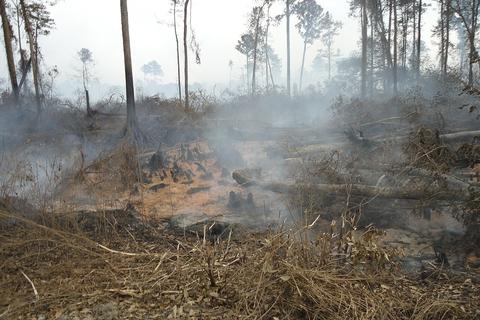
Smouldering peat / Photo: Chris Lowie / USFWS, CC BY 2.0


Restoring Peatlands: What this means in practice
Restoring peatlands does not mean removing these areas from economic use. Rather, it involves a transition to land‑use models that align with the wise use principle enshrined in the Ramsar Convention.
In practice, this means shifting to forms of land management that are possible without draining peat soils. One such approach is paludiculture – the cultivation of crops on wet or rewetted peatlands. These may include reeds, cattails, sedges, sphagnum mosses, and other plants adapted to high groundwater levels. Such areas can also be used for harvesting wild berries, mushrooms, and medicinal plants.
This approach makes it possible to retain carbon in the soil, reduce fire risks, and at the same time produce biomass, fodder, and raw materials for various traditional livelihoods and economic needs.

Tetiana Tevkun in Nobel National Nature Park / Photo: UNDP in Ukraine
Another important approach is extensive livestock farming on wet meadows, which has historically been part of traditional land use in wetlands. Such practices prevent meadows from becoming overgrown with shrubs and trees, help preserve biodiversity, and allow communities to use these lands for their own needs without harming ecosystems.
Wetlands, including peatlands, can also be used as spaces for tourism and recreation without altering their natural state. This includes the creation of recreational areas, eco‑trails, and nature parks where people can spend time outdoors, observe birds and landscapes, and enjoy nature without harming ecosystems.
Such approaches support the development of ecotourism, create opportunities for local guides, guesthouses, and small businesses linked to tourism and local products mentioned above.
All of this can bring tangible benefits to communities – additional income and new jobs.

Photo: Maksym Yakovliev
A different situation arises when wetlands fall within city boundaries: in most cases, such areas are drained for development, destroying their natural functions. In Lutsk, however, a different approach was chosen – the Hnidav Bog was preserved and integrated into the urban environment as a natural recreational area. This solution made it possible to balance community needs with environmental protection.


Illustrations from the “Hnidav Bog” Recreational Area Project. Author: Volodymyr Tsapuk
The project is implemented with the support of the Tourism and Promotion Department of the Lutsk City Council and the European Union’s House of Europe programme.
Ukraine’s International Commitments: Why peatlands are also a policy issue
As part of wetlands, peatlands fall under Ukraine’s international commitments. The Ramsar Convention, adopted in 1971, establishes a framework for the conservation and wise use of wetlands. Ukraine has been a party to the Ramsar Convention since 1976, which entails an obligation to develop policies and practices that ensure the protection of wetland ecosystems and prevent their degradation.
At the same time, the European Union has adopted the Nature Restoration Regulation, which mandates the restoration of drained peatlands on agricultural land: at least 30 percent by 2030, 40 percent by 2040, and 50 percent by 2050, with a defined share of rewetting.
As a candidate country for EU membership, Ukraine is expected to gradually align its national approaches and policies with these standards and to implement European norms in the field of nature conservation and environmental protection.

State Policy: Establishing a legal framework for the protection of peatlands
Alongside practical measures to restore peatlands, Ukraine is also developing a comprehensive state policy in this area. In January 2026, the Ministry of Economy, Environment and Agriculture of Ukraine released for public consultation a draft resolution of the Cabinet of Ministers of Ukraine titled “On the Specifics of the Legal Regime for the Use of Peatlands and Possible Types of Their Designated Purpose.”
The draft resolution was developed with the support of the United Nations Development Programme (UNDP) in Ukraine and the Global Environment Facility (GEF), as part of the project “Promoting Sustainable Livestock Management and Ecosystem Conservation in Northern Ukraine.”
In essence, the document sets out clear rules for the use of peatlands aimed at preventing the destruction of their ecosystem functions and the increase of greenhouse gas emissions. Decisions on land allocation, changes in land designation, or further use must take into account the risks of peatland degradation and the loss of their climate‑ and water‑regulating functions.
At the same time, the draft resolution does not change existing land designations and does not restrict current economic activities – the new requirements will apply only to future land‑management decisions.
Priority is given to types of land use that preserve the peat layer and the natural water regime, including conservation areas, forestry lands, and wetlands, with clearly defined exceptions for national security and critical infrastructure facilities.
In this way, the draft resolution establishes a legal framework for the implementation of European legislation in the fields of climate policy, environmental protection, and sustainable land use. It also strengthens Ukraine’s compliance with the Ramsar Convention on Wetlands and brings the country closer to implementing the EU Nature Restoration Regulation.
An investment in resilience
For Ukraine, peatlands are a vital component of climate, water, and ecosystem resilience. The way these areas are managed is directly linked to climate change adaptation, the fulfilment of international commitments, and the long‑term security of communities.
Protecting and restoring peatlands is neither a return to the past nor a rejection of development. It is an investment in stability – one that makes it possible to combine climate, environmental, and socio‑economic benefits.
This is precisely the approach being implemented through the project “Promoting Sustainable Livestock Management and Ecosystem Conservation in Northern Ukraine,” which is being carried out by UNDP in Ukraine with financial support from the Global Environment Facility (GEF). The project aims to develop a model for sustainable livestock farming in northern Ukraine that combines economic viability with ecosystem restoration and responsible land use, while also supporting climate change adaptation, including through the reduction of greenhouse gas emissions.
The project focuses on restoring degraded peatlands, introducing sustainable land use models – particularly paludiculture – and integrating an ecosystem‑based approach into natural resource management practices in northern Ukraine. The first preparatory stage for peatland restoration has already begun. Specialists from Ecobereg LLC have conducted geodetic and hydrological surveys, as well as assessments of hydraulic infrastructure, across seven sites in Volyn, Rivne, Zhytomyr, and Chernihiv regions. The collected data will serve as the basis for a technical project to restore peatland water regimes.


Photo: Vitalii Matviienko / UNDP in Ukraine
Peatland management is a practical component of water policy: it helps retain water in the landscape, reduce fire risks, and increase community resilience to droughts and extreme weather events. That is why, when we talk about water security, we must also talk about wetlands as natural infrastructure – without which engineered infrastructure functions less effectively and requires greater investment.
More information about the project “Promoting Sustainable Livestock Management and Ecosystem Conservation in Northern Ukraine” is available on the UNDP in Ukraine website.