

 Locations
ASL 3 Project Presented to Communities in West Suriname
March 9, 2026
From 19 to 23 February 2026, a field mission to Apoera and nearby villages, such as Washabo, Kabalebo and Sandlanding, was carried out by the UNDP in collaboration with the Ministry of Oil, Gas, and Environment, as well as the Directorate of Sustainable Development of Indigenous People of the Ministry of Regional Development. This field mission was conducted in the scope of the Sustainable and Inclusive Development of West Suriname/ Amazon Sustainable Landscapes Program Phase 3 (SID‑WS/ALS3) Project’s inception phase, focused on consultations with communities and strengthened coordination among local stakeholders and government partners.
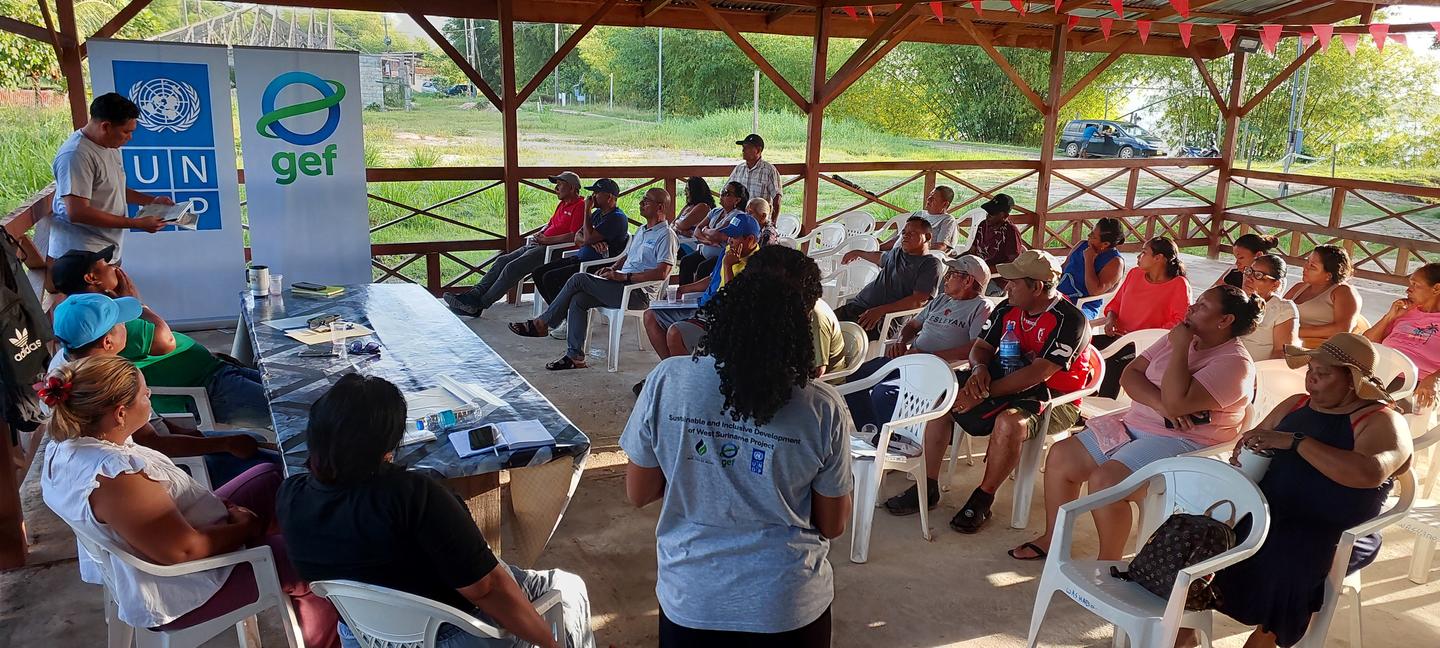

Through open and in-depth dialogue, the ASL3 team presented the project’s key components of this project and gathered community perspectives to inform implementation approaches that reflect local priorities, knowledge systems, and governance structures. The present community members actively engaged throughout the sessions, raising questions ranging from budget transparency and communication mechanisms to collaboration in the planning, design, and management of new and existing project areas. Discussions also explored opportunities for local entrepreneurs to strengthen market access and add value through further processing of their products.

In total, six awareness sessions were held, and two site visits to local entrepreneurs in the fields of agriculture and eco-tourism. One of these is Ms. Ingrid Arupa-Peneux, a local farmer that started small in her backyard and expanded progressively to a larger plot of land with the support of her husband. She started by supplying the households in Washabo and gradually also to nearby communities. She uses traditional planting and harvesting techniques and said to looks forward to the support of the ASL3 project to not only being able to expand her production, but also to improve her business and marketing strategies, expressing “you should think ahead. If you don’t, you stay small”.
One of the reasons for her desire to grow her family business is due to the lack of interest in agriculture among the youth. “The youth doesn’t wat to plant any more. They see agriculture as hard work with no future”, Ms. Arupa-Peneux said. She is confident that by expanding her business, the youth can better understand the value of agriculture, as it provides an income and independence.

This mission highlights ASL3 Project’s commitment to transparent information sharing, trust-building, and inclusive participation, thus laying the foundation for strong partnerships and effective, community-driven project delivery in Suriname. The Sustainable and Inclusive Development of West Suriname/Amazon Sustainable Landscapes Program Phase 3 (SID-WS/ALS3) is funded by the Global Environmental Facility (GEF), implemented by the Ministry of Oil, Gas, and Environment, with the support of the United Nations Development Programme (UNDP). This project focuses on stimulating sustainable economic growth in West Suriname, strengthening local communities, social inclusion, and responsible nature management in West Suriname.