
 Locations
Massive engineering project brings piped water back to Port Sudan
Restoring water
March 17, 2026

Prior to the flood, and together with several smaller dams, the Arbaat system once met up to half of Port Sudan’s daily water demand.
Photo: UNDP Sudan
When Arbaat Dam collapsed in 2024, the consequences spread quickly through Port Sudan. A city already absorbing large numbers of displaced people suddenly lost around half of its water supply. Pipes were torn from their foundations, wells were choked with mud and entire neighbourhoods were left dependent on expensively trucked water.
Even before this disaster, water systems were stretched. The outbreak of war in April 2023 displaced millions, many fleeing to Port Sudan, the capital of Red Sea State. It took on a national role and now hosts Sudan’s main port, the country’s only functioning international airport and has become, effectively, its administrative centre.
“We depended entirely on the Arbaat dam for drinking water,” said Ishag Mohamed Ishag, a labourer living with his mother and sister in Shagar, the largest neighbourhood in Port Sudan. “When the dam collapsed, everything changed. The price of a single jerrycan of water increased fivefold, especially during the hot summer season when demand was highest. Families struggled to afford even basic drinking water and daily life became extremely difficult.”
Arbaat Dam lies on Khor Arbaat, a seasonal valley descending from the Red Sea Hills north-west of the city. Built in 2003, the earth dam was designed to capture flash floods during the rainy season that supplies a downstream wellfield. To recharge the groundwater aquifer, together with several smaller dams, the system once met up to half of Port Sudan’s daily water demand.
That ended with the heavy rains of 2024. Extreme flooding caused the dam to fail, releasing a surge of water mixed with silt and debris. Villages downstream were destroyed, farmland damaged and lives lost. The flood wave also ripped through the water network, displacing pipelines, damaging electrical connections and burying boreholes under mud. What remained was a fractured system unable to deliver water to a city of more than one million people.

In 2024 extreme flooding caused Arbaat Dam to fail, releasing a surge of water mixed with silt and debris.
Photo: UNDP Sudan
“We depended entirely on the Arbaat dam for drinking water.”—Ishag Mohamed Ishag
Racing against time
Restoring water supply became an immediate priority. Without clean water, the risk of cholera, diarrhea and other waterborne diseases rose sharply. Health facilities struggled to operate and households were forced to divert scarce income to buying water.
But restoring such a massive system requires a huge effort from many partners. UNDP worked with national and state authorities to assess the damage and identify interventions that could restore an adequate supply quickly. The focus was on rebuilding core infrastructure rather than temporary measures. Then we pulled out all the stops to get it done in a race against time.
The completed works included drilling and rehabilitating 15 boreholes in the Arbaat wellfield, each tested for yield and water quality. Seventeen kilometres of new pipeline were laid to reconnect the wells to the main transmission line serving Port Sudan. Ten flowmeters were installed to improve monitoring and distribution.

UNDP worked with national and state authorities to assess damage and to restore supply quickly, including drilling and rehabilitating 15 boreholes.
Photo: UNDP Sudan
All boreholes were equipped with solar-powered pumping to reduce dependence on fuel and an unreliable grid power. This allows water to be pumped even during power cuts and lowers operating costs for the state water authority.
As a result, the restored system can now supply around 65 million cubic metres of water per year. That volume represents a significant share of the city’s current needs–enough for almost 230,000 people–at a time when population pressure remains high.

All boreholes were equipped with solar-powered pumping to reduce dependence on fossil fuels and unreliable grid power.
Photo: UNDP Sudan

The restored system can now supply around 65 million cubic metres of water per year meeting a significant share of the city’s needs when population pressure remains high.
Photo: UNDP Sudan
“Water started flowing again through the main pipe from Arbaat. Prices dropped and most of the population regained access to affordable drinking water.”—Ishag Mohamed Ishag
A national effort
The work at Arbaat forms part of a wider UNDP programme that includes around 350 projects to improve water access in Sudan, even as the challenges mount, with funding from the Central Emergency Response Fund, Italy, Japan, King Salman Relief, the Qatar Fund for Development and the Swiss Agency for Development and Cooperation.
These challenges include conflict and climate-related disasters, which have directly damaged water systems in both urban and rural areas, increasing the risk of disease and undermining livelihoods. Then there are the indirect effects of the war. Sudan’s economic collapse and currency devaluations have made importing the supplies needed to maintain and repair systems much harder.
In response, UNDP draws on more than 60 years of experience working in Sudan and a global team of experts and suppliers. We have maintained operations throughout the war, with teams based in 10 offices across the country. Fast-track procurement and specialized technical capacity have enabled rapid delivery in emergencies, such as the response at Arbaat.
From Darfur to South Kordofan, and from Blue Nile up to Red Sea State, UNDP is supporting the construction and repair of water sources, the rehabilitation of pipelines and the upgrading of irrigation schemes, with 290 drinking water projects underway or already complete, as well as 49 irrigation projects and 28 canals.
Across all our projects, solar energy is being integrated into water and health infrastructure to improve reliability, cut costs and minimize emissions.




Circles of development
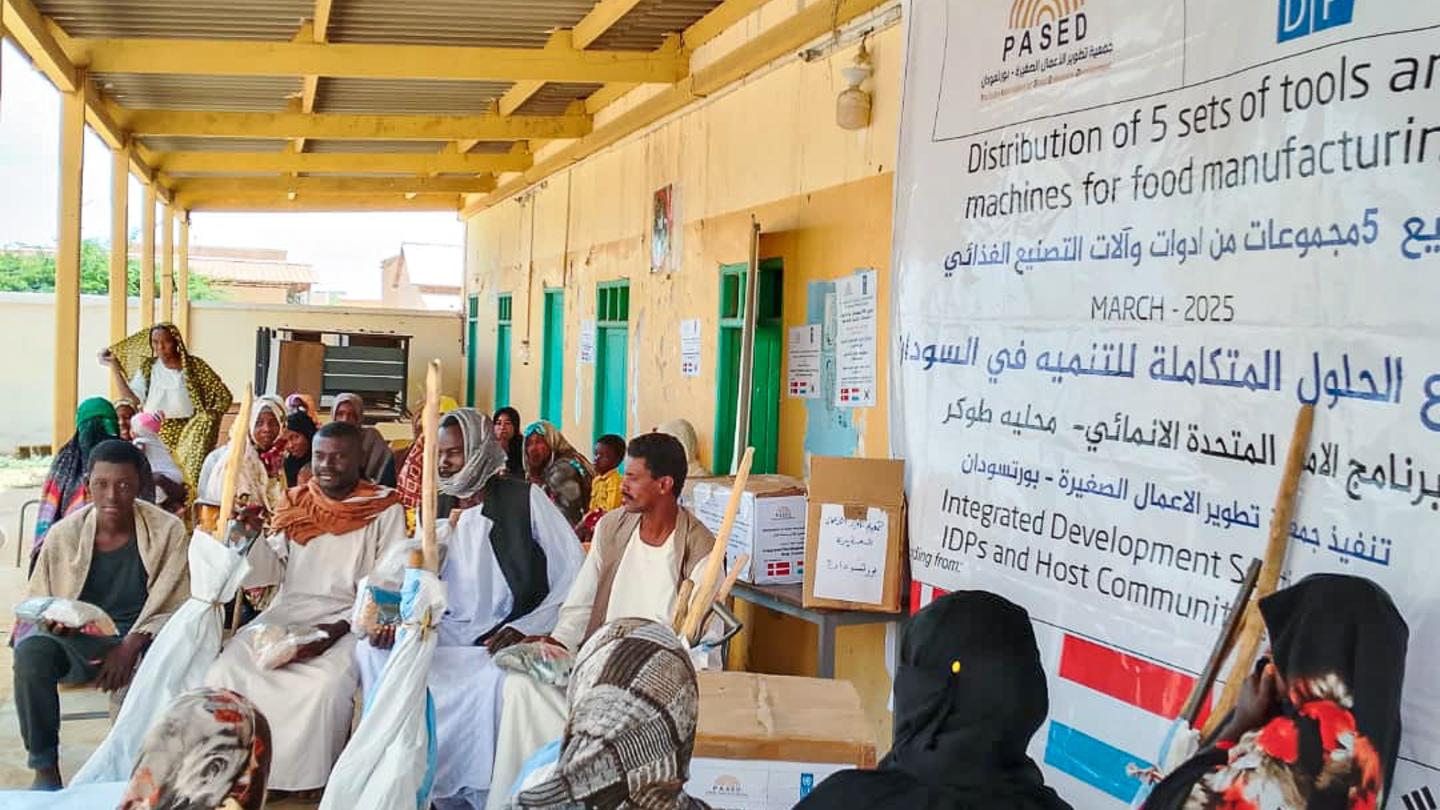
These interventions are designed as part of an integrated approach linking water, health, livelihoods and local governance in a way that generates virtuous circles of development. Reliable power and water supports health facilities, reduces grievances linked to scarcity and contributes to social cohesion. This in turn allows healthier, more secure communities to boost production and invest more confidently in the future.
To maximize impact and sustainability, projects are planned and carried out with local counterparts, communities and the private sector, building local capacity that ensures systems are maintained over time.
In Arbaat, as well as boosting the water supply, we have provided seeds and training to farmers to grow crops they can now irrigate, and we have boosted local livelihoods with equipment for local fishermen.
Long term recovery
Sudan’s war is approaching its third year and there is no end in sight. But for millions of people in this vast country, the daily battle isn’t fought on the frontline; it’s the battle to feed families, send children to school, to find paying work and get basic healthcare. This different struggle is being waged in areas that are desperately poor but where there are no armed clashes and where UNDP and our partners are showing that long-term recovery is already possible.
We have a blueprint for how to transform lives for millions of people. Now we just need to scale up.
Related
content
content


