On International Day of Persons with Disabilities, survivors lead the way to a mine-free future
Investing in victim assistance is also an investment in recovery and rights
December 1, 2025
Chhuon Heng, 57, a widow with five children, stepped on a landmine while clearing her farmland.
Photo: UNDP Cambodia
International Day of Persons with Disabilities is marked every 3 December. This year, the UN is also shining a spotlight on a group too often overlooked: survivors of landmines and explosive remnants of war.
To coincide with the day, UNDP is taking part in a special event in New York City, the launch of the Forward Not Fragmented Exhibition, to uphold international commitments to a mine-free future and accelerate mine action activities.
Across the world, persons with disabilities caused by landmines and explosive remnants of war are showing what is possible when they receive the support and opportunities to contribute to their communities.
The most recent data is from 2023 and shows 5,757 casualties from landmines and explosive remnants of war, an increase of 22 percent from the previous year. Civilians made up a staggering 84 percent of these casualties, with children accounting for over a third of victims.
Of the most heavily impacted countries, half are Least Developed Countries. When a landmine injury takes away mobility, income or access to school or work, it deepens poverty for survivors and for families and communities.
Yet survivors from Ukraine, Cambodia and Viet Nam tell another story: when they gain access to rehabilitation, mental health care, employment, education, business opportunities and barrier-free services, they can look after themselves, their families and contribute to their communities.
With support from UNDP and Australia, New Zealand and the Republic of Korea. Heng (second left) has been receiving free physiotherapy services and prosthetic replacements.
Photo: UNDP Cambodia
“Even with an amputated leg, I can work and help.”
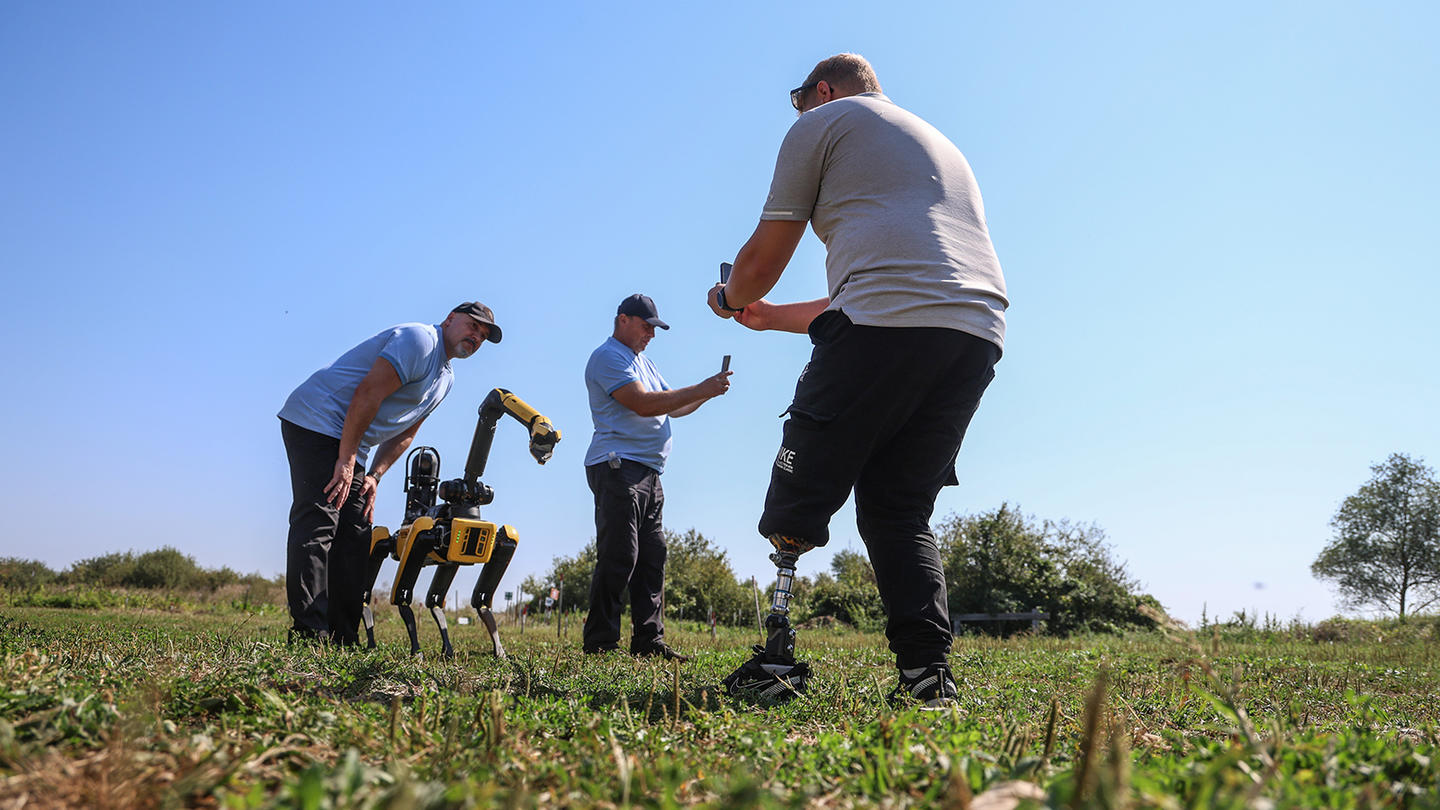
Ruslan is a veteran who lost his leg in the conflict in Ukraine. UNDP supported a humanitarian demining course for veterans with disabilities, launched with support from the Netherlands and Ukraine’s Ministry of Economy, Environment and Agriculture. Today, Ruslan works as an imagery analyst with the NGO, HALO Trust.
Photo: UNDP Ukraine
“The HALO Trust allows me to continue this work but in a slightly different field. Even with an amputated leg, I can work and help. My job involves analysing satellite images. Later this information is provided to deminers,” he said.
The training model is already showing results: 11 veterans have secured employment with leading mine action operators in Ukraine. At a high-level conference in Kyiv, UNDP Deputy Resident Representative Christophoros Politis said, “Victim assistance is not an afterthought, it is central to inclusive and long-term recovery.”
“Victim assistance is not an afterthought, it is central to inclusive and long-term recovery.”
— Christophoros Politis, UNDP Deputy Resident Representative in Ukraine
“I find ways to do whatever it takes to feed my children.”
In Battambang province, Cambodia, Chhuon Heng remembers the moment her life changed.
“I lost hope. I wanted to die. But then I thought of my children. So, I carried on working hard, relying on a walking stick and determined to feed my children,” she said.
She stepped on a landmine in 2003 while clearing her farmland. A widow with five young children, she survived, but it took a year before she could get her first prosthetic leg.
With support from UNDP and partners, Heng has been receiving free physiotherapy and prosthetic replacements through the Battambang Physical Rehabilitation Centre under the Clearing for Results project. The centre has been supported by Cambodia along with donors including Australia, Luxembourg, New Zealand, Republic of Korea and International Committee of the Red Cross.
Long-term investment in landmine victim assistance, in Cambodia means 8,500 survivors, more than half of them women like Chhuon Heng, have received physiotherapy and prosthetics.
Photo: UNDP Cambodia
Chhuon Heng has opened a small grocery stall at her home, providing a vital source of income.
Photo: UNDP Cambodia
Today, she is independent.
“With the prosthetic leg, I can ride a motorbike, so I go to buy fish, crabs and snails to sell. Basically, I find ways to do whatever it takes to feed my children.”
She also received livelihood training and financial support, which allowed her to open a small grocery stall at her home. It is a vital source of income as she grows older.
Cambodia remains one of the world’s most heavily contaminated countries. But thanks to long-term investment in victim assistance, over 8,500 survivors more than half of them women, have received physiotherapy and prosthetics.
“I finally have peace.”
In Quang Ngai province, Viet Nam, Thanh has lived through a lifetime of loss. At age 14, a bomb killed her mother and seven siblings. She survived with severe injuries to her leg and arm.
For decades, she relied on government support and the kindness of neighbours, especially when storms and floods hit her home. Many nights, she stayed awake, afraid the floodwaters would sweep everything away.
Through the Korea–Viet Nam Peace Village Project, the next phase of the Korea–Viet Nam Mine Action Project, Thanh received a new climate-resilient house designed to withstand the annual storms that once kept her in fear.
Standing in her new home, she said softly:
“I can finally feel safe in my own house,” she said. “I feel protected now. I finally have peace.”
Thanh received a new climate-resilient house designed to withstand the annual storms that once kept her in fear.
Photo: UNDP Viet Nam
Towards a barrier-free future
This International Day of Persons with Disabilities is a reminder that investing in victim assistance is an investment in recovery and rights. When survivors regain mobility, access employment and live in safe homes, their families thrive and communities grow stronger.
This truth is at the heart of the UN Secretary-General’s warning this year that recent moves by several Member States to withdraw from the Mine Ban Convention risk “weakening civilian protection and undermining two decades of a normative framework that has saved countless lives".
The UN campaign aims to “accelerate mine action as an enabler of human rights and sustainable development” and uphold the vision of a mine-free world. Mine action is not just about clearing land. It is about people: their rights, their recovery, the services to provide for their needs, their meaningful participation and their ability to contribute fully to society.

 Locations