Locations
By Phan Duc Tuan | Published on the People's Army of Viet Nam Newspaper
Linking Mine Action and the Sustainable Development Goals: A strategic path to sustainability
May 30, 2025

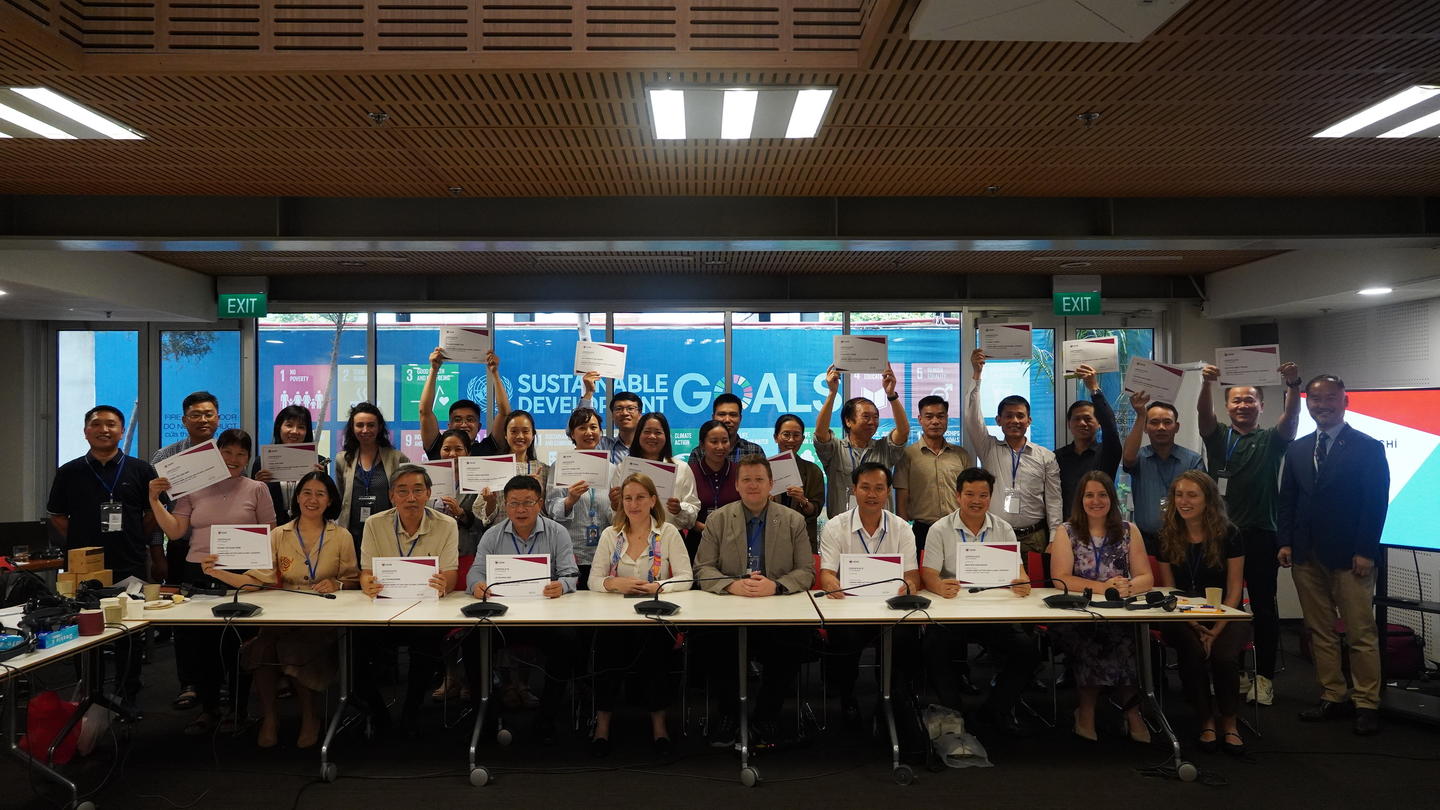
Photo: UNDP in Viet Nam
Addressing the consequences of explosive ordnance is not only about clearing land and ensuring safety for production and socio-economic development. In the long term, it also makes a significant contribution to achieving Sustainable Development Goals (SDGs).
On 27–28 May 2025, a technical meeting themed “Mine Action and the Sustainable Development Goals (SDGs)” was held at the Green One UN House in Ha Noi. The event was co-chaired by the United Nations Development Programme (UNDP) in Viet Nam and the Viet Nam National Mine Action Center (VNMAC), with technical support from the Geneva International Centre for Humanitarian Demining (GICHD), as part of the Korea–Vietnam Peace Village Project (KVPVP). The meeting brought together officers from VNMAC, KVPVP project management units of Binh Dinh, Quang Ngai and Hue City, and experts from international mine action operators such as KOICA, UNDP, Project RENEW, NPA, MAG, PEACETREES, CRS.
Viet Nam remains one of the countries most severely affected by landmines and explosive ordnance (EO). With approximately 5.6 million hectares of EO-contaminated land, EO poses not only persistent threats to human safety but also significant barriers to socio-economic development, particularly in rural, bordering, and mountainous areas. Over the past years, mine action in Viet Nam has been implemented comprehensively, yielding positive outcomes that have contributed to stabilizing local communities, rehabilitating contaminated land, and promoting sustainable development.
Since 2017, the Government of Viet Nam has adopted a National Action Plan for the implementation of the 2030 Agenda for Sustainable Development (Decision No. 622/QĐ-TTg), which translates the 17 global goals into national targets and indicators. Notably, on June 15, 2022, the Prime Minister signed Decision No. 841/QĐ-TTg, approving a roadmap for achieving the Sustainable Development Goals (SDGs) by 2030. This roadmap provides specific timelines for each goal, thereby laying a basis for the relevant ministries, sectors, and localities to develop realistic and actionable implementation plans.
Viet Nam has also submitted two Voluntary National Review (VNR) reports to the United Nations High-Level Political Forum in 2018 and 2023, respectively, reaffirming the country’s transparency, accountability, and strong commitment to international integration.
At the technical meeting, experts and participants explored the interlinkages between mine action and the SDGs. In addition to directly contributing to the SDG 16 (Peace, Justice, and Strong Institutions), mine action also supports the achievement of several other goals including: Poverty Eradication (SDG 1), Good Health and Well-being (SDG 3), Quality Education (SGD 4), Gender Equality (SDG 5), Decent Work and Economic Growth (SDG 8), and Partnerships for the Goals (SDG 17).
Case studies presented at the meeting demonstrated that integrating mine action into national and local socio-economic development plans yields more sustainable and impactful results. Landmines and EO clearance do more than just create safe spaces. It enables the construction of schools, healthcare facilities, and rural infrastructure, thereby directly improving people's quality of life.
Despite these achievements, Viet Nam's mine action sector continues to face significant challenges: the extensive remaining contaminated land area, the complex types of explosive remnants, limited resources and technology application and noticeably a lack of a unified mechanism at both national and local levels to systematically monitor and evaluate the contributions of mine action to the SDGs.
As Viet Nam is now developing its National Programme for Mine Action for the period of 2026–2045, with a vision toward 2065, this technical meeting served as an opportunity for Viet Nam to learn from international good practices while reaffirming its proactive and constructive role in global initiatives.
Mine action, in its broader sense, presents a continuous peace-time mission of the army: to safeguard the people’s safety and peacefulness and restructure the areas once ravaged by war. Over the years, the Engineering Corps, the People’s Army of Viet Nam, particularly demining teams, have demonstrated high levels of responsibility, collaborating effectively with national and international organizations to gradually clear the contaminated land and make it safe for production and development.
Linking mine action with sustainable development agendas is not only an inevitable, humanitarian, and strategic approach. It goes beyond being a technical or humanitarian obligation; it forms part of a broader strategy for national defense, reinforcing the country’s resilience, building a safe and stable environment, and thus laying the foundation for sustainable social and economic development, as well as the safeguarding of the national sovereignty.