Locations
Focus Areas
Sustainable Development and Resilience
Summary
To support the government in meeting its commitment under the United Nations Framework Convention on Climate Change, UNDP, in collaboration with the Food and Agriculture Organization (FAO), IOM, the World Food Programme (WFP), and the United Nations Office for Disaster Risk Reduction, strives to alleviate the causes of vulnerability to climate change while fostering national capacity for transformational climate action. Community-level engagement will intersect with national and regional level engagements through climate information systems to inform national policies, plans, and investments in adaptation and mitigation. The impact of UNDP in this area will be measured by a national climate action platform where the government will facilitate a whole-of-society, whole-of-government, and whole-of-private-sector response to the climate crisis. It will serve as a facility to broker larger partnerships for innovative initiatives to tackle frontier challenges faced by Timor-Leste, foment new collaborations on climate action, and new public and private financing for circular blue economies that enhance institutional capacities for evidence-based climate-smart policies, plans, and budgets.
In Timor-Leste, UNDP is building on successes in areas of:
• Coherent, long-term resilience-building support for the country through social cohesion and social protection
• Disaster and climate risk management policies
• Preparedness and response to natural hazards.
In Depth
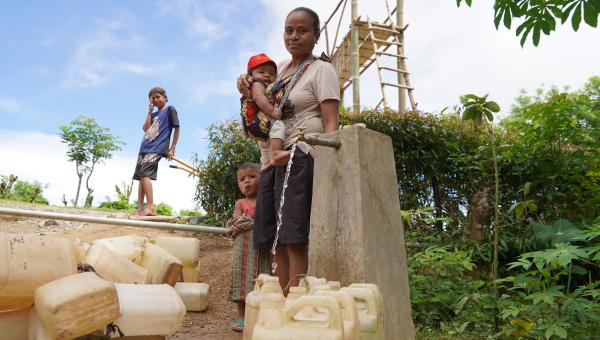
Through the Green Climate Fund (GCF) project, UNDP is aiming to safeguard vulnerable communities and their physical assets from climate change-induced disasters. We assess and identify institutional, financial, and legislative barriers to developing the climate resilience of vulnerable small-scale rural infrastructure. Approximately 175,840 people – around 15% of the population – will benefit from the GCF project, building 38 new water supply systems, 25 irrigation schemes, 216 kilometers of rural roads, and 20 flood-protection infrastructure. Incorporating the potential for climate-induced disasters while designing infrastructure is essential for sustainable disaster risk management which pays for itself by reducing recurrence, maintenance, and post-disaster recovery costs.