

 Locations
Season 3: Namibia’s Digital Identity Journey – From Vision to Reality
September 3, 2025

This article is part of UNDP Namibia’s ongoing series on digital public infrastructure and digital legal identity.
Namibians have always been proud of their ingenuity, and in recent years that spirit has turned toward the digital sphere. In Parts 1 and 2 of this series, we examined why digital legal identity (DLI) is a human right and how it can open doors to services and economic opportunity. This final instalment brings the story home: it explores how the Ministry of Home Affairs, Immigration, Safety and Security (MHAISS), in collaboration with UNDP, is transforming that vision into a uniquely Namibian reality.
From fragmentation to foundation
Like many countries, Namibia entered the 2020s with identity systems that were outdated and scattered across different platforms. Rural communities, women and marginalised groups often found themselves without reliable documents, making it difficult to access social grants, healthcare or banking. In 2021, MHAISS partnered with UNDP to conduct a baseline assessment of the country’s information‑technology systems. The findings were sobering: software was obsolete, databases were siloed and there was little interoperability. Instead of being discouraged, the Ministry saw opportunity in the gaps.
UNDP’s global work on digital public infrastructure emphasises that secure digital identity, payment platforms and data‑exchange systems are as fundamental to modern life as roads and bridges. MHAISS embraced this principle and committed to building a rights‑based digital identity system that would leave no one behind. The first step was to look critically at governance.

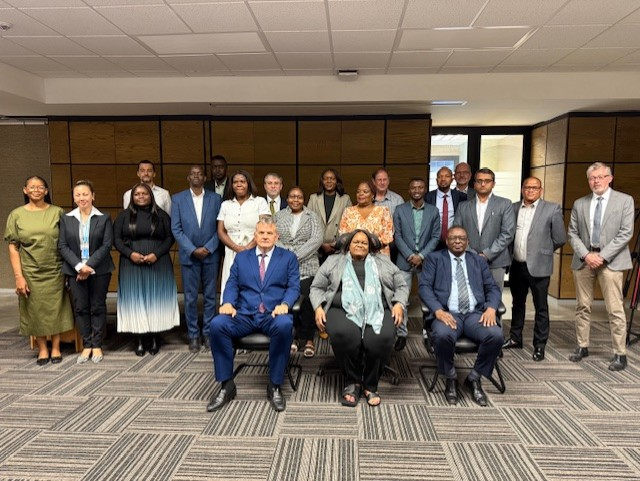
Hon Minister Lucia Iipumbu and her team at the Ministry of Home Affairs, Immigration Safety and Security
Assessing governance to build trust
In 2024, Namibia became the first country to pilot UNDP’s Model Governance Framework for Digital Legal Identity. This holistic tool examines the technical, legal and social dimensions of identity systems: Is there a clear legal mandate? Are privacy and data‑protection safeguards robust? Who is accountable for the system’s integrity? How can citizens seek redress? The assessment flagged three themes for Namibia:
- Interoperability and capacity: Legacy databases and new digital platforms still struggle to communicate, and government needs more technical expertise to bridge them.
- Public trust: People remain wary about how their data will be used, especially without a comprehensive data‑protection law. The recently promulgated Civil Registration and Identification Act, 2024 is a step in the right direction because it consolidates laws on births, deaths, marriages and identity documents and embeds privacy principles.
- Inclusive design: Without deliberate planning, rural populations and people with disabilities could be left out. Sign‑language guides, multilingual interfaces and gender‑sensitive enrolment processes are essential.
The assessment laid the groundwork for a constructive dialogue between UNDP and the Ministry. Honourable Lucia Ipumbu, Minister of Home Affairs, Immigration, Safety and Security, met with UNDP to discuss the findings. The resulting partnership has been characterised by transparency and a shared determination to address the gaps.
Namibia’s edge: local leadership and cultural creativity
What sets Namibia apart is its decision to combine technical innovation with cultural engagement. Rather than waiting for a perfect system, the Ministry built its own national population register, with technical support from the Office of the Prime Minister. It also tested remote biometric enrolment using hand‑held devices to reach people in hard‑to‑access areas. This “learn fast, scale smart” approach allowed for experimentation while respecting local context.
In July 2025, the MHAISS and UNDP hosted the Digital Pathways Un‑Conference, an event that blended technology with Namibian art and storytelling. The National Art Gallery curated an interactive Mural with citizens to show how identity shapes daily life. The Ombetja Yehinga Organisation performed a carefully choregraphed dance exploring what it means to belong in a digital world. During the same event, participants solved real‑world challenges in an “Identity Escape Room” and shared experiences in a Human Library where community members were the “books”. By weaving culture and art into innovation, Namibia is making the abstract concept of digital identity tangible and inviting public input.
Inclusivity as innovation
As Namibia designs its digital identity system, inclusion is not an afterthought. UNDP and MHAISS plan to co‑create with underserved communities through workshops that address language barriers, age‑related accessibility and gender markers. There will be sign‑language guides at enrolment centres, and mobile teams will travel to remote villages. The goal is to ensure that everyone, regardless of income, geography or ability, can claim their identity with dignity.
Beyond identity: the path to digital public infrastructure
The digital identity initiative does not stand alone. Namibia has already begun to integrate it with other parts of digital public infrastructure. The government is finalising preparations to launch the e‑ID in 2026, supported by a significant budget allocation. The new system will be built on the Model Governance Framework’s principles of security, inclusion and human rights. Simultaneously, the country is deploying NamX, a data‑exchange platform that allows ministries to share information securely, and Nampay, a real‑time payment system for instantaneous transfers. When combined, these components will form the backbone of Namibia’s digital economy.

A call to action
Namibia’s progress is inspiring, but the work has only just begun. As we look to 2025 and beyond, different stakeholders have roles to play:
- Government agencies should adopt governance frameworks that balance innovation with rights and ensure that data‑protection legislation keeps pace with technology.
- Private‑sector innovators can partner with government to develop affordable biometric hardware and ethical AI tools for fraud detection, helping to scale inclusive solutions.
- Civil society must hold power to account, advocate for transparency and participate in public consultations. UNDP’s #IdentityForAll campaign invites community groups to share their perspectives.
- Development partners and donors should invest in interoperable systems rather than isolated projects. Namibia’s experience shows that middleware and open standards yield far greater impact than proprietary silos.
Why it matters
An estimated 850 million people worldwide still lack legal identity. Without it, they cannot exercise basic rights or access services. Namibia’s journey demonstrates that exclusion is not inevitable; it is a challenge that can be overcome with political will, thoughtful governance and community involvement. By treating digital identity as both a technical and a social issue, Namibia is forging a path toward an equitable digital future. UNDP is proud to walk alongside the Ministry on this journey and hopes other countries will follow. Together, we can build digital systems that do more than identify people – they value them.
Join Us:
- Collaborate with UNDP to replicate the process and Model Governance Framework for Digital Legal Identity.
- Invest in a future where no one is left invisible.
Together, let’s make Digital Legal Identity a bridge to dignity, not a barrier.
Learn more: UNDP Namibia
Contact: Yrika Maritz, yrika.maritz@undp.org
UNDP’s DLI funding window and project for UNDP’s Namibia, the Governance Team and Chief Digital Office, is supported by and the Governments of Denmark, Luxembourg, and Korea.
Related
content
content


