

 Locations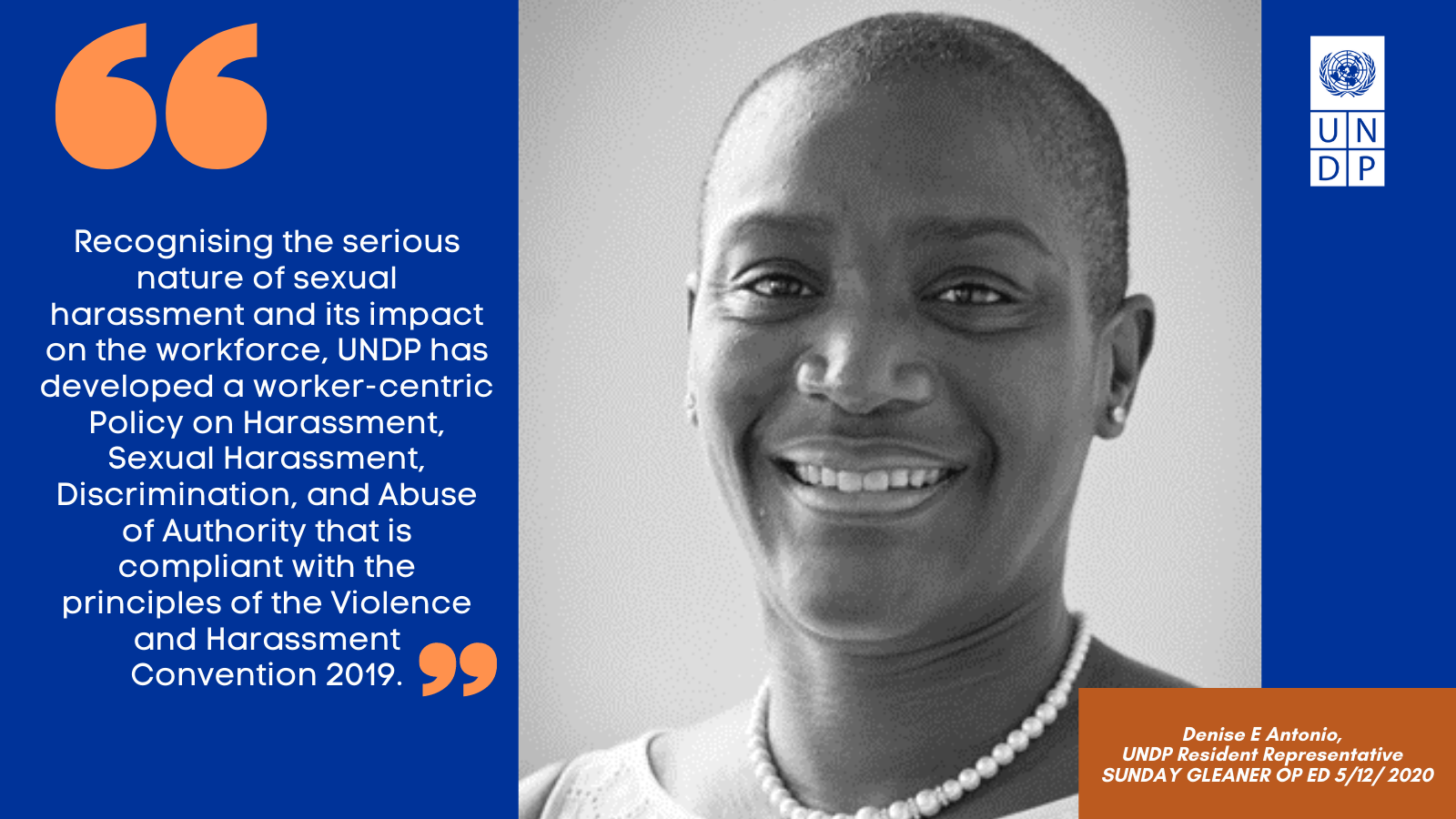
Denise E Antonio, UNDP Resident Representative
UNDP Resident Representative Denise E Antonio
Spotlight Initiative Sexual Harassment Virtual Roundtable
Wednesday 2 December 2020 via Zoom
Salutations
- Head of the Hugh Shearer Labour Studies Institute, UWI Open Campus, Danny Roberts
- Legal Officer, Ministry of Culture, Gender Entertainment and Sports, Georgette Grant
- Spotlight Initiative Programme Coordinator in Jamaica Novia McKay and other representatives of partner implementation agencies of Spotlight here in Jamaica and the region
- UN Stress Counsellor Kamala McWhinney
- Moderator Emprezz Golding
- Members of the UN Country Team
- Attendees and visitors watching this livestream
Good afternoon and welcome to this lunchtime Roundtable on Sexual Harassment.
The United Nations Development Progrmme (UNDP) Multi Country Office in Jamaica is pleased to lead the implementation of a series of Virtual Roundtables on legislation underpinning the protection of women and children in Jamaica. Under the auspices of the European Union-funded Spotlight Initiative Jamaica, we aim to facilitate exchanges between the public and experts that will inform, seek inputs and provide practical help where relevant.
First on the agenda is the draft Sexual Harassment Act, currently before the Joint Select Committee of Parliament. Jamaica is on the verge of passing a Sexual Harassment Law that proposes to hold workplaces and state institutions accountable and to impose penalties for wrongdoing. On behalf of the United Nations agencies implementing Spotlight Initiative Jamaica, I commend the government of Jamaica for this bold step in the right direction and for its unwavering commitment to finalizing the legislative process concerning the Sexual Harassment Act.
We must remain invested in ensuring Jamaica passes the best possible fit for purpose legislation. Let’s keep talking and sharing until then. For too many women, and men too, workplaces and roadways are battle zones. Sexual Harassment imposes a personal, professional and mental cost on victims and a reputational and productive cost on organizations. Many suffer in silence fearing loss of jobs, perceiving that there is insufficient recourse in workplace policy and law.
Unwanted catcalls, touches, crude and degrading statements, taking advantage of unequal power dynamics, amounts to unhappy workers and unsafe and toxic work environments. We must recognize Sexual Harassment for what it is – an assault on the dignity, productivity and career prospects of women and men.
Research confirms that the reality of sexual harassment is bigger than the official complaints indicate. A 2007 study on Hong Kong showed that nearly 25% of workers interviewed suffered sexual harassment, but only 6.6% reported their grievance because they felt too embarrassed to face "ridicule". In the European Union 40–50% of women report some form of sexual harassment or unwanted sexual behaviour in the workplace, and a 2004 report in Italy indicated that 55.4% of women in the 14-59 age group reported having been victims of sexual harassment.
Recognizing the serious nature of sexual harassment and its impact on the workforce, UNDP has developed a Policy on Harassment, Sexual Harassment, Discrimination, and Abuse of Authority. There are seven guiding principles evident in the policy that I would like to share with you today:
· One, there is mandatory requirement for country offices to promulgate the policy and to report on this progress: This means all country offices are required to formulate work plans to foster a harassment free environment and to educate staff and partners about its provisions.
· Two, the policy adopts a rights-based approach with the wellbeing of team members taking primacy. UNDP's holistic approach is designed to create and maintain a working environment that respects the inherent dignity of all persons, affording them the opportunity to reach their fullest potential and empowering them to deliver the best possible results for UNDP and the people we serve.
· Three, the serious nature of the offence is emphasized: Sexual Harassment is regarded as Prohibited Conduct at UNDP and team members found guilty may be subject to administrative, disciplinary or contractual measures, up to and including dismissal.
· Four, complainants and whistleblowers are afforded significant protections. Retaliation against a complainant is prohibited conduct. Complainants are protected at UNDP and can officially file for Protection Against retaliation if they feel they have been threatened during the course of an investigation. Anyone who retaliates against whistleblowers will face sanctions up to dismissal.
· Five, the sanctity of the investigative process is protected. The investigation is assigned to a special office at headquarters. Persons with a complaint have the right to either enter into a dispute resolution process or to skip this altogether and initiate the formal complaint process.
· Six, there is frank and open access to resources and complaint mechanisms including a 24-hour hotline to clarify issues and to officially file their complaints without the knowledge or say so of the field office.
· Seven - Accountability is strong: The policy holds managers accountable for taking the prescribed steps to handle complaints that may come to their attention.
The Multi Country Office is currently in the process of conducting its internal campaigns with staff and partners and welcomes the opportunity to share further insights from our policy with interested organizations. Let us keep the exchanges flowing.
We have an opportunity during the period of the global commemoration of the 16 Days of Activism Against Gender Based Violence to let our voices be heard. Through the Spotlight Initiative we hope you will count us as your partner in this journey. Thank You.


