

 Locations
Saving Yaki, Sustaining Livelihoods
January 27, 2026

Yunita and Fonnie, one of the local guide and women ranger in Batu Putih Nature Recreational Park (TWA Batu Putih), Bitung, North Sulawesi.

Yunita still remembers the early 2010s, when she had just begun her role as a research assistant studying the Yaki (Macaque Niggra) the Sulawesi crested black macaque. At the time, she did not yet imagine that this work would shape more than a decade of her life. What she had was curiosity, passion, and a growing concern for a species she was only beginning to understand.
With no motorbike and limited resources, Yunita moved mostly on foot, occasionally hopping onto public minibuses around Manado. She followed her research lead from one site to another, helping collect data and document Yaki populations across North Sulawesi. The work was physically demanding, but for Yunita, it felt meaningful. Each encounter with the Yaki raised new questions, not just about the species itself, but about the people living alongside it.
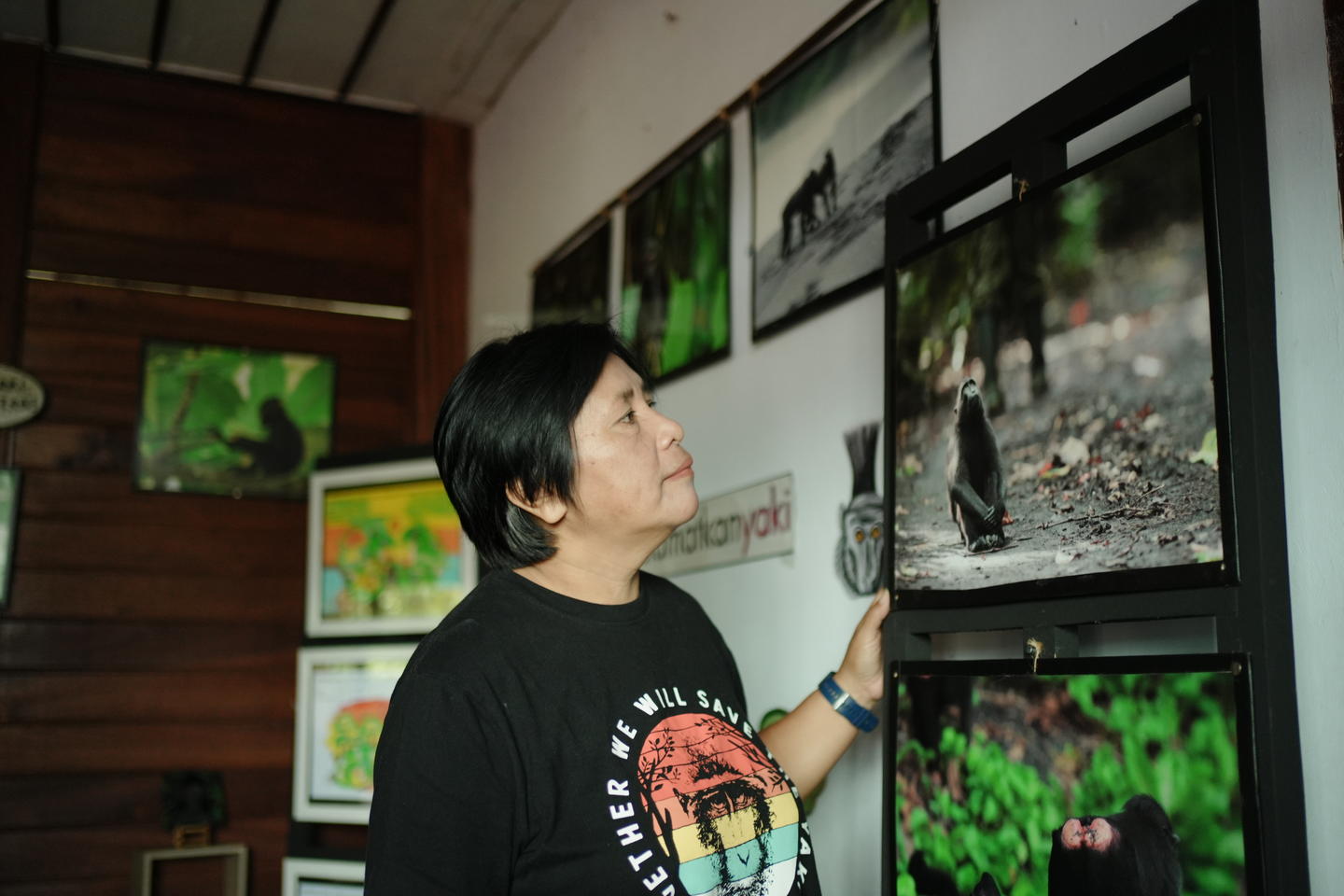
Yunita looking at Yaki photos at her office, Selamatkan Yaki in Manado, North Sulawesi. Photo: UNDP Indonesia
Yaki is endemic to North Sulawesi, found only in forest landscapes stretching from Dumoga to Manado. Once abundant, its population declined dramatically, by an estimated 80% between the 1980s and early 2000s. Habitat loss played a major role, but hunting was equally devastating. For generations, Yaki meat had been consumed as part of local culture, particularly in Minahasa communities. Long-held beliefs claimed that eating Yaki could increase vitality or cure illnesses such as asthma. Despite being scientifically disproven in the 2010s, these myths endured, fueling practices that threatened Yaki survival and accelerated their decline.
As Yunita spent more time in the field, research alone began to feel insufficient.
“We could document population decline and publish findings,” she recalled, “but it wouldn’t stop the hunting.”
Through her involvement in the Selamatkan Yaki movement—an initiative founded on scientific research but driven by local engagement—Yunita became increasingly convinced that conservation could not stop at data collection. Awareness had to start within communities. Change had to be owned by the people who shared their forest with Yaki. And for that change to last, it also needed to reach decision-makers and influence policy.
In 2012, Selamatkan Yaki was still small, just two staff members, including Yunita. Resources were limited, but ideas were not. They began visiting villages not only to talk about Yaki protection, but to listen: to understand why people hunted, what alternatives were possible, and how conservation could coexist with livelihoods. The conversations were not easy. Awareness of wildlife protection was low, and resistance was common. Yunita often described that period as “running into a wall.”
Yet small shifts began to happen.
Yaki is more than a protected animal, it is a keystone species. When Yaki eat forest fruits and disperse seeds through natural processes, those seeds can grow up to five times faster than seeds planted by humans. Without Yaki, forest regeneration slows, biodiversity declines, and ecosystems weaken. Protecting the Yaki meant protecting the forest itself.

A family of Yaki in the forest of North Sulawesi. Photo: Jesus Cobaleda/Shutterstock
As Selamatkan Yaki’s work expanded beyond research into education, livelihoods, and advocacy, new partnerships emerged. Yunita began working closely with conservation actors in North Sulawesi, including the Manado Conservation Center, and later with UNDP Indonesia. These collaborations marked an important turning point: conservation efforts were no longer isolated initiatives, but part of a broader, more coordinated approach linking communities, institutions, and policy frameworks.
For Yunita, the real turning point for Selamatkan Yaki and for Yaki conservation more broadly came during the implementation of the Enhancing the Protected Area System (EPASS) project in Sulawesi. Running from 2017 to 2019, the UNDP-led initiative strengthened protected areas not just on paper, but on the ground, linking biodiversity protection with the lives of the communities around them. Funded by Global Environment Facility (GEF) and implemented with Indonesia’s Ministry of Environment and Forestry, EPASS helped transform protected areas into spaces that were better managed, more sustainable, and deeply connected to local people, creating new momentum for conservation efforts like Selamatkan Yaki.
Through EPASS, Selamatkan Yaki grew from a small grassroots team into a recognized conservation partner, bringing its local knowledge to complement institutional support. The program helped communities understand that Yaki plays a crucial role in keeping forests alive and healthy. People began to see that protecting Yaki wasn’t just about saving a species, it was about protecting the forest that sustains their own lives, water, and livelihoods.
That shift in understanding translated into real ecological gains. Between 2016 and 2019, the occupancy rate of maleo bird nesting sites across three locations in Bogani Nani Wartabone National Park rose sharply, from just 6.4% to 54.4%—signaling healthier, safer habitats. In Tangkoko Batuangus Nature Reserve alone, monitoring in 2019 identified that Yaki population density reached 14.6 individuals per square kilometer. The legalization of the Yaki Conservation Strategic Action Plan (SRAK) that same year further anchored conservation efforts in formal policy.
On the ground, communities were supported with sustainable livelihoods such as hydroponics and permaculture, while local ecotourism guide groups were strengthened. Educational investments—including the Tangkoko Education Center and village signage—helped reinforce conservation messages. Since the project began in 2017, the number of trained local guides nearly tripled, from 30 to 84, with most still actively engaged today—evidence of lasting capacity, not one-off participation.
EPASS also helped shift government awareness. What had once been a marginal conservation issue became a recognized priority, with stronger support for protecting Yaki and their habitat.
Building on that foundation, Selamatkan Yaki later became one of the partners in UNDP’s Combating Illegal Wildlife Trade (CIWT) project which was funded by Global Environment Facility (GEF), and implemented in 2023-2024 in Bogani Nani Wartabone National Park, Sulawesi’s largest terrestrial protected area. Focused on combating illegal wildlife trade, CIWT strengthened law enforcement, provided sustainable livelihood alternatives, and engaged youth as champions of conservation, while integrating gender inclusion in its programs.
Through EPASS and CIWT, Selamatkan Yaki has grown from a small research-focused initiative into a multi-faceted organization, connecting science, community action, youth engagement, and policy advocacy. Their work shows that when communities understand that protecting species like Yaki is essential to protecting the forests they rely on, conservation becomes meaningful, local, and lasting.
Looking back, Yunita sees a line connecting those early days, walking under the sun, riding minibuses with research notes in hand, to the conservation movement that followed.
“What has started as curiosity for me has become responsibility, and that very responsibility has turned into an impactful action,” she said.

Yunita often brings her family, including her son Ethan, to Batu Putih Nature Recreational Park, where learning about the Yaki becomes a family tradition. Photo: UNDP Indonesia
For her, saving the Yaki is not only about protecting a species, it’s also about shaping how communities relate to their environment and ensuring conservation extends from villages to policy. Collaborating with UNDP through EPASS and CIWT, and working alongside the Manado Conservation Center, has shown how grassroots action and institutional support can amplify impact.