

 Locations
EU and UNDP build confidence between communities divided by conflict
Confidence that Leads to Achievement
March 19, 2018
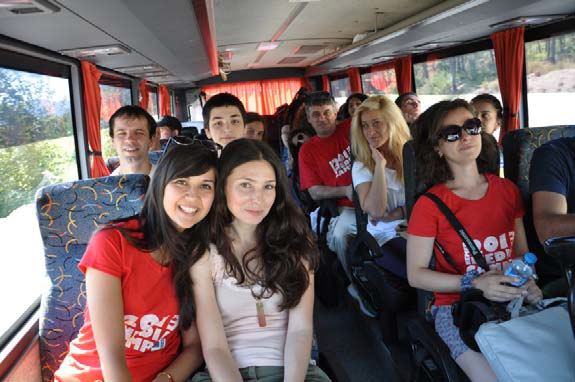
Abkhaz, Georgian and South Ossetian teenagers travelling to a summer camp together. Photo: UNDP
Youth camps, training, research, healthcare services, and business development initiatives make an incomplete list of projects undertaken within the Confidence Building Early Response Mechanism (COBERM) since 2010.
Implemented jointly by the European Union and UNDP, this complex programme seeks innovative and realistic ideas from civil society to promote peace, build confidence, foster connections between communities divided by conflict, and people understand each other better.
Friendship vs Conflict
In September 2013, the media camp in Turkey brought together young Georgian, South Ossetian and Abkhaz journalists. For many, this enjoyable learning experience was the turning point to change their perceptions of each other.
“From childhood, I thought that Georgians were rude and arrogant. But after meeting Georgian youth, this appears untrue,“ says a 19-year-old TV reporter from Tskhinvali.
The authors of the media camp – experts from the Georgian media organization Internews, believe that only face-to-face contact and joint activities can smooth the awkwardness and tension between the communities divided by conflicts.
During a nine-day training, youngsters familiarized themselves with practical and theoretical aspects of journalism, learning filmmaking, editing, and documentary. Theoretical classes were followed by interactive activities: young people were split into groups of three with one Georgian, one Ossetian, and one Abkhaz in each, and were assigned to make short films.
“The first days were not smooth. Young people locked themselves in their ethnic groups and rarely communicated with their peers. But after a while, youngsters became more open with each other. They worked together, brainstormed for hours, and in no time started bonding,“ says one of the course coordinators.
Separated by prejudice and lack of information, the young people never thought that a media camp could bring a bunch of new friends into their lives. As one of them said:
“We have the same interests and problems, we like the same films and music, and we read the same books. Now we keep in touch on Facebook, and share news and plans. Media camp showed us that shared professional interests often lead to friendship, a friendship which builds confidence and overcomes conflicts.”
Healthcare across Conflict Divides
An eight-month-old child spent two weeks in the Sukhumi hospital after being diagnosed with a serious liver disease. His condition remained critical despite the efforts of the Abkhaz doctors. The child’s parents were losing hope for his recovery.
The organization “For Future Generation” helped the family to arrange emergency transportation to Tbilisi where the baby patient received medical treatment in the Iashvili Central Children's Hospital, Centre for Infectious Diseases, and the Aversi Clinic.
To the relief of his family, the severe diagnosis was disproved by the medical tests. The boy’s critical condition improved with more effective treatment and he quickly began to recover.
This child is one of the many Abkhaz kids who receive medical help in Tbilisi, Zugdidi, Kutaisi and Gori. Child mortality in Abkhazia is about 20% according to the unofficial data. In many cases, this high rate is caused by poor treatment and lack of medical equipment in the clinics. Organizations like “For Future Generation” help the Abkhaz patients to cross conflict divides for life and hope.
Crossing the Bridge
“It's been almost 20 years since I last saw my cousin. The conflict in Abkhazia of the early 90s separated us. She lives in Kutaisi, I live in Tkvarcheli. Small distance, huge barriers,” says an elderly woman.
The long-lost relatives met each other after two decades when she was visiting Kutaisi to receive medical assistance. Travelling across the conflict divide was not an easy decision, but the treatment in Sukhumi and Tkvarcheli brought no tangible results.
After much consideration, she decided to cross the Enguri Bridge, an administrative boundary line, to receive qualified medical assistance in Kutaisi.
“People in Kutaisi showed me respect and love, they cared for me. Doctors are highly qualified and the hospital facilities really comfortable. There should not be a separation between people. The wall of distrust must be torn down.”
Many patients benefit from the medical assistance programme led by the Georgian non-governmental organization 'Peaceful and Business Caucasus'. In 2013 only, up to 300 Abkhaz and South Ossetians received healthcare services in Tbilisi, Zugdidi, and Kutaisi. The organization helps connect with the clinics arranging transportation and other logistics. In most cases, medical service is provided free of charge.
Language of Art
Art makes people speak a common language, and believe in DVV International, a Georgian non-governmental organization. The language to discuss peace rather than conflict; the language that does not judge, but feels; the language that goes beyond the boundaries.
The organization invites young Abkhaz, Georgian and Ossetian artists to take part in the workshops in Turkey. Young creative minds share their ideas, learn from each other, produce joint artworks and create strong personal and professional bonds.
“You can come from different walks of life but if you write poems, or play music, or make beautiful photos, there’s a common passion,” says one of the workshop participants, a theatre director from Tbilisi.
Three freelance photographers from Tetritskaro, Gali and Sukhumi met each other at the art workshop in Hopa, Turkey, in October 2013. Soon enough they became the “inseparable trio.” Now they are working on a joint photo exhibition 'Life around us: Gali – Sukhumi – Tbilisi' to be held in Germany.
“No borders and distances can separate people if they want to communicate and do things together,” they say.
The first art workshop in Hopa gave a start to joint projects, such as exhibitions and theatrical performances. One of the Abkhaz participants decided to continue her studies in Tbilisi, something she would not even think about before.
With this first success, workshops will continue in 2014 and 2015.
Related Content


