

 Locations
From a Countryside Well to the Global Sea: My Journey Through Governance and Gender
May 18, 2026

Youngchan Kim Policy Specialist on Governance and Gender, UNDP Seoul Policy Centre
A Frog in the Well
There’s a Korean proverb that goes, “a frog in a well only sees the well.” Having grown up in rural Korea, I often say it because it describes where I began and how far I’ve travelled. Through travel, education, and above all people, my world expanded, and so did my sense of possibility. “Sea Frog” symbolizes my willingness to leap beyond what’s familiar in curiosity, openness, and adaptation.
In high school, my dream job was simple: event organizer. I loved making people happy, planning surprises, creating moments of joy. In my final year, my ambitions had deepened, thanks to parents who encouraged me to dream beyond limits. On my graduation form I wrote: “UN Secretary-General.” I didn’t know the path, but I knew I wanted to work for people, not just near me but everywhere.
Despite this big dream, I started university with poor English and zero international experience behind me. My curiosity about how societies work led me to study Political Science served the student union at Kyung Hee University. Then I completed a dual master’s at The Fletcher School (Tufts) and the University of St. Gallen focusing my thesis on Korea’s democratic transition and the role of security sector governance. That focus institutions, accountability, inclusion has shaped everything since.
Geneva Beginnings: Security and Governance
My professional journey began at DCAF - the Geneva Centre for Security Sector Governance, a “think-and-do tank” focused on security sector reform. I started with the Ombuds Institutions Programme, supporting policy research and forums to promote human rights and accountability in military institutions. A highlight was our support to Korea which later led to establish Korea’s Military Ombudsman under the NHRC.
With growing demand in the Asia-Pacific, I became a project officer of DCAF’s new regional unit. This role offered immense learning as I contributed to the development of regional strategy and managed projects like the EU-funded Police Reform Project in Myanmar. Aiming to promote good governance in the security sector, I carried out field missions, workshops and training for government ministries, military, police, parliamentarians and CSOs.
DCAF was my first real-life exposure to the mechanics of governance and the difficult, necessary work of reform . But Geneva was still far from the communities whose lives these policies were meant to change. I wanted to be closer to the people living the realities behind the reports and frameworks. I wanted the field.

Youngchan engaging Parliamentarians in Myanmar on the role of parliament in security sector governance.
Timor-Leste: When Policy Meets People
That opportunity came when in 2020 I joined UNDP in Timor-Leste as Governance Team Lead. I managed twelve governance projects, and almost immediately, the context shifted. COVID hit. Then came devastating floods. Overnight, we had to shift focus, redesigned portfolios - launching a flood response cash-for-work project and standing up “COVID-Resilient Elections,” a programme that helped balance public health measures with electoral integrity.
Those two years were intense. They taught me that governance is not an abstract concept. It is the difference between safe polling stations and suppressed participation, between rapid relief and prolonged vulnerability, between uncertainty and trust. Governance is people’s lives.
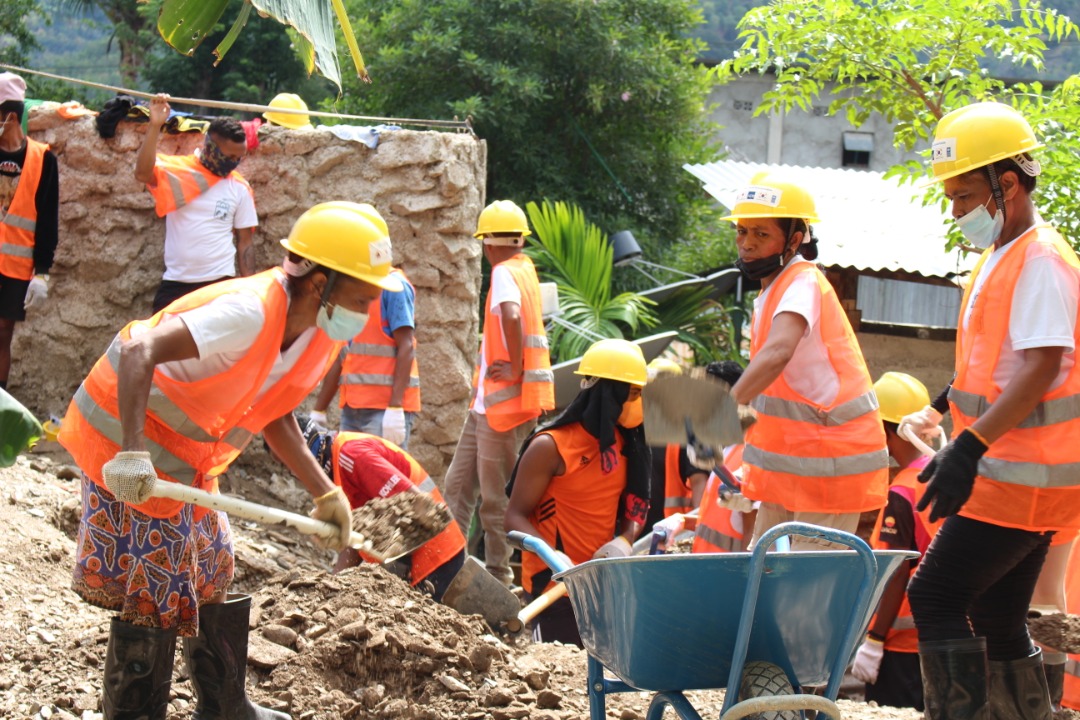
Timor-Leste, Cash for Work Project participants cleaning debris from the flood in their neighborhood.
A Personal Commitment: Following My Wife’s Career
While working at Timor-Leste, I made a decision that shaped both my personal and professional life. On International Women’s Day all the staff at the office made two commitments -one professional, one personal. Mine was to support my wife’s career. Soon after she received an offer to work in public health at the WHO Western Pacific Regional Office in Manila. It was now her turn and I followed.
Soon after landing in Manila, I secured a consultancy at WHO and joined the Health, Law and Ethics Division, engaging parliaments across Asia-Pacific on legislation for cross-border health collaboration. A year later, my wife took a field post in rural Laos. I followed again, volunteering as an English teacher while continuing WHO work remotely. Those experiences reshaped my understanding of what it means true collaboration, recognizing that progress often comes from creating space for others.

Engaging Parliamentarians in the Republic of Korea on their role in health security.
Homecoming to Seoul: Joining UNDP’s Best-Practice Hub
I didn’t know UNDP had a policy center in Seoul until I read the job description for a role that seemed written for my blend of field and policy experience. I learned about UNDP’s long relationship with Korea - from a country office opened in 1966 to support one of the poorest, war-torn countries in the world, through decades of partnership and evolving funding, to Korea’s transition to OECD membership and the establishment of the UNDP Seoul Policy Centre (USPC). Returning felt like the right next step.

UNDP Seoul Policy Center team posing with former UNDP Administrator, Achim Steiner.
Korea and UNDP: A Partnership That Proves Multilateralism Works
The partnership between UNDP and Korea is a living testimony to why multilateralism matters. When UNDP opened its country office in Korea in 1966, the country was devastated by war and poverty. Over the next four decades, UNDP implemented more than 240 projects across sectors - from fisheries to governance to women’s empowerment - supporting Korea’s transformation into one of the world’s leading economies. This journey is often called the “miracle of the Han River,” but behind the miracle were institutions, democracy, and inclusive policies.
Funding patterns tell the story: in the early years, UNDP’s budget for Korea was fully internationally financed. By the late 1990s, Korean government contributions matched international funding. By the end, programmes were 100 percent nationally funded. When Korea joined the OECD DAC, the country office closed, but the partnership evolved. Korea and UNDP agreed to continue sharing Korea’s development lessons with other countries. That is why USPC was established: to facilitate knowledge exchange between Korea and the world.

Supporting UNDP-ROK high-level dialogues.
The Seoul Policy Centre: A Best-Practice Hub
Unlike other UNDP global policy centers with fixed themes - Oslo on governance, Istanbul on private sector partnerships, Singapore on digital, USPC is knowledge-driven across a selection of thematic areas. Our mandate is to curate Korea’s tested policy practices and share them with countries seeking solutions, pairing knowledge exchange with seed funding to enable adaptation in local contexts. It is multilateralism at eye-level: a civil servant in Seoul speaking frankly with a civil servant in Sarajevo; a gender policy lead in Córdoba sparring constructively with a counterpart from Busan.
At USPC, I lead the Governance and Gender Team, one of four thematic teams alongside Green Transition and Recovery, Development Cooperation, and Private Sector Development and Partnerships. Our flagship initiative is the SDG Partnership Programme. In essence, it combines seed knowledge- policy tools and lessons from Korean institutions - with seed funding of USD 100,000 to pilot those insights in partner countries.
The funding is modest, but the catalytic effect is real. The power lies in field demand-driven peer-to-peer exchange - local professionals dialoguing with local professionals, so that reform ideas move with legitimacy, practicality, and context.

Moderating a webinar for knowledge exchange between Korea and partner countries
Impact Stories: When Pilots Become Policy
One of the most rewarding moments of my work is hearing impact stories of actual institutional change from partner countries. Montenegro is a case in point. With Korea’s Anti-Corruption and Civil Rights Commission, we shared a policy tool called Anti-Corruption Initiative Assessment. Montenegro adapted it, assessed over 130 public institutions across five sectors, and crucially, nationalised the approach beyond the project. They even presented their success at the UN Convention Against Corruption.
Argentina offers another example. We shared Korea’s Sunflower Centres - one-stop services for survivors of gender-based violence. Argentina adopted quality assurance mechanisms to monitor and improve services in Córdoba, then shared lessons with Salta and convened peers from Brazil, Uruguay and Guatemala. What began as seed knowledge grew into a regional conversation.
Bosnia and Herzegovina show how innovation meets urgency. Technology-facilitated gender-based violence (TFGBV) is rising faster than policy can keep up. Through exchanges with Korean police, Bosnia created a designated police unit to tackle TFGBV - backed by national resources and staff. Institutional change may be the slowest, but it’s also the most durable type of impact.
Uzbekistan and Tajikistan illustrate the network effect we aim for. Our partnership in Uzbekistan sparked a peer exchange with Tajik counterparts. When we announced a new call on whistleblower protection, Tajikistan’s Anti-Corruption Agency and UNDP CO applied proactively, citing their exposure to the Uzbek experience as the motivation. That is the ripple effect of multilateralism done right.

Youngchan at a SSTC workshop in Western Balkan
How We Work: Field-Grounded, Locally Tailored
If there is one principle that has guided me from the field to policy and back, it is this: policy must be grounded in reality. Good ideas on paper need listening, adaptation, and time in local soil. Korea’s experience is not a panacea; it is a reference point. True change is co-designed with local stakeholders.
I also learned that SDGs are interlinked. COVID made it clear: health systems needed legislative backing for cross-border cooperation; elections needed public health safeguards; justice needed digital access. Work in one goal nudges progress in others. We don’t move the world forward in silos.
Innovation, Risks and the Driver’s Seat
Technology tends to outpace policy, and bad actors often adopt it first. Technology-facilitated gender-based violence (TFGBV) is the clearest example: gender-based violence amplified by digital tools. Technology is a fast moving train and we need to be in the driver seat. Our new partnership with Korea’s Ministry of Government Legislation will share how Korea uses digital tools and AI to increase access to legal information and strengthen access to justice. The principle is simple: maximise the benefits of digital transformation for the people we serve and regulate the risks with clarity and speed.
Leadership, Twins and the Practice of Care
My twins arrived last year in early November. Anyone who has parented newborns - let alone two - knows that sleep becomes a luxury and humility a daily practice. The mission-driven nature of our work can make self-sacrifice feel noble, but I have learned to prioritize health and family. Sustainable development work is only sustainable if we are, too.
When work gets tough, I hold onto two anchors: field memories that remind me why this work matters when I start to doubt, and rituals that release stress: baseball and karaoke. In Timor, where baseball wasn’t available, we improvised softball with colleagues from embassies and aid agencies. Where there is no karaoke, I sing at home. Small joys keep the larger purpose clear.

Family picture with the newly arrived twins.
Advice to Young Professionals: Step, Learn, Document
When interacting with students they often ask me how to specialize. My answer is always the same: take the pressure off your shoulders; you don’t need a 20-year plan. Take the opportunities in front of you, do your best, and document your lessons. Those notes will become your compass. The path won’t be linear; embrace change, curiosity, and service.
And remember the ladder metaphor: when you are choosing a ladder, look up to see where it is going; when you are climbing, watch your next step so you don’t fall.
Professionally, I aspire to serve again in the field - perhaps one day as a UNDP Deputy Resident Representative or Resident Representative. Personally, I aspire to keep being the partner and parent my family deserves. In both, the core remains the same: people matter - the people we serve, and the people we serve alongside.
Korea has taught me that multilateralism works when it is grounded in local realities and shared with humility. While in Timor-Leste with UNDP, I witnessed firsthand that governance is human. WHO taught me that health needs laws, and parliaments need science. The UNDP Seoul Policy Centre teaches me daily that seed knowledge and seed funding can grow forests.
I started life as a frog in a well. Today, I am navigating the sea, rowing forward alongside frog friends I met along the way, with purpose and with hope.
Related
content
content


