

 Locations
Promoting community-based reforestation, and developing micro water catchment structures to increase water availability for the improvement of livelihood in Oebaha.
“Making my forest green again”
August 1, 2023

The activity of collecting water from several women in Oe-baha
Maria Silvia D.R. Lopes/UNDP Timor-Leste
Instead of heading to school, each day, 12-year-old Gilberto Elu sets out on his six-hour journey to fetch water. By his side is Ludvina Oki, 64, who has spent nearly all her life – 51 years ever since she was 13 – fetching water for her family.

Gilberto Elu, a 12-year-old boy, fetching water for his family.
Maria Silvia D.R. Lopes/UNDP Timor-Leste
Despite her age, Oki has to make the three-kilometer trek barefoot, climbing up and down a couple of hills every day, to fill up three jerricans of water. As she finally arrives at the small pond after the lengthy trekking, she has to wait in a long queue for more than an hour to fill the jerricans, as the amount of water is limited, or even not enough sometimes. The return journey is even more debilitating. With all her jerricans full, Oki carries 15 litres of water along the rugged mountain road back home. In all, it is a six-hour journey.
For Oki, with each passing year, the journey becomes a heavier burden. When we caught up with her, she expressed thoughts about how she might die on the trail given the intense physical demand.
Her skin is darkened and wrinkled by the hours in the sun, and her feet, she said, are perpetually bruised.
This is the daily task Oki and her fellow women have been doing for decades. The precious water they bring will be used mostly to cook and drink – there is not much left after that to wash clothes or bathe. It is hard, but it is the only way to survive.
If things do not change, the trek will also define the life of 12-year-old Gilberto Elu.
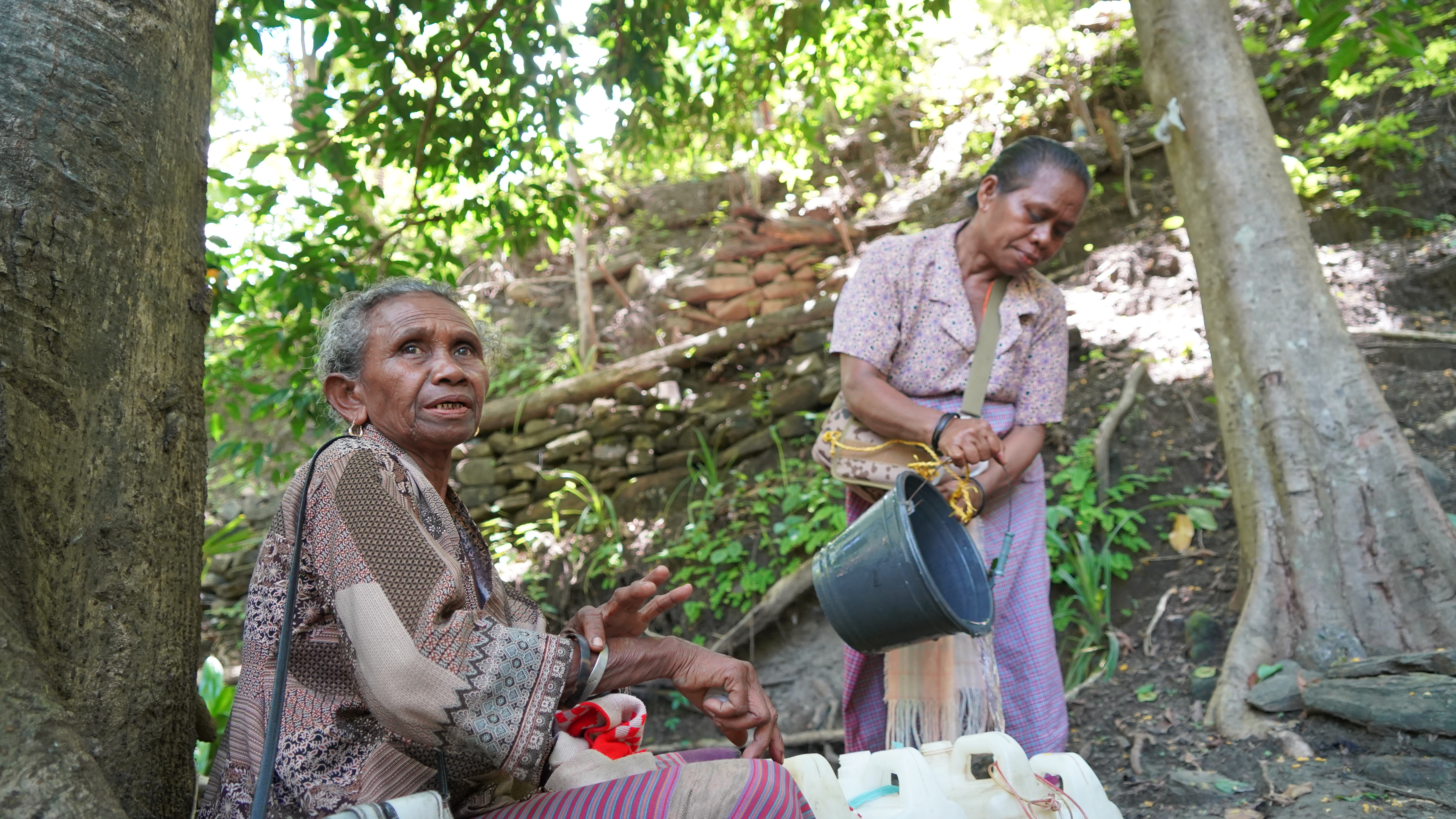
Ms. Ludvina Oki is in the queue to fetch water
Maria Silvia D.R. Lopes/UNDP Timor-Leste
Oebaha, where Oki lives, is located in Oé-cusse, an enclave of Timor-Leste, 200m above sea level, with a semi-arid climate. It has a population of 238 families, among which 70 percent live below the poverty level. Most of them have lived without much water for decades.
It is a place that suffered significantly from the impacts of climate change – severe droughts, heavy rains, and flash floods. Meanwhile, deforestation has dramatically increased due to harmful agricultural practices. Together, these factors caused and intensified land degradation and water scarcity, trapping the community in a poverty cycle. How can we hope for a better future if children have no access to clean water?
Moreover, water scarcity interlinks with gender inequality and domestic violence. In Oebaha, water collection is undertaken mainly by women and girls from natural springs and wells located 500m-750m downhill from the community. The daunting journey across the steep hills needs to be completed twice a day, and the two to three kilometers of walk takes up the whole day. Ms. Dora Tia Teme, 67, said that she often argues with her household and other women in the village, as she barely has time to do household chores due to the all-day travel to fetch water.

Over 50% of the forested area in Oé-cusse is degraded by harmful cultivation practice (slash and burn)
Maria Silvia D.R. Lopes/UNDP Timor-Leste
Oki hopes that the situation improves. If she can get water closer to home, she could spend more time doing other work or taking care of her grandchildren. “If the situation in my village improves, we can continue to live here. Otherwise, we may have to move to another place for a better future,” said Oki.
In response to the devasting water scarcity, the UNDP Special Economic Zone (ZEEMS) project launched several activities that focus on creating awareness, promoting community-based reforestation, and developing micro water catchment structures to increase water availability for the improvement of livelihood in Oebaha.
“Previously, Oebaha had plenty of water, but we started losing it due to deforestation and climate change-related disasters. Through the UNDP Special Economic Zone (ZEEMS) project, we are working closely with the community and NGOs, supporting infrastructure such as water supply systems and water-saving techniques, and planting trees,” said Patricia Porras, the ZEEMS project manager. “To tackle this problem, we need to find a long-term, sustainable solution.”
In cooperation with the Special Administrative Region of Oe-cusse Ambeno (RAOEA), the ZEEMS project supports the development of micro water catchment and community-based reforestation to enhance access to clean water and livelihood in Oebaha. The ZEEMS project plan to provide this vulnerable community with a solar-powered water supply system to facilitate the water supply, so that women no longer need to carry water uphill every day. Also, the ZEEMS project assists in planting trees of various species, including coconut, mango, banana, jackfruit, orange, and areca nut, to reduce soil erosion and maintain water balance in the micro-catchment areas. This will bring multiple benefits to the community – in addition to improving the resilience of the land, the Oebaha community can sell these fruits and produce local products with the planted trees for their sustainable livelihood.
For Oki, the ZEEMS project is a long-awaited ray of hope. “Perhaps I won’t live to see that day when water comes to my home. But I’m glad that things started to move ahead to change the life of my grandchildren. They shouldn’t experience the hardships my generation had to go through” she said.
Story by: Maria Silvia D.R.Lopes & Ayumi Kimura
Directed by: Cedric Monteiro

Daily activity of women in Oe-baha
Maria Silvia D.R. Lopes/UNDP Timor-Leste