

 Locations
The value of light in bringing change
Counting Costs in the Dark
December 22, 2025

Manuel da Costa demonstrates how a solar lantern illuminating his home in Uma Naruc once cost his family $30-$40 monthly in kerosene, now provided free by the sun.
Photo: UNDP BRH/Kapil Das
In a village under the Manatuto municipality, every month, a 43-year-old Manuel da Costa spends his mornings calculating what his family of six could afford and what may have to be sacrificed to keep the lights on.
A large portion of his family’s average monthly expenditure is spent on finding alternate—often expensive—sources of lighting, as they continue to remain disconnected from the main grid.
Kerosene costs go up $30 to $40 monthly. While car batteries range anywhere between $30 to $40 for smaller ones and $80 to $100 for larger capacity ones. When batteries fail—and they usually do—or die down, the entire cost is doubled.
By the end of each month, energy expenses often become a source of financial stress, especially in households with an average income of $200 monthly. Manuel’s home is one such example.

Manuel's family of six benefits from a solar lantern inside their home. This portable, reliable light source is ready for evening use, eliminating the need for batteries or fuel. The switch saves his family a significant amount of money every month. Photo: UNDP BRH/Kapil Das
Manuel is a farmer in the sub-village of Bua. For him and his family, darkness brings more than inconvenience; it also often brings anxiety. Manuel's farm animals graze on land beyond his house, and his crops demand careful attention. Most nights, he circles these grounds with inadequate lighting at night to safeguard his house and farm animals from theft or predators.
"We didn't feel unsafe in our home," he says carefully. "But we felt uneasy about our animals, about our livelihood out there in the dark. We needed to check on them, especially at night, but it was difficult."
At the same time, his family struggled with everyday tasks in the absence of reliable lighting throughout the day.
"We needed light for everything—cooking, cultural gatherings at home, our daily routines," Manuel explains. "But we also needed to save for cultural expenses, for our obligations to extended family. The money going to kerosene and batteries should have gone to our children, to our future."

Manuel walks through his village compound with his son—a father who can now extend his work and family time past sunset, no longer constrained by expensive, unreliable lighting solutions. Photo: UNDP BRH/Kapil Das
A significant shift came in 2025, when Manuel’s household was one of the 1000 beneficiaries of a solar panel kit and an improved cooking stove as part of the UNDP Pacific Green Transformation Project, supported by the Government of Japan. The installation included a solar panel, four lanterns, cables, a charger, and a remote control.
"Everything changed with our daily routines," Manuel reflects. "Cooking became easier. The kids could study properly. We could gather with family in the evenings.”
For Manuel's wife, the extra hours of light have expanded her possibilities—giving her time to weave, sew clothes, create mats, and tablecloths—to revive traditional crafts which can become a future source of income.
"My wife can do so much more now at night," Manuel observes. "Helping the children, household tasks, and her crafts. We share the work. I repair walls and garden fences, and she manages the household and helps the kids with their studies. We both believe women and men carry the same responsibilities for sustaining our family."

Manuel carries wood he uses to make a sturdy fence around his farm—protecting his crop and property. Photo: UNDP BRH/Kapil Das
The children's education has also transformed drastically. Before solar power, they studied using kerosene lamps under its diminishing beam. Now they work under reliable, bright light long beyond the sunset.
"Our children study better, for longer periods, without hurting their eyes," Manuel says with satisfaction. "They can finish their homework properly. They have the same opportunities as children in places with electricity."
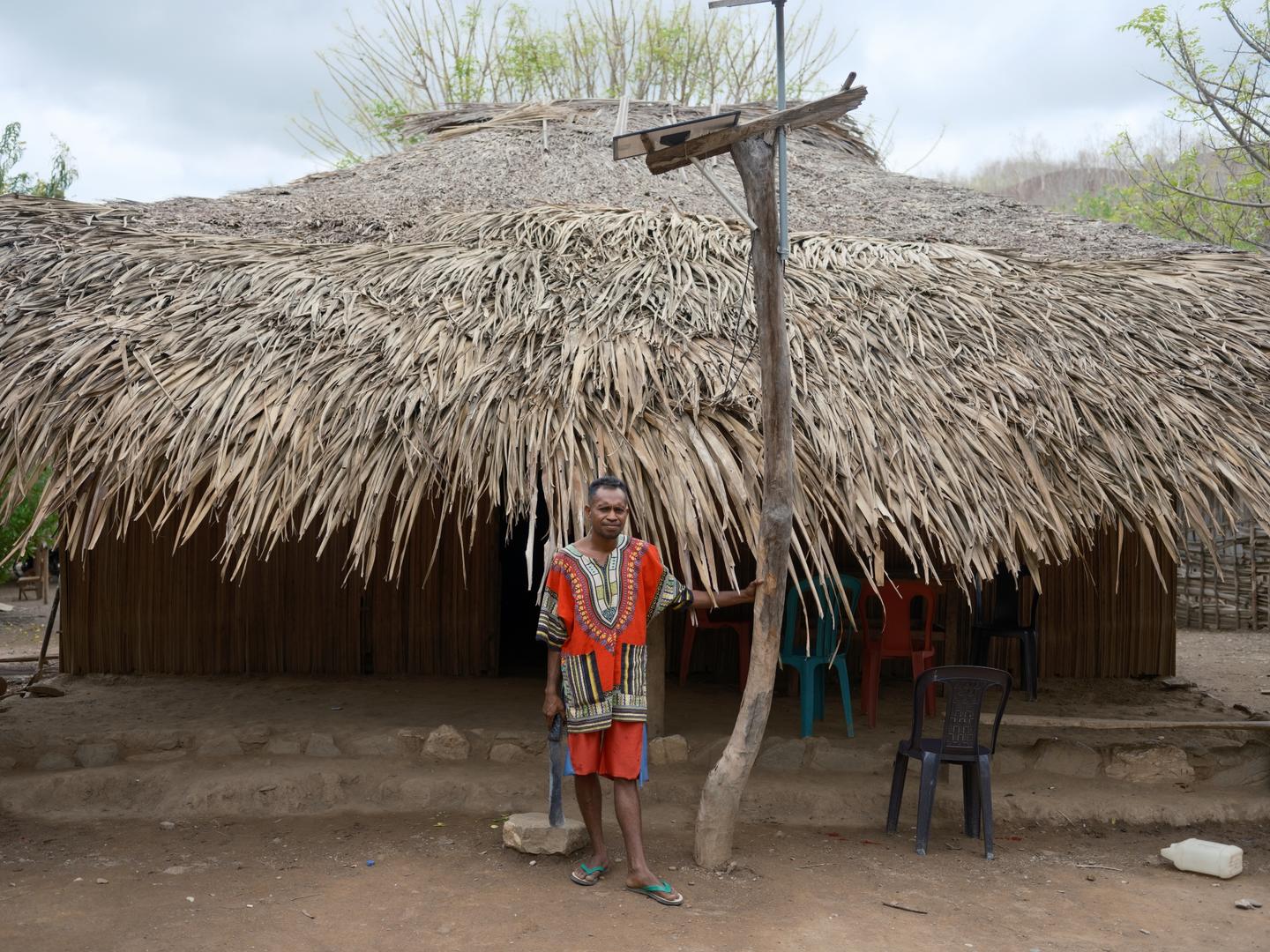
Manuel stands before his traditional home in the sub-village of Bua, where solar panels mounted above have transformed daily routines for his family to feel more secure after dark. Photo: UNDP BRH/Kapil Das
His family’s largest source of stress was the financial dent energy costs would create, but the financial benefits of solar panels have been instrumental in transforming their lives. Manuel estimates he saves a substantial amount of money every month now. Those savings are now redirected towards children's books, household necessities, and family gatherings.
The portable lanterns also bring in a new sense of flexibility. He could carry them wherever needed—out to check the animals, across the grounds to inspect crops, into different rooms as work demanded. Additionally, these lanterns have two switches; the second switch has a lower-power setting that lasts all night.

Manuel gestures toward the solar panel above his home that has increased security for his livestock and crops, allowing him to check on animals at night with portable lanterns and eliminating the constant anxiety about things disappearing in darkness. Photo: UNDP BRH/Kapil Das
Across Timor-Leste, many households like Manuel's remain off-grid, unable to experience the independence that reliable energy can bring. Through the UNDP Pacific Green Transformation Project, supported by the Government of Japan, families like Manuel's are discovering what becomes possible when darkness no longer limits their choices.
For now, in Bua, Manuel da Costa no longer calculates the cost of light; instead, the possibilities it holds.