Locations
Strengthening Justice and Security Sector Governance in Pakistan
Project Summary
The rule of law is integral to building peaceful, just, and equal communities. Pakistan’s justice and security sectors face multidimensional challenges, including outdated policies, poor infrastructure, a lack of capacity, and limited service delivery. This impedes the rule of law. From from the rights holders’ perspective, access to justice, legal awareness, and legal aid remain largely inaccessible for many, particularly women and marginalized groups.
As the keystone for peace, security, and development, the UNDP Rule of Law Programme, active since 2011, strengthens justice and security sector governance in Pakistan. Its approach prioritizes sustainability, national ownership, digital transformation, and a people-centered focus to ensure efficient, gender-responsive, and inclusive access to justice and security for all.
The Programme supports policy reforms, institutional capacity building, infrastructure development and renovation, legal empowerment, as the upgrade of digital systems and services. The Programme works in close cooperation with federal and provincial government departments, courts, law enforcement agencies, community-based organizations, civil society, women’s networks, and legal aid service providers to empower people to seek and exercise their rights. Taken together, the Programme delivers interventions that build public trust and confidence in governance institutions.
Objectives
- Strengthen policy, legal, and regulatory frameworks by providing technical advice and assistance.
- Increase the capacity of justice and security stakeholders to deliver inclusive, timely, and accessible services.
- Empower women and the most vulnerable and marginalized communities to access referral pathways to justice and security.
- Improve institutional facilities in the justice and security sector through infrastructure development
Outcomes
- Developed 23 policy documents for the justice and security sectors in Balochistan, KP, and Gilgit-Baltistan, and trained 1,120 justice stakeholders (33% women) and 2,726 law enforcement personnel (15% women) to improve service delivery.
- Established 72 virtual courts and 75 access points, enabling over 50,720 hearings in 2024 (compared to 16,000 in 2022), alongside the digitization of 85 years of KP Bar Council records.
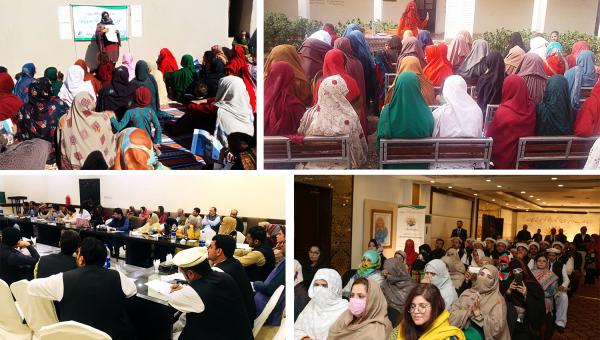
- Raised legal awareness among 35,000 people (including 10,000 women) and provided legal aid to over 700 individuals, primarily women, in the targeted districts.
- Improved infrastructure in 29 facilities, directly benefiting 4,500 security personnel and 5,426 inmates.
- Demonstrated improvement in public trust, with a 2022 survey reporting high respondent satisfaction in interactions with police (73%), jirgas (81%), and peace committees (82%), and reported improvement in courts (37%), police (32%), and local/district governments (26%).
Project Brief