Locations
Climate Resilience Programme
Project Overview
Pakistan is among the world’s most climate-vulnerable countries, ranking 8th on the Global Climate Risk Index. Rising temperatures, shifting rainfall patterns, accelerated glacial melt, increasing pollution and recurring climate disasters continue to disrupt lives, livelihoods, and ecosystems. These impacts place immense pressure on natural resources and the economy, with women, youth, and marginalized groups bearing the greatest burden.
The Climate Resilience Programme (CRP) responds to this challenge by strengthening Pakistan’s capacity to adapt to and mitigate climate change through policy support, institutional strengthening, and community-led interventions. Anchored in national priorities such as the Nationally Determined Contributions (NDCs) and Vision 2025, and aligned with global frameworks including the Paris Agreement and Agenda 2030, CRP promotes inclusive, evidence-based climate action across key sectors.
The programme adopts a layered and circular approach: supporting national policy development while equipping communities with the skills, tools, and resources required to adapt, with grassroots learnings informing national climate strategies.
The United Nations Development Programme (UNDP) serves as the Secretariat of the National Plastic Action Partnership (NPAP) in Pakistan, part of the World Economic Forum’s Global Plastic Action Partnership. In close collaboration with the Ministry of Climate Change and Environmental Coordination, UNDP is also leading cross-sectoral efforts to tackle plastic pollution and transition to a circular plastics economy under NPAP.
Objectives
- Strengthen institutional capacities at national and sub-national levels for evidence-based, inclusive, and climate-smart decision-making.
- Support the Government of Pakistan in meeting international commitments under the Paris Agreement, including the NDCs and Long-Term Low Emission Development Strategy (LT-LEDS).
- Advance just transition pathways by equipping women, youth, and vulnerable groups with green skills and sustainable livelihood opportunities.
- Promote circular economy models and reduce plastic pollution through the National Plastic Action Roadmap under NPAP.
- Strengthen cooperation and partnerships among government, civil society, private sector, and communities for stronger climate resilience.
Outcomes
- Support the revision of Pakistan’s NDCs in 2021 and continue to provide technical assistance for NDC 3.0, as well as the development of frameworks such as LT-LEDS and the National Adaptation Communication Report.
- Facilitate the development of national and regional climate policies, including the National Climate Change Policy, Karachi Climate Action Plan, Balochistan Climate Change Policy, and Gilgit-Baltistan (GB) Environment Policy.
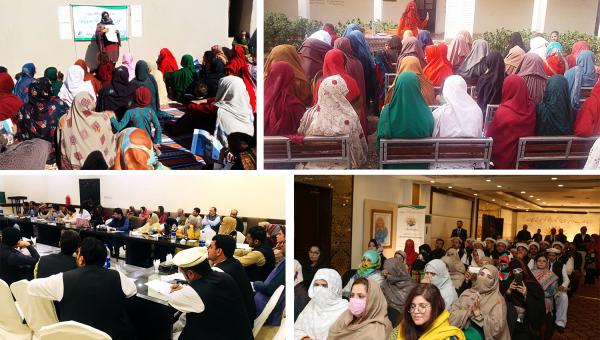
- Train more than 4,000 youth, half of them women, in GB and Sindh in climate-smart skills such as beekeeping, floriculture, food preservation, oil extraction, wool processing, water harvesting, and e-commerce, enabling climate-resilient livelihoods.
- Established 16 Green Business Centres in GB, training 370 women in biodegradable bag production and supporting local eco-friendly enterprises.
- Launched Pakistan’s first National Plastic Action Roadmap, a milestone in advancing circularity, gender-responsive micro, small and medium enterprises MSMEs, and sustainable waste solutions.
- Pilot nationwide initiatives, including the distribution of 600 fuel-efficient cookstoves in forest-dependent communities of GB and Balochistan as well as the establishment of the Green Career Launchpad at the University of Baltistan to prepare youth for the emerging green economy.
Project Brief