Locations
Water for Development
Project Summary
Pakistan is among the world’s most climate-vulnerable countries, facing rising temperatures, melting glaciers, floods, and droughts, which directly impact both ecosystems and livelihoods.
The Water for Development (W4D) initiative focuses on Gilgit-Baltistan (GB), one of Pakistan’s most climate-sensitive regions, to strengthen adaptation and resilience in the region. By addressing scientific, technological, and institutional gaps, the project aims to improve glacier and water monitoring, support sustainable agriculture and livestock value chains through the establishment of modern laboratories for water analysis, improve glaciology lab and related technical assistance, crop health, and animal disease control, and promote eco-tourism as a driver of conservation and job creation.
By building the capacity of government institutions, communities, and the private sector through training and awareness campaigns, W4D ensures sustainability in managing climate risks in alignment with Pakistan’s National Climate Resilience and Adaptation Plan (2023–2030) as well as Sustainable Development Goal (SDG) 6 (Clean Water and Sanitation), SDG 13 (Climate Action), and SDG 15 (Life on Land).
Objectives
- Improve climate resilience and disaster risk management by strengthening glacier and water resource monitoring, data collection, and information sharing with the GB Environmental Protection Agency, Disaster Management Authority, and academic institutions, including Karakoram International University and University of Baltistan .
- Strengthen agriculture and livestock value chains by establishing modern phytopathology and zoo-prophylaxis laboratories to ensure sustainable, evidence-based practices.
- Advance sustainable tourism as a key driver for conservation and diversified livelihoods, partnering with the GB Department of Tourism to build inclusive, community based eco-tourism models.
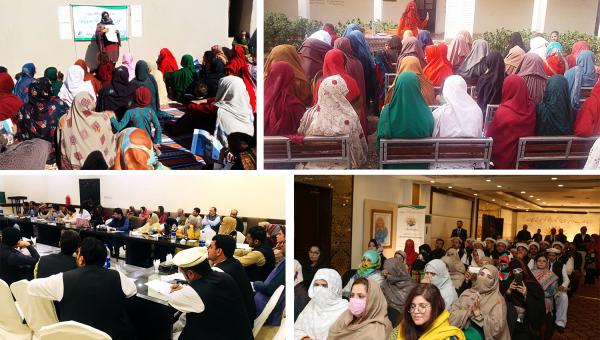
- Build institutional and community capacity for sustainable natural resource and mountain ecosystem management through targeted, gender-inclusive training, awareness, and private sector engagement.
Outcomes
- Strengthened institutional effectiveness for water and disaster management through the installation of four meteorological/hydrometric stations, upgrades to Geographic Information System (GIS) technology, and glaciology lab enhancement, resulting in informed disaster risk planning.
- Enhanced agricultural and livestock practices supported by upgraded laboratories for water analysis, crop health, and animal disease control, benefiting over 250 farmers through improved productivity and food safety.
- Sustainable eco-tourism models established and implemented, setting criteria aligned with international standards (e.g., Global Sustainable Tourism Council (GSTC) / ISO) and creating more than 100 new jobs for local communities.
- Improved knowledge and technical skills across government and communities, with over 1,000 officials and community members trained in mountain ecosystem management and climate-resilient policies.
- Long-term sustainability ensured through public awareness campaigns and private sector engagement, promoting best practices and stakeholder collaboration for effective policy implementation.
Project Brief