

 Locations
Fraud Risk Management Training at UNDP Indonesia: Building a Work Culture of Integrity
May 5, 2025
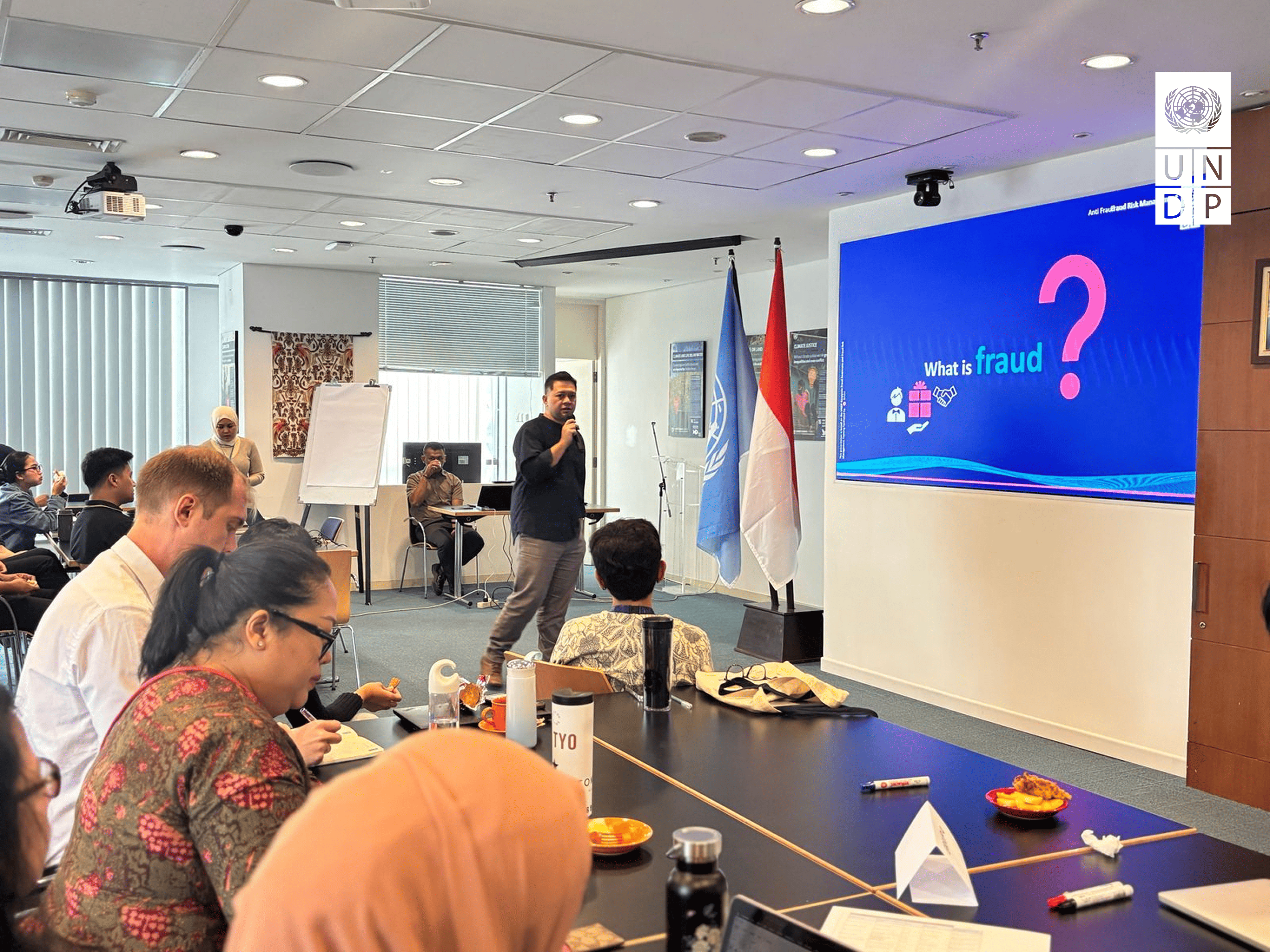

Fraud does not just cost money, it costs trust. When development funds meant to support vulnerable communities are lost to fraud or mismanagement, the consequences are far-reaching. At UNDP, maintaining public trust and ensuring resources reach those who need them most is a non-negotiable priority. That is why UNDP’s Zero Tolerance Policy on fraud is important. It is not just a rule; it serves as a reminder that integrity in our work is a shared responsibility.
Recently, I had the opportunity to participate in UNDP Indonesia's second Fraud Risk Management Training. Far from a box-ticking exercise, this session marked a key milestone in our structured and systematic approach to fraud prevention. It brought together staff from every level and unit—team leaders, project implementers, and operational colleagues alike—for a hands-on experience that invited us to reflect on how fraud risks can touch every layer of our work.
One of the most notable improvements in this year’s training was its practical, interactive design. I recalled last year’s session, which was opened by Ms. Indira Malik from the Corruption Eradication Commission (KPK). Her insights, drawn from real cases, laid a strong foundation. Building on that momentum, this year’s training went deeper—introducing tools like risk assessment matrices, scenario analysis, and early warning systems. These were not just theoretical concepts; they were applied directly to our daily responsibilities. Through group work and case studies, we analyzed real-world scenarios, recognized red flags, and explored how best to respond. This shift from theory to practice made the training more engaging and immediately useful.

Having worked at UNDP Indonesia for almost a decade, I have witnessed firsthand how the organization has grown in both ambition and scale. As our portfolio expands to become one of the most dynamic in the region, with steadily increasing programmatic expenditures, so does our exposure to operational risks. This growth demands not only agility but also vigilance. Participating in this training helped me better understand how fraud risks can emerge—even in fast-paced, complex environments—and what concrete steps we can take to prevent them.

One moment that stood out during the case study session was when my peer in the training group, Ms. Ratna Sari, FOLUR Project Manager, shared how the training equipped her to strengthen internal checks for activities implemented in the field. She highlighted how a simple adjustment, like cross-verifying vendor documentation with community feedback, can significantly reduce risk. Many of us found this highly relevant, as similar challenges often arise when working away from the Jakarta office. In addition, Mr. Ari Yahya, Head of the Management Performance Oversight Unit and the session’s facilitator, reminded us that integrity starts with creating a safe space—where staff feel free to raise concerns without fear of judgment or retaliation.
For me, this training was a timely reminder of why we do the work we do—and how easily its integrity can be compromised if we are not paying attention. Fraud risk management is not about policing each other; it is about strengthening systems and fostering a culture of accountability to protect the communities we serve.
Moving forward, we need to keep reinforcing this culture—not just through policies, but through everyday actions. That means asking questions, raising concerns, and supporting one another in doing the right thing.
Integrity is not built in a day. But with continued efforts like this training, we are taking real, necessary steps to make it part of how we work—every day.