

 Locations
Reflection on #HDR2015: Building a Decent Work Agenda for Moldova
January 21, 2016


The 2015 Human Development Report, launched in December 2015, is entitled “Work for Human Development”. Work is essential to human development and it implies much more than jobs that generate income. It includes unpaid care work, creative and voluntary forms of work. Not all work is sustainable and contributing to human development in a sustainable way.
Over the past two decades or so, the Europe and Central Asia (ECA) region in general and the Republic of Moldova, in particular, made important progress in terms of human development.
As the Global Report underlines, women and men have an unbalance participation on the global labor force.

At global level, female participation in the labor force and employment rates are heavily affected by economic, social and cultural issues and care work distributions at home.
Women carry out the major share of global work, they face disadvantage in the world of work, both in paid and unpaid work.
In Moldova, based on the recently conducted Time Use Survey, the time use is as per below infograph:
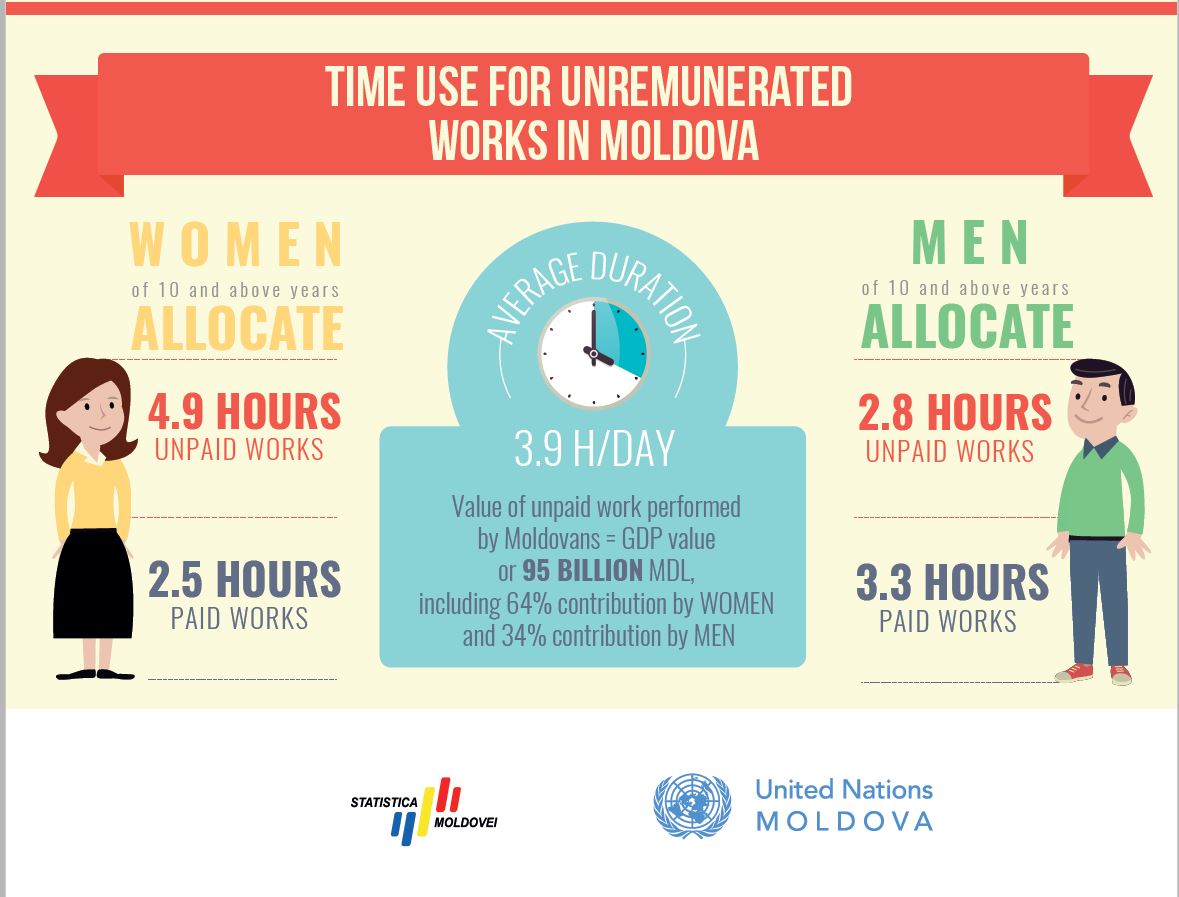
One of the components of the Moldova HDI which drags down the national achievements is related to income dimension. The economic growth in the recent years has been to a large extent jobless. With the current economic downturn the achievements in terms of human development come under high risk. Decent jobs were recently flagged by people of Moldova in the national post-2015 consultations as their highest aspiration of future development and improvement of the living conditions.

The Human Development Report shows that at global and regional levels youth unemployment trends are worrisome. In Moldova, more than 30% of young graduates do not work in areas close to their fields of specialization and higher education. Youth unemployment rate in Moldova is about 21% (2015) and might further increase.
At UNDP Moldova we foresee several policy alternatives to enhance human development through sustainable work:
- Creating more work opportunities to expand work choices - setting an employment target and formulating and employment-led growth strategy. With employment focus in mind, economic growth could progressively turn into job-rich growth and labor market could become more inclusive, particularly for excluded groups like disabled, women, ethnic minorities, etc. But creating more work opportunities might not bring equal results for men and women. In Moldova, the existing wage gap remains high. It is an indication that opportunities and related policies can still be improved to facilitate better and more equal inclusion of women on local labor market.
- Ensuring workers’ well-being to reinforce a positive link between work and human development – ensuring that people with disabilities can work, targeting interventions for older people, fairer pensions and social benefit systems, among others. Such priority areas were flagged during the post-2015 consultations. There is much work ahead in the reformation of the pensions system in the country. Unemployment benefits shall not constitute a disincentive for work, as it turns to become due to still very limited work force mobility, limited job opportunities and low remuneration levels in rural areas. The Government might be interested to invest into direct employment guarantee programmes.
- Targeted actions to address the challenges of specific groups and contexts - more efforts in promotion of women to high-level positions, enlarging care options (day-care center, after-school programmes, senior citizens’ homes and long-term care facilities), engaging young people in finding innovative solutions to sustainable employment. Additional and extended child care options would allow women, particularly in rural and remote areas, but also in the capital city to access at least part-time jobs. The availability and coverage of such day-care options is critically low. Based on the available data, only 10% of women with children aged 0-3 years and only 33% of women with children aged 3-7 years are employed.
UNDP Moldova is tackling the unemployment phenomena through various initiatives and projects. An example is the Innovative Entrepreneurship for Sustainable Employment Project, which seeks to spur relevant employment and self-employment through the development of soft and entrepreneurial skills. So far, the project benefited more than 300 skilled unemployment with a success rate on the employment side of about 75-80% in five regional employability centers spread throughout the country. Nevertheless, the number of highly skilled unemployed remains high and growing. In 2014, based on National Bureau of Statistics data, every fourth unemployed had higher education, compared to 10% in 2000. Another example is that of the Better Opportunities for Women and Youth project, which promoted women entrepreneurship and youth engagement into income generation activities throughout the country.