Publications
UNDP publications on social protection showcase the organization’s thought leadership and technical expertise in advancing inclusive and resilient systems.
Publications
Resilient Human Development: Advancing Human Development amidst Shocks and Crises
This paper introduces the concept of Resilient Human Development, a framework that adapts the human development approach to today’s reality of recurring, overlapping crises and interlinked stressors—climate, economic, political, and social shocks. It is the first background paper of the Latin America and the Caribbean (LAC) Regional Human Development Report 2025.
Social protection offer for Latin America and the Caribbean
Social protection plays a crucial role in achieving sustainable development. At its core, sustainable development aims to meet the needs of the present without compromising the ability of future generations to meet their own needs. Social protection mechanisms contribute to this goal by reducing poverty, fostering social inclusion, and promoting economic stability.
Guidelines for care policies from a gender, territorial and intersectional perspective
Latin America and the Caribbean is immersed in a care crisis that is having a disproportionate impact on women and especially those subject to various forms of intersectional exclusion.
Multidimensional Poverty Index with a Focus on Women for Latin America and the Caribbean
This proposal for a Multidimensional Poverty Index with a focus on women seeks to call attention to the need to have information in surveys that allows poverty to be measured with a gender perspective.
Digitalization as a Driver of Inclusion
Digitalization is transforming the world but also represents challenges. The pandemic highlighted digital weaknesses in LAC. Despite progress, a significant digital divide remains, worsening inequalities. To overcome this, there need to be investments beyond access and infrastructure.
Poverty and Inequality Funding Window in Latin America and the Caribbean
UNDP has been a strategic partner of national governments, donors, and international financial institutions in the development of social protection systems in Latin America and the Caribbean.
Practical implementation of risk prevention and anticipation from a gender perspective
This policy note addresses the experience of the pilot design and implementation of a Multidimensional Risk Index System with a gender perspective to: i) strengthen community resilience, ii) improve early warning systems, and iii) ensure the protection and economic autonomy of women in vulnerable situations.
Toward a Regional Approach to Social Protection
This paper analyzes a regional approach to social protection in Latin America and the Caribbean (LAC), grounded in the universal principle that all individuals facing similar risks should receive equitable coverage, irrespective of labor status.
Recovery and disaster risk reduction in Central America
The present document searches to reflect on the results of recovery processes, considering a transformative and resilience-building approach, and analyzing its impact on the drivers of disaster risk.
A universal social protection system at the core of a new fiscal pact in Latin America and the Caribbean
This note aims to place the creation of a USPS at the center of the fiscal discussion in the region. To this end, the following section analyzes the importance for the countries of the region to transition to an USPS, to break the trap that combines inequality and low growth.
Digitalization as a Driver of Inclusion
Digitalization is transforming the world but also represents challenges. The pandemic highlighted digital weaknesses in LAC. Despite progress, a significant digital divide remains, worsening inequalities. To overcome this, there need to be investments beyond access and infrastructure.
A Better World for the Migrant in Latin America and the Caribbean
This book is the result of a joint research initiative of the Inter-American Development Bank (IDB) and the United Nations Development Program (UNDP) to improve the welfare conditions of the migrant population in Latin America and the Caribbean, and contribute to facilitate their integration into society through the generation of evidence on the provision of information and influence on policy design.
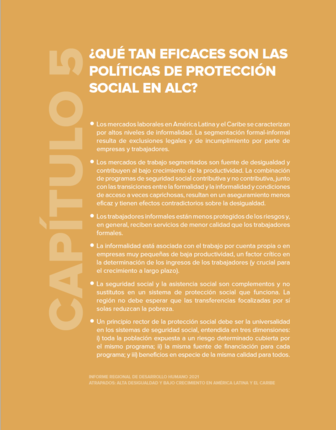
Social Protection Policies in Latin America and the Caribbean
A characterizing feature of labour markets in Latin America and the Caribbean is their high informality levels. The formal-informal segmentation of the labour force results from a mix of legal exclusions and non-compliance by firms and workers.
Financing for Development Challenges in Caribbean SIDS
Small states in the Caribbean, despite their past achievements in reaching the status of middleincome countries and medium to high ranking in the United Nations Human Development Index, currently experience a range of fundamental economic and social difficulties which threatens to reverse gains already made and impede future progress.
Microsimulation of the Auxílio Brasil
The fight against poverty and inequality is both a social and economic imperative. Reducing these disparities is not only a matter of social justice but also a smart investment.
Mercado laboral en Guatemala: Análisis de los últimos 10 años, proyecciones para los próximos 30 años.
Los objetivos de este trabajo son presentar un resumen del marco institucional del mercado laboral y las principales políticas de empleo en Guatemala, evaluar lo ocurrido del mercado en el país en los últimos once años (2011-2021), presentar escenarios para su evolución en los próximos 30 años con base en la evolución demográfica, y proponer políticas de empleo que puedan contribuir a incrementar el bienestar y la protección de la población.
Toward a Regional Approach to Social Protection
This paper analyzes a regional approach to social protection in Latin America and the Caribbean (LAC), grounded in the universal principle that all individuals facing similar risks should receive equitable coverage, irrespective of labor status.
Fortalecimiento del Sistema de Protección Social
Fortalecer el sistema de protección social nacional, particularmente el sistema No Contributivo (programas de asistencia social), con enfoque de género e inclusión, articulándolos con acciones de prevención respuesta y recuperación en contextos de crisis.