

 Locations
The Trees She Chose to Keep: Restoring Livelihoods and Biodiversity in Central Sulawesi
June 24, 2026

Femmi, a woman cacao farmer from Tuva Village, harvests cocoa pods from her own farm.

On the edge of the Lore Lindu National Park in Central Sulawesi, one farmer’s decision to keep her cacao trees is helping restore livelihoods, protect biodiversity, and build resilience in the face of climate and economic shocks.
In Desa Tuva, Femmi spends her mornings moving through rows of cacao trees that were once her parents' to tend. Together with her older sister, she now manages roughly three hectares of this land, checking pods for ripeness, inspecting branches she pruned weeks earlier, and tending to the trees she has been steadily replanting. It is steady, familiar work. It was not always hers to do.
As the youngest child, Femmi had stayed on with her parents while her older siblings moved on to their own households. For most of her life, Femmi’s role in the family was limited. Like many younger women in rural communities, she supported post-harvest work but was not involved in the daily management of the land. It can be either helping gather the harvest and dry the beans in the sun, or occasionally making the two-hour motorbike ride into town to sell what they had. The deeper work of the land, the planting, the pruning, the daily decisions a cacao tree demands, belonged to her parents.
When the Ground Gave Way
Everything changed in 2018, when the Donggala earthquake struck Central Sulawesi. The earthquake triggered widespread soil liquefaction across Sigi, severely disrupting local agriculture. Cacao trees that had borne fruit for years simply stopped. Some stopped flowering. Some stopped growing altogether. Some died where they stood.
For many smallholder farmers, this environmental shock quickly became an economic crisis.

Cocoa farmers like Femmi face compounding pressures: volatile global prices, climate-driven crop stress, and the lingering impact of natural disasters leave little room for error when a harvest falls short. Photo: UNDP Indonesia
The timing made things worse. As farmers across the region tried to recover, global cacao prices fell significantly during the pandemic years of 2019 to 2021, further reducing what little financial cushion remained. Across the region, many farmers shifted to short-term crops like corn and legumes—choices driven by urgent income needs rather than long-term sustainability.
Choosing to Stay
For Femmi, the hardship carried a second weight. Her father passed away during these difficult years, and her mother fell ill not long after. With her father gone, Femmi found herself stepping fully into work she had only ever assisted with before. Neighbors, not unkindly, urged her to do what everyone else was doing: clear the land, plant something that would pay off sooner.
She chose otherwise.
"Other people might depend entirely on what the garden brings in, but that wasn't my situation," she said. "There was my mother and me to think about. The cacao trees had already grown. Even if the harvest wasn't much, it was still cheaper to maintain them than to tear everything out and start over alone."
It was a decision shaped by necessity—but one that would ultimately align with a more sustainable path for both her livelihood and the surrounding ecosystem.
Learning to See the Trees Anew
That decision also opened the door to new knowledge and support. Femmi joined the Sekolah Lapang Kakao (Cocoa Farmer Field School) run in Desa Tuva by Badan Amil Zakat Nasional (BAZNAS), the National Zakat Collection and Distribution Agency in Central Sulawesi and the Tadulako University.
The programme is part of the Biodiversity Finance Initiative (BIOFIN), implemented by UNDP Indonesia in partnership with Indonesia’s Ministry of National Development Planning (BAPPENAS) and BAZNAS. It channels innovative financing—such as the Green Zakat Framework—into community-based conservation and sustainable livelihoods.
Through the Green Zakat Framework, zakat, the Islamic practice of charitable giving meant to support the poor and economically vulnerable, is being directed toward communities like Tuva, where many households depend directly on forests and farmland for their livelihoods.The approach recognizes a critical link: biodiversity loss and rural poverty are deeply interconnected. Supporting farmers to restore existing land—rather than expand into forests—helps protect ecosystems while strengthening incomes. For Femmi, the field school introduced practical techniques that transformed the way she managed her family's trees. Like many farmers in the area, Femmi inherited older cacao varieties that were difficult to manage and less productive—requiring more labor while yielding less income.


The Cacao Farmer Field School introduces participants to sustainable agricultural practices — from grafting techniques and organic fertilizer production to proper pruning — skills most small-scale farmers in Tuva had never formally learned before. Photo: UNDP Indonesia
"Most of the trees needed to be pruned at the crown so they would flower faster," she said. "The ones that were old and no longer productive, I tried to revive one by one with new seedling varieties that were more productive and quicker to bear fruit."
Instead of clearing unproductive trees, she adopted restoration techniques such as grafting (sambung pucuk), allowing more productive varieties to grow from existing root systems. Once the graft took hold, she could cut away the original trunk above it, keeping the root system intact while effectively renewing the tree. She combined these techniques with organic inputs and polyculture—introducing crops like avocado and coconut to diversify both income and biodiversity.
A Harvest Renewed
The changes showed up first in rhythm. Where harvests had once come irregularly, often after the beans had grown overripe, Femmi now harvests on a routine two-week cycle. The difference shows in the quality of what she sells: well-formed, properly timed beans now earn only a 3 percent price deduction at sale, compared to the 5 to 7 percent cut applied to lower-quality harvests. Her overall yield has risen by an estimated 25 to 35 percent. Market prices, meanwhile, have remained beyond anyone's control. In 2024, Femmi sold her beans at a peak of around IDR182,000 ($10) per kilogram; more recently, prices have fallen back to around IDR50,000 ($2.8). While global price fluctuations remain beyond farmers’ control, improved practices significantly increase how much income each harvest generates.


After harvest, cocoa beans are carefully dried under the sun. For smallholder farmers like Femmi, the quality of every dried batch directly shapes how much of the harvest actually translates into household income. Photo: UNDP Indonesia
Femmi trained alongside 19 other women—highlighting the growing role of women in driving sustainable agriculture at the community level.
The programme has also supported community-level restoration, producing over 15,000 seedlings—more than 7,000 of which have already been replanted across the village.
Faith, Land, and a Shared Future
What Femmi rebuilt goes beyond a cacao farm. It was evidence that conservation and household survival do not have to compete for the same piece of land, and that even a centuries-old tradition of giving can be redirected toward a modern environmental challenge.
Through initiatives like BIOFIN, UNDP is helping demonstrate that protecting nature does not require sacrificing livelihoods. Instead, it can mean investing in them.
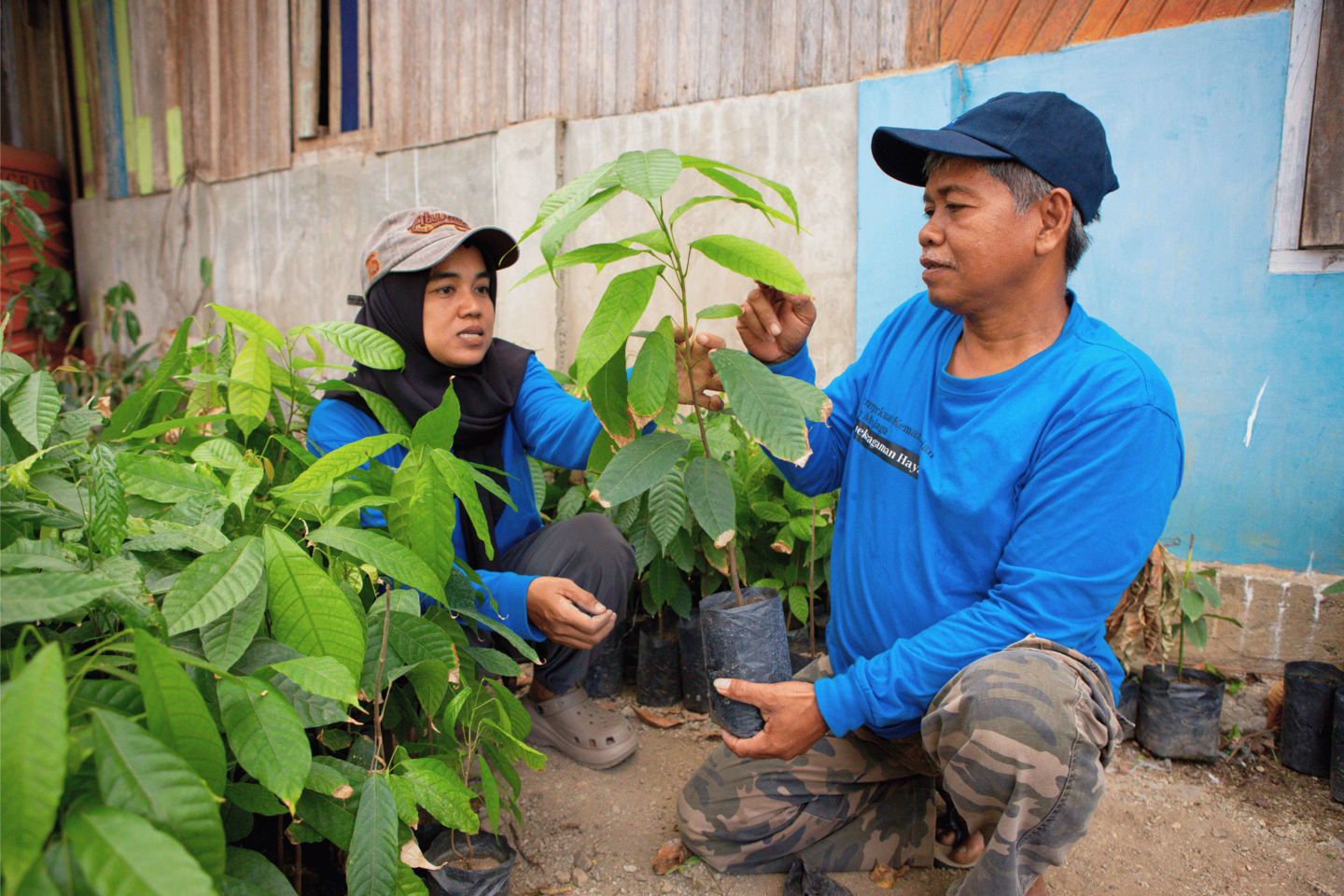
Femmi and fellow cacao farmer tend to nurseries established through the Field School, producing seedlings that will be distributed to other participants as part of Desa Tuva's broader cacao rehabilitation effort. Photo: UNDP Indonesia
Giving them the tools to make those livelihoods sustainable enough to be worth keeping. When farmers have the knowledge and support to restore the land they already manage, both livelihoods and biodiversity become more resilient.
Because sustainable human development begins exactly where Femmi chose to stand, on the land she refused to give up.
***
Author: Anastasia Weningtias
Editor: Thomas Benmetan